Morning Star improves fleet routing for address-less tomato fields
Key takeaways
- Morning Star uses truck-specific routing to reach more than 950 address-less tomato fields safely and legally.
- Pre-designated routing saves Morning Star 5,600 driving hours annually and lowers operating costs by $523,000.
- Lightweight tomato trailers carry two tons more per trip while remaining under legal weight limits.

If there’s a difference between being a trucking company and a company that uses trucks, you wouldn’t know it when it comes to Morning Star.
“Our brand may now be an enterprise, but trucking remains a vital part of who we are,” Ernesto De Loza, operations manager at Morning Star Trucking, said. “Our mission always has been to transport tomatoes from fields to processing plants at the highest level of efficiency possible—and in a safe and timely manner.”
In 1970, Chris Rufer started Morning Star as a one-truck operation hauling tomatoes through California's Central Valley. Today, the company still hauls its own tomatoes from fields, making more than 2,000 trips per day during harvest season. It also supports other producers and operates three of the world's highest-capacity tomato plants, supplying more than 40% of the national market for tomato paste and diced tomato products.
“During peak summer operations, we employ around 600 drivers operating approximately 400 trucks,” De Loza related. “We always equip our drivers with the most up-to-date models available for fuel efficiency and comfort.”
Currently in the Morning Star operation are Peterbilts, Macks, Freightliners, and Internationals. Trailers in the fleet include 50- to 53-ft. units specially designed to hold tubs full of tomatoes, 48-ft. low-bed models, and flatbeds in a range of sizes to provide seasonal and full-time freight-hauling services.
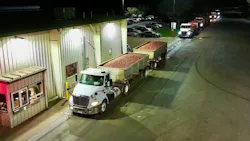
During harvest season, each Morning Star truck hauls two specially designed lightweight tomato trailers, which, on average, carry two tons more tomatoes per trip while remaining under the legal weight limit. This results in fewer trips to transport the same number of tomatoes.
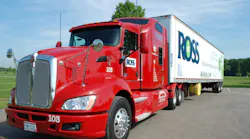 ross_transportation_services
 dji_01423
Morning Star’s fleet handles round-the-clock tomato hauling
Throughout the tomato harvest season, which runs 24 hours a day, seven days a week from July through October, the company’s fleet moves from fields to the nearest Morning Star processing plant. Rather than having every truck travel to a single central facility, the plants are located no more than two hours from any field.
De Loza pointed out that hauling from hundreds of fields across Central and Northern California requires getting drivers in the right trucks with the right equipment and dispatching them to the correct location.
“That was historically difficult because many fields have no formal street address for a navigation platform to reference,” he said. “Our Just in Time Inventory Control system lets our dispatchers know exactly how many trucks are needed, but we mainly depended on local knowledge for routing.
“What we needed was an ability to make every Morning Star field a valid destination, despite having no street address, and to have routes that account for each truck's dimensions and keep them off restricted roadways,” De Loza continued. “We needed to make every tomato field reachable legally and safely without an address in a way that would automate the process for dispatchers and drivers.”
Trucker Path automates routing to more than 950 tomato fields
For Morning Star, the Trucker Path app with truck-specific routing was the foundation of that solution. Now, an integration between the fleet dispatch app and the Trucker Path platform’s open API and deep links automatically triggers pre-designated routes to more than 950 custom POIs or predetermined field locations.
“Trucker Path functions as infrastructure, not just a navigation app,” De Loza explained. “It all happens the moment a route is assigned by dispatch, with no manual entry. GPS identifies the truck’s location, and address-less tomato fields become one-tap destinations. All the driver has to do is hit navigate.”
Since implementing the navigation solution, De Loza noted that Morning Star has saved 5,600 driving hours annually through pre-designated routing, significantly reduced fuel costs, and, based on ATRI's $2.336-per-mile average, lowered operating costs by $523,000. Additionally, the system is used to plan the logistics of moving loaded and unloaded trailers, resulting in fewer trips and less fuel consumption.
“In addition to running around the clock during tomato season, we haul freight year-round, and we support transplanting and harvesting operations with shuttle trucks for unloading tomatoes at processing factories, a sun-drying facility, and a foodservice program that are all part of our vertically integrated enterprise,” De Loza said. “Our one-truck operation may have grown into a brand of its own, but Morning Star started out as a trucking company, and trucking is still a vital part of who we are.”
About the Author
 Seth Skydel
Seth Skydel
Seth Skydel, a veteran industry editor, has more than four decades of experience in fleet management, trucking, and transportation and logistics publications. Today, in editorial and marketing roles, he writes about fleet, service, and transportation management, vehicle and information technology, and industry trends and issues.