How ProVia Logistics built an award-winning culture of driver trust
Key takeaways
- Award & recognition: ProVia Logistics was named FleetOwner’s 2026 Midsize Private Fleet of the Year for its human-centric culture, proprietary technology, and non-punitive safety model across its 170-driver fleet.
- Cost & operational efficiency: Reduced overall operational logistics costs by 2.6% while expanding inbound raw material backhaul capacity by 102% using an internally engineered custom load board.
- Safety breakthroughs: Achieved a 0.35 DOT recordable accident rate per million miles by replacing harsh telematics discipline with "Speed 2.0"—an incentive program offering a 2.5% mileage bonus for compliance that cut fleet speeding to 11–12%.
- Driver retention strategy: Maintained a low 14% driver turnover rate through fixed regional "bread routes" guaranteeing weekend home time, alongside embedded Corporate Care advocates focusing on driver well-being.
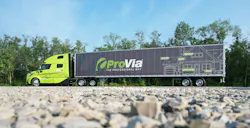
While more trucking companies lean on granular camera data and rigid telematics scoring to correct driving behaviors under a cloud of compliance penalties, Ohio-based manufacturer ProVia’s private fleet is taking a different path. Its logistics team leads with trust.
As the dedicated transportation arm behind a premier American manufacturer of high-quality exterior doors, vinyl windows, siding, manufactured stone, and metal roofing, ProVia Logistics supports an operation with zero margin for product damage or delivery delays. Moving highly customized building products directly to job sites and distributors requires a workforce that views itself as brand ambassadors—not monitored machine operators.
That human-centric approach is precisely why ProVia Logistics won the 2026 FleetOwner Midsize Private Fleet of the Year award, sponsored by Descartes. In a challenging economic climate marked by stubborn supply chain headwinds, the fleet slashed overall operational costs by 2.6% while supporting a massive 14% year-over-year surge in outbound freight capacity.
ProVia Logistics: Facts and Figures
- Parent organization: ProVia, a premier vertically integrated U.S. manufacturer of durable exterior building products, including steel entry doors, vinyl windows, siding, manufactured stone, and metal roofing systems.
- Corporate headquarters: Sugarcreek, Ohio
- Private fleet size: 170 company drivers operating an owned asset mix of heavy-duty tractors and specialized delivery trailers.
- Network footprint: Continuous regional distribution from manufacturing sites to regional delivery hubs in South Carolina, Mississippi, Kansas, and Connecticut.
- Safety excellence: 0.35 DOT recordable accident rate per million miles; managed via “Speed 2.0” tribal team safety incentive models.
- Operational efficiency: Cut total logistics costs by 2.6% over the past 12 months; expanded inbound raw materials backhaul freight capacity by 102% using proprietary custom load boards.
- Talent retention: Maintained a stable 14% driver turnover rate through weekend-off “bread route” scheduling and embedded fleet care ambassadors.
- Community outreach: Distributed 1,200 fully equipped backpacks to local students through the “Prepare for Success” campaign; provides fully paid leave for corporate volunteer service.
“I just feel like we have, in the last nine years, brought on people who have added a skill set of exactly what we needed at the right time,” Wyman Miller, ProVia’s director of logistics, told FleetOwner. “That has helped us scale up from 27 drivers in 2017 to 170 drivers today. And that growth has not come without challenges.”
Flipping the script on safety
The centerpiece of ProVia’s operational excellence is its in-house Speed 2.0 safety program, which relies on positive reinforcement rather than punitive discipline. While many fleets use advanced telematics exclusively to flag speed violations and issue reprimands, ProVia rewards compliant behavior directly on the driver’s paycheck.
The carrier introduced a 2.5% mileage incentive bonus directly tied to non-speeding compliance. The result was immediate and profound: by offering a financial reward for legal, safe driving speeds, the fleet observed a dramatic drop in speeding events, which naturally trickled down to a massive reduction in harsh braking and unsafe following-distance triggers.
“We don’t force them to do this. We try to draw them in so that they want to do that,” Chris Carter, manager of safety and compliance, explained. “Incentivizing good behavior aligns much better with our core culture than being reactive and correcting bad behavior after the fact. What we discovered exceeded our expectations. Our speeding time as an entire fleet is down to just 11% to 12%, with many drivers sitting well below 10%—and that includes minor instances of just one mile per hour over the limit.”
To drive the message home, ProVia grouped drivers into competitive teams dubbed “tribes.” The tribes compete against each other for the lowest speeding percentages, with the winning group taking home an additional team bonus on top of their individual monthly mileage payouts.
“It creates peer accountability, but it’s done constructively,” Carter added. “Even the data outliers aren’t pulling the tribes down because the team synergy is so strong. We also don’t blast or publish individual speed data. We aren’t here to make anyone feel called out or single anyone out. They know we operate with a baseline of trust, so when we roll out safety technology, they approach it with patience.”
 Telematics Tower of Babel
Slashing TCO through internal tech
That same cultural buy-in enabled ProVia to tackle its cost management targets. Instead of sourcing off-the-shelf software, ProVia leaned on its internal IT department to engineer a proprietary load board tailored specifically to the manufacturer’s supply network.
The custom software gives the logistics team visibility into raw material lanes, turning what used to be empty outbound return miles into high-value backhaul freight. Driven by this internal tech deployment, ProVia increased its raw materials backhaul capacity by 102% over the past year, serving as the leading factor in the fleet’s 2.6% total cost reduction.
“Our load board has been an enormous win for us,” Tim Elliott, logistics manager, pointed out. “It allows us to coordinate closely with our suppliers so our private fleet can handle the freight rather than relying on outside third parties. It was a massive project that required a year and a half of beta testing to ensure it was completely user-friendly for everyone involved, but the return on investment has been exceptional.”
Beyond freight optimization, ProVia has insulated its drivers from the headache of breakdown stress. The fleet maintains an exceptionally low asset age by specs-matching equipment at a premium level, refreshing power units via predictive trade cycles, and employing an emergency on-call driver pool alongside custom-engineered proprietary liftgates to ensure independent, hassle-free unloading at delivery points.
Designing the 'bread route' for retention
ProVia’s driver retention strategy focuses heavily on protecting the driver’s home life, resulting in a 14% turnover rate—miles below the industry average. The operation accomplishes this by structuring its distribution network around fixed regional “bread routes.”
“ProVia drivers cover an expansive footprint extending to Arizona, Colorado, Utah, and every state east of them, but our routes are designed in a predictable, weekly recurring pattern,” Miller explained. “Routes are typically set up Sunday through Thursday or Monday through Friday. Even on our longer multiday runs—with touchpoints at our hubs in South Carolina, Mississippi, Kansas, and Connecticut—the scheduling is locked so that every driver is home by a respectable hour on Friday. They get the entire weekend off, period.”
Comprehensive corporate care programs support this structured work-life balance. Through ProVia’s dedicated Corporate Care team, an embedded corporate ambassador is assigned specifically to the driving fleet. This advocate focuses entirely on the emotional, mental, and spiritual health of the drivers, providing a direct avenue of support during family celebrations or personal life crises.
“We want to build a culture based on values that places employee needs ahead of the customer,” Miller said. “We believe that by taking care of our employees first, they will naturally take care of our customers out on the road. When one of our recent hires went through our onboarding process, he told us, ‘This is so different—I wish I had found you sooner.’ That’s the standard we strive for.”
Letting employees' light shine
The final pillar of ProVia’s winning blueprint is an open commitment to corporate citizenship and faith-based community service. At the beginning of every August, the logistics division anchors the company’s annual “Prepare for Success” outreach program. In the past year alone, the company funded, packed, and distributed 1,200 backpacks loaded with school supplies to local students to kick off the academic year.
Furthermore, ProVia pays its employees regular hourly wages to step away from their regular duties and volunteer directly in local community outreach projects, including serving meals at food banks and working in regional nonprofit thrift stores.
“ProVia is a faith-based company, which is something we share openly right from the initial interview process,” Miller said. “It gives complete context to who we are, how we treat our relationships, and how we manage our business. Our ultimate mission is adapted directly from Matthew 5:16: To let our light shine before others, so that they may see our good works and give glory to our Father in heaven. We don’t just say it—we try to live it every day.”
About the Author
 Josh Fisher
Josh Fisher
Editor-in-Chief
Editor-in-Chief Josh Fisher has been with FleetOwner since 2017. He covers everything from modern fleet management to operational efficiency, artificial intelligence, autonomous trucking, alternative fuels and powertrains, regulations, and emerging transportation technology. Based in Maryland, he writes the Lane Shift Ahead column about the changing North American transportation landscape.