Data orchestration problems facing commercial carriers
Key takeaways
- Most fleets use telematics and advanced digital platforms, but only a small percentage have full implementation across their operations.
- Data accessibility and integration are the primary barriers to optimizing fleet efficiency, with siloed systems causing significant delays and inaccuracies.
- Industry vendors are actively developing integrations and automation tools to centralize workflows and improve data consistency across systems.

Transportation efficiency today is largely driven by improvements in information technology. From GPS tracking and vehicle diagnostics to driver monitoring, backhaul optimization, and, lately, artificial intelligence (AI) chatbots, the industry is heavily vested in data management. Many fleets, if not most, already use these tools.
Fleets may have high technology adoption rates, but full implementation is a different story. New technology is only as good as the data infrastructure supporting it, and fragmented data remains a major industry issue. The next generation of information technology requires a shift from data collection to synchronization.
Like the Tower of Babel in its downfall, a carrier may aspire to great heights, but its vendors speak several different languages.
Successful operations demand smooth data orchestration across back offices, shops, customer locations, and, of course, the vehicles themselves. The greatest enemies of that orchestration today are fragmented, inaccurate, and siloed data.
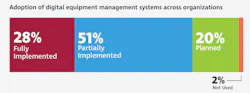
According to Teletrac Navman’s recent uptime survey of 600 global companies, 84% of organizations with vehicle fleets use telematics, asset tracking, or integrated equipment management systems. Beyond basic monitoring, 69% report using more advanced, integrated technology platforms.
Yet only 28% of those surveyed companies report that those digital solutions are fully implemented across their fleets. Less than half (ranging from 40% to 46%) receive live utilization data for the majority of their assets.
For Teletrac Navman’s uptime survey, the greatest common barrier to optimizing equipment utilization is data accessibility: 74% of surveyed fleets identify it as a major obstacle.
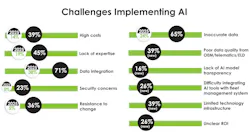
A 2026 Use of AI in Fleets survey, conducted by Fleet Advantage, finds a similar problem, although its data raises some questions. Around 7% of fleets report full integration of AI in their operations, while 58% have partial AI adoption and 36% are undergoing limited experimentation. By far the greatest selected challenges to adopting AI are data integration (71%, up from 38% in 2025) and inaccurate data (65%, up from 24% last year).
Some other noteworthy quirks in the Fleet Advantage survey suggest that the world’s most popular buzzword is less popular than a year prior:
-
The portion of fleets using AI-powered predictive analytics fell from 57% in 2025 to 39% in 2026.
-
Reported use of agentic AI for procurement, asset life cycle management, and maintenance scheduling all fell by around 40% from last year.
-
Fleets that report not using any agentic AI for data decisions grew from 19% to 39%.
Not every metric was as unflattering. The data from the latest survey, however, conflictingly reported that 87% of respondents identified using generative AI in fleet operations.
The main takeaway from these studies is a disconnect between technology procurement and field deployment. Carriers have an abundance of vehicle and operational data but often struggle to integrate and access all that data efficiently.
The good news, though, is that several industry vendors are working to resolve that problem. Major technology providers are undertaking the meticulous work of building out integrations and shortcuts to sync disparate systems.
The core bottleneck: Silo fatigue
In transportation, those obstacles look like data silos and data overload.
At a panel on AI during the Advanced Clean Transportation (ACT) Expo, the panelists agreed that fragmented data is one of the biggest barriers to new technology adoption. Jake Fields, co-founder and CTO of Platform Science, called this “silo fatigue”
"I think the problem we have right now is silo fatigue,” Fields said. “I think we have eight different systems that are proactively talking to the driver like we're all talking about each other here, [and] that needs to get solved. That's an industry initiative that everybody has to come together for.”
Fleets have dozens of disconnected systems—maintenance platforms, telematics systems, dispatch software, fuels systems, OEM platforms, dealer networks—that, more often than not, speak different languages. The goal for the industry’s vendors now is to deploy technology that automatically acts on this data.
"If you don't have the data cleanly put together, and if you have seven different systems calling the same asset in 20 different ways, you're not going to have a clean system," Codrin Cobzaru, co-founder of vehicle data tech startup Sparq, said during the ACT Expo AI panel discussion .
Obligatory AI case studies for tech unity
Artificial intelligence solutions often get more coverage than they may deserve, but the technology is actively helping fleets with the data problem. Two ways that AI solutions are helping break down data silos are through in-cab coaching and natural language interfaces.
In-cab coaching
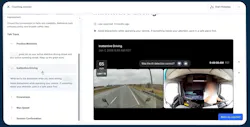
Orchestrated dashcam and telematics systems are helping manage driver behavior. By using real-time in-cab nudges for speeding or distracted-driving violations, fleets can correct driver behavior in the moment rather than a day later in a manager's office.
For data management, in-cab coaching is simplifying the driver coaching workflow. Records of driver violations and the fleet’s response processes for those violations are being consolidated into fewer documents, handled by fewer individuals. This streamlined method is reducing data overload and earning results.
For example, at a panel discussion from this year’s NAFA Institute & Expo, carriers shared their experiences with budding technology. In-cab coaching was making a noticeable difference.
Paul Palmer, senior director of safety for national tree care company SavATree, discovered how an in-cab coaching program could improve his company's fleet operations. Originally skeptical, Palmer ran pilot programs with multiple camera companies.
“The technology can manage this on the front end,” Palmer said. “The old state of affairs, before you had in-cab coaching, was that a driver could have a violation on a Tuesday and it would be Wednesday morning before their manager or supervisor pulled them into the office and said, ‘Hey, do you remember this yesterday morning?’ Well, no, the driver didn't remember it then, so they're immediately defensive.”
When SavATree turned on the coaching features in its pilots, “we watched how drastically those safety violations—the seat belt violations, harsh braking, distracted driving—just dropped by themselves. With no input from local management,” Palmer said. “That was really my ‘aha’ moment.”
Jon Malish, public works manager for the City of Akron, Ohio, had a similar experience. The city first tested in-cab coaching by using it to immediately nudge drivers who were speeding by 20 miles an hour or faster. In a 90-day period preceding the in-cab coaching, the city logged 393 speeding incidents.
“Since we’ve turned those in-cab nudges on, we’re down to zero. It is fixing behavior,” Malish emphasized. “That’s all that we’re trying to do with AI, and it’s been absolutely fantastic seeing our cases drop.”
The small fleet winner of this year’s FleetOwner Private Fleet of The Year, Ross Transportation Services, also used coaching to boost safety. Over the past year, the private fleet has achieved a perfect 0.0 DOT recordable accident rate. The hazardous waste carrier attributed its stellar record, in part, to early adoption of telematics coaching.
In the spirit of disparate data ecosystems, video telematics suppliers are launching several of their own versions of these programs.
 truck at loading dock with line chart
 Opposition grows to 91,000-lb. truck pilot in federal highway bill
Motive’s AI Coach, which was launched last year, offers automated coaching sessions tailored to specific drivers and their performance. In addition, a new feature from Motive’s program this year is the option to show drivers recognition for good driving. Samsara has Samsara Coach. Isaac has in-cab coaching. Lytx has Coach Assist. The list goes on.
Natural language interfaces for data queries
As the domain of databases expands, fleet managers also need more efficient ways to interact with that data. The ability to query data in natural language is becoming essential for data accessibility.
Tools like Motive’s AI Answers, Collective Data’s Ask Anything, and Fleetrock’s AI assistants allow managers to type natural language questions and instantly receive contextual answers, charts, and graphs.
Some industry players are also using large language models (LLMs) to interface with business partners. McLeod’s RespondAI tool, for example, reads incoming messages, determines the intent, and drafts a response for human review. The company has said that the solution cuts time spent crafting messages by 50%.
Backend integrations, workflow automation
The real heavy lifting for data management is in automating document management and centralizing workflows.
Fleets can perform some of their data integrations in-house. But this is slow, technical work that requires constant collaboration with multiple parties: maintaining a heap of application programming interface (API) calls whenever a data supplier makes an update; consolidating disparate databases that often have ever-so-slightly shifting methodologies and definitions for the same thing; troubleshooting endless communication protocol errors … not to mention the work of scoping and building the initial integration. The work load quickly piles up.
Thankfully, data integration is hardly a lone venture. Vendors are already putting in the hours to keep up with that pile of tasks. But fleets should be suspicious of any vendor that describes these data integration solutions as merely “AI” secret sauce. It is slow, technical work to build a cohesive system, with machine learning as a very small (and often unnecessary) component. Data integration is executed brick by brick and step by step.
Cloud-based computer maintenance management system (CMMS) and service relationship management (SRM) platforms, for example, can digitize and coordinate Vehicle Maintenance Reporting Standard (VMRS) code workflows across suppliers, dealers, and manufacturers. Companies like Decisiv are offering systems that can automatically integrate VMRS workflows into warranty claim documentation.
A number of vendors are actively working toward the development of unified fleet systems.
Fleetio’s Fleet Map integrates location tracking with maintenance workflows, letting managers see nearby service vendors and asset statuses via geofencing without jumping between external directories and platforms. The map can connect source-agnostic asset tracking data into the Fleetio ecosystem. Managers can even set up automated service approvals for certain errors and preferred vendors.
Trimble’s fleet maintenance software TMT recently partnered with Corcentric to incorporate automated billing around payments, purchasing, and procurement. With invoice integration enabled on TMT, the system can automatically populate about 30 different fields for invoices and repair orders. The system also uses that data to offer a detailed view of maintenance costs.
“We’ll get it down to what it costs you per mile to operate that truck by system group, [such as] tires, air conditioning, brakes,” said Brian Mulshine, senior director of TMT product management at Trimble, at this year’s Technology & Maintenance Conference. “And now you could look at where you’ve got to focus training and cost improvements and what’s driving those.”
Motive recently introduced a feature that enables automated workflows following certain conditions. Fittingly named Motive Automation, the feature can, for example, provide a fleet manager with a plain language description of a fault code, automatically tell a driver to pull over under certain fault codes, or notify a driver when they enter a geofenced area.
OEM Integrations
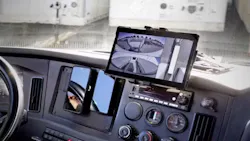
Truck manufacturers and transportation technology companies are also deeply embedding these capabilities into their systems. In just this year, the following have been implemented:
-
Isuzu expanded its collaboration with Decisiv to enhance its SRM, Isuzu Connect. The Isuzu SRM now integrates with Isuzu360 telematics and offers enhanced appointment scheduling.
-
Daimler Truck North America has several partnerships to integrate with third-party applications. The Freightliner Cascadia has an open telematics platform developed with Platform Science and telematics integrations with Geotab and, as of this year, Isaac.
-
Trucker Path integrated Truckstop’s load feed into its digital freight exchange, TruckLoads.
-
Motive became the first telematics partner to join Holman’s Telematics Preferred Integration Network to centralize operational data.
-
Hyundai Translead’s LinkVue trailer camera system allowed integrations with Netradyne and Lytx.
Edge vs. cloud processing of fleet data
Camera and sensor data can be large, and truck connectivity can be limited. Vendors are finding that one shortcut to minimize the data managed is to keep some of that information in the truck.
As Patrick Barragán, VP of AI at Samsara, said during the ACT Expo AI panel: "Once you get to gigantic data volumes, it becomes entirely prohibitive to try to upload everything. ... But it's actually really interesting because then if you put yourself in a position to run artificial intelligence at the edge effectively, then you can actually start to focus on what insights can you derive from those situations."
To handle massive data volumes, fleets are utilizing edge AI directly on vehicles for instantaneous, reactive decisions, while reserving the cloud for broader AI coaching and demand forecasting.
In a breakout panel on AI during Motive’s Vision 26 conference, Michael Benisch, VP of artificial intelligence at Motive, split the approaches into edge processing and cloud AI.
"Everything that we want to do that's very instantaneous or reactive has to be on that edge device ... then there are things that can happen after the fact like AI coaching, right?" Benisch said. "That doesn't need to be in the moment ... that can happen in the cloud, and that's what we call cloud AI."
Depending on the urgency of the task, edge computation can be tech providers' answer for immediate computer-vision driven tasks such as driver monitoring and collision detection.
Traditional cloud computation, on the other hand, remains convenient for reporting, database management, trend analysis, coaching, and similar tasks.
Find your Babel Fish for fleet tech unity
New technology solutions promise unprecedented visibility, but they cannot function in isolation. The next task for the industry is to clean up the data pathways they already have in order to realize a return on investment (ROI): data accessibility, data integration, and data validity.
Whether that’s using AI to find data shortcuts through automated coaching and edge computing, or finding partners with established integrations, efficiency belongs to the operations that keep their data on a clean, unified foundation—all speaking the same language.
About the Author
 Jeremy Wolfe
Jeremy Wolfe
Editor
Editor Jeremy Wolfe joined the FleetOwner team in February 2024. He graduated from the University of Wisconsin-Stevens Point with majors in English and Philosophy. He previously served as Editor for Endeavor Business Media's Water Group publications.