Automation: Motive's way of decreasing manual labor workloads
Key takeaways
- Automated License Plate Recognition (ALPR) helps fleet managers quickly resolve accidents, especially hit-and-runs, by providing detailed vehicle information in real-time.
- Motive automates routine tasks like fault code alerts, customized driver notifications, and more, saving an estimated 860 million hours annually across U.S. fleets.
- AI Coach sessions are now more customizable, allowing drivers to receive recognition and targeted coaching.
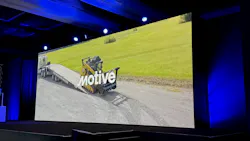
NASHVILLE—In Motive’s millions of miles traveled and thousands of customer visits that took place since last year’s Motive Vision conference, the transportation technology team learned that the biggest pain points for customers rest in fragmentation and manual workloads. They spend too much time clicking through too many dashboards and pulling data from here to there. They spend too much time on administrative work instead of focusing on the job at hand.
This is the second part of a two-part series on the news coming from Motive Vision 2026. Read part one here.
These are aspects of the job for which Motive seeks to find solutions or invent the solution.
Part one of this two-part series outlined how Motive helps its customers eliminate data fragmentation through integrations. The team announced its new AI Dashcam Plus, which marries telematics to camera views. It also announced an integration with large language models (LLMs) Claude, ChatGPT, Gemini, and Copilot. These solutions help streamline reports for fleet managers and also help keep drivers safe on the road.
But what is Motive’s solution for lessening the manual workload? Automation.
Motive’s automated solutions help decrease manual work
Motive’s product announcements this year work hand-in-hand. While the AI Dashcam Plus and data connectivity with LLMs are integrations, these integrations are what power Motive’s automation solutions.
The AI Dashcam Plus uses a camera and artificial intelligence to predict the behaviors of moving objects and prevent collisions. But the advanced hardware in these cameras allows it to capture minute details. And that’s where automation comes in.
Automated License Plate Recognition
While the AI Dashcam Plus helps drivers avoid collisions via alerts, when an accident does happen, the camera and AI system automatically record license plates. This is especially helpful during hit-and-run events, which make up seven in 10 collisions on U.S. roads, according to Nihar Gupta, Motive VP of product management.
Known as Motive’s Automated License Plate Recognition (ALPR), the narrow vision camera on the AI Dashcam Plus is capable of recording the details: vehicle plate number, model, make, and color. It sends this information directly to the fleet manager in the event of a collision to resolve collisions more quickly.
One Motive customer, Liberty Coca Cola Beverages, is no stranger to hit-and-run incidents and truck drivers from other companies making false claims. Safety manager at Liberty, Caesar Rodriguez, said the AI Dashcam Plus has been a “game-changer” for his fleet.
“The wide-angle lens is allowing us to capture as much information as possible off of the road,” Rodriguez said. “We're able to see if there's any potential witnesses, able to get information off of the scene, and able to get as much detail as possible that we didn't have before. The zoom lens is definitely the biggest factor. Now we're able to zoom into the scene, capture license plate information, look into the vehicle to see if there's any potential distractions, or malpractice from the driver, and also excitingly we're able to now capture the make and model of the vehicle.”
While this is something that is valuable in the event of an accident, Motive’s additional automation offerings go beyond reactive and become proactive.
Quick fleet reactions with Motive Automation
“Across the U.S. fiscal economy, 860 million hours were spent last year on tasks that Motive can now automate,” Sean Santschi, director of product at Motive, said. Further, using Motive fleet data, Motive estimates that $46 billion is lost annually due to preventable downtime, compliance violations, and unproductive idling, Santschi said.
To help cut those costs, here is an example of Motive Automations when a fault code is triggered:
If a vehicle throws a fault code, Motive provides the fleet manager with a plain language description of what’s happening with the vehicle, the severity of the issue, and a recommended action. Fleet managers can then set an “automation,” or an action that is triggered automatically if this fault code occurs, which becomes embedded in the Motive system.
With AI Dashcam Plus, Motive’s Atlas AI agent can then notify the driver of what’s happening, prompting them to pull over and call maintenance or continue with their route and resolve the issue after their shift.
Fleet managers can use Motive Automation for multiple scenarios. One customer, XKIG, wanted to create alerts for drivers when they enter a wildfire geofence to ensure they stay aware. When the driver enters a wildfire area—which changes by the day—Motive Automation automatically sends an alert to the driver through AI Dashcam Plus. These notifications are customizable, and XKIG’s alert notifies drivers they’ve entered a wildfire zone, but also reminds them to adhere to XKIG wildfire policies.
 Emily Parsons speaks at Motive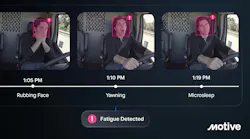
Motive enhances AI Coach offerings for 2026
Motive’s automation didn’t just begin with these latest announcements, however. Last year, Motive launched AI Coach, an automated coaching session tailored to specific drivers and their performance. Since its launch, Motive has found that drivers who routinely review their AI Coaching sessions see an eight times greater improvement score and 50% drop in events detected, including cell phone events, which Dinesh Coca, Motive’s director of product, said dropped to zero.
These results speak for themselves, but it’s also something that has surprised AI Coach’s own development team.
“I definitely thought there would be skepticism [with the AI Coach],” Coca said. “But I think we pretty quickly started to see the results. … I've been surprised myself at how well it's gone.”
These coaching sessions are triggered automatically, with little to no fleet manager intervention. Drivers receive these coaching videos like clockwork, emphasizing consistency and personalization using data and video that would otherwise take managers months to sift through.
Motive has expanded its AI Coach capabilities in 2026, allowing fleet managers to customize the AI Coaching sessions even more—from adding new avatars to segmenting coaching sessions per region to sending drivers reminders when a coaching session is available. Fleet managers can decide which behaviors trigger a coaching session and how frequently drivers are coached. Also new for 2026 is AI Coach’s ability to show drivers recognition for great driving, which is something Coca is personally excited about and something Motive customers have asked for.
“How do we change that conversation from one that just feels like ‘Big Brother is calling me, watching everything I do wrong,’ to ‘How can I actually feel good about what I'm doing each day?’” Coca said. “A lot of customers have come up to me like, ‘That's amazing, I've been wanting to do that for a long time,’ but I haven't had the system to do it. It's really exciting to see that within Motive.”
As CEO Shoaib Makani said in his keynote at the conference, finding solutions for fragmentation and decreasing the fleet manager workload has been Motive’s north star for 2026 product enhancements and innovations. Increasing data integrations and using AI-powered automation is the transportation tech company’s way of ensuring more optimized and productive operations for the year ahead.
About the Author
 Jade Brasher
Jade Brasher
Executive Editor Jade Brasher has covered vocational trucking and fleets since 2018. A graduate of The University of Alabama with a degree in journalism, Jade enjoys telling stories about the people behind the wheel and the intricate processes of the ever-evolving trucking industry.