Integration: Motive's solution for data fragmentation
Key takeaways
- Motive launches AI Dashcam Plus with enhanced processing power and Motive Collision Avoidance alerts to prevent hazards.
- The new AI Omnicam Plus offers 360-degree visibility inside and outside the vehicle, supporting multiple camera inputs to prevent accidents caused by blind spots.
- Integration with large language models like ChatGPT, and now Motive’s own Atlas AI assistant, enables fleet managers to generate comprehensive reports and automate tasks using conversational commands.

NASHVILLE—Since last year’s Motive Vision conference, members of the Motive team traveled more than 8 million miles over the road and in the air to visit more than 4,000 customer sites to seek out what its transportation customers want and need from the transportation technology company. Conversations with these customers reveal two common pain points: fragmentation and manual work.
This is the first part of a two-part series on the news coming from Motive Vision 2026. Read part two here.
“These are our two north stars when we think about building technology for you,” Shoaib Makani, Motive cofounder and CEO, said during the keynote here. “How can we build products that work together to break down data silos and give you one integrated view of your operations, and how can we automate the manual workflows so that you can focus on the things that matter most?”
Motive’s solution? Integration and automation.
Here’s how Motive’s integration solutions will help fleets improve their operations in 2026.
New Motive offerings that improve fleet data integration
This year, Motive is taking integration beyond software and into hardware, Makani said. With its new AI Dashcam Plus, telematics is mated with a camera in an all-in-one solution.
The new camera features: three times more processing power than its predecessor, thanks to a Qualcomm processor; two noise-canceling microphones along with a speaker to enable live two-way communication; and two forward-facing cameras for stereo vision and a narrow field of view. These features enable enhanced detection—both with driver distractions and potential collisions—as well as better communication from the cab to the back office.
AI Dashcam Plus Collision Avoidance
When a vehicle is equipped with AI Dashcam Plus, the two camera views and the faster processor “model the physics of the entire scene in real time on the device,” Nihar Gupta, Motive VP of product management, said during the keynote.
Then it provides a Collision Avoidance alert to the driver if it detects that a moving object could potentially cross the vehicle’s path.
“The camera sees one vehicle, [while] our AI sees multiple possible future trajectories in real time,” Gupta said. “We reason which trajectory puts your driver at risk, and we alert [the driver] seconds earlier while there’s still time to act.”
In essence, AI Dashcam Plus takes what was previously a flat, 2D view of the road and predicts where objects could end up, alerting drivers more quickly. Think: a deer on the road at night, an oncoming vehicle veering into another lane, or pedestrians walking across the street.
Nihar believes Collision Avoidance alerts from AI Dashcam Plus will help prevent more collisions than anything Motive has built.
AI Omnicam Plus
Integration also comes into the cab with Motive in 2026. The new AI Omnicam Plus provides drivers with a 360-degree view of what’s happening all around the vehicle, as well as what’s happening inside the vehicle—a view that was previously only available for fleet managers.
Drivers will see camera angles on monitors inside the cab to ensure they are aware of their surroundings, including blind spots and behind them. This feature seeks to prevent multiple accidents caused by sideswipes and rear-end collisions that occur outside a driver’s line of vision, Makani said.
AI Omnicam Plus supports up to four camera inputs, enabling integration with cameras inside the trailer as well, so drivers can monitor their cargo. Fleet managers can connect cameras they already own or use Motive’s new side, internal, or rear cameras.
Because these cameras are supported by AI Omnicam Plus, drivers will get the same safety benefits as the forward-facing cameras. The integrated system will alert drivers when a vehicle, cyclist, or pedestrian has entered their blind spot, ensuring the safety of the driver and others around them.

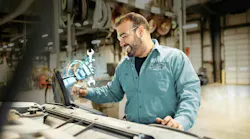 A truck maintenance technician using an advanced diagnostic device to analyze vehicle data in a garage bay, illustrating the application of AI for predictive maintenance and operational efficiency.
Motive now integrates with artificial intelligence assistants—and offers an assistant of its own
Large language models (LLMs) and digital “assistants” powered by artificial intelligence are becoming a staple in offices across the globe—and the trucking industry is no different. Motive understands this and announced that Motive is now connected to these systems. With Motive data integrated within Claude, ChatGPT, Copilot, or Gemini, fleet managers can build their own reports using conversational language.
Emily Parsons, staff product manager at Motive, provided the example of insurance renewals. When LLMs like Claude and ChatGPT are connected with email, they can retrieve the correspondence that has already begun with an insurance provider. This offers a “clean summary of your contract and every exchange with your insurance partner,” she said. And now, because Motive integrates with Claude and other LLMs, it can pull fleet safety data to “build a full renegotiation report.”
“The result is one report with three sources: your safety data from Motive, industry benchmarks from the open web, and insurance contract history from your inbox,” Parsons explained. “No single source could have answered that on its own.”
Not only is Motive now integrated with these systems, but it also offers its own AI assistant, Motive Atlas.
“An atlas is what you reach for when you need to find your way,” Parsons said. And Motive’s Atlas “understands your fleet data, your drivers, your workflows. It remembers context. And when you ask it to do something, it doesn’t just tell you how—it does it.”
Atlas works similarly to LLMs, allowing fleet managers to ask specific questions and receive answers based on their fleet data in Motive. Atlas is active within the system for the fleet manager—built into every part of the Motive platform—and is also integrated into the AI Dashcam Plus in the cab to benefit the driver.
Drivers can talk to Atlas to sign into the platform before their route begins, ask for the next fueling station on their route, and instruct Atlas to navigate there. Atlas is “simple, hands-free, and secure,” Parsons said.
But Atlas is more than just a chatbot. It also opens up multiple ways to automate tasks. More of that to come in part two.
About the Author
 Jade Brasher
Jade Brasher
Executive Editor Jade Brasher has covered vocational trucking and fleets since 2018. A graduate of The University of Alabama with a degree in journalism, Jade enjoys telling stories about the people behind the wheel and the intricate processes of the ever-evolving trucking industry.