AI reality check: Converting the hype into fleet uptime and profits

Fleets have the potential to save thousands of dollars per vehicle and hours of labor costs with emerging artificial intelligence tied to fleet maintenance. But how do you get beyond the “AI” buzzword into genuine operational solutions?

Key takeaways

  • AI’s most immediate and profitable application is in maintenance, enabling fleets to prevent over-maintenance and achieve up to $6,000 per vehicle in annual oil-drain savings.
  • Vehicle architecture is shifting toward "edge computing," allowing AI decisions to be processed locally on the truck for real-time operational efficiency without overwhelming network bandwidth.
  • Advanced suppliers are replacing costly physical hardware with software-based "virtual sensors" enabled by centralized computing.
  • Many effective safety and maintenance tools rely on traditional machine learning rather than expensive generative LLMs, a distinction that is critical for procurement.
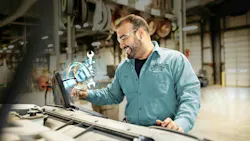
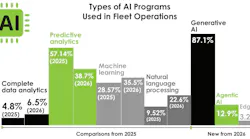
The big picture: Commercial transportation is moving past the conceptual hype of artificial intelligence and into the complex, potentially profitable reality of implementation. At ACT Expo 2026 in Las Vegas, a FleetOwner-moderated panel of technology and fleet leaders shared how extracting true value demands deep nuance, clean data, and a fundamental shift in vehicle architecture.

Moving past the buzzword: Differentiating AI from functional machine learning: 

"AI" has become a catch-all buzzword, confusing fleets trying to procure actual operational solutions.

  • What they're saying: Patrick Barragán, VP of AI at Samsara, noted that the industry often uses AI as a "Find-replace for generative LLMs."
  • Yes, but: Many of the most effective safety and maintenance tools actually rely on lighter, traditional machine learning models that don't depend on expensive token spend to third-party tech giants.

Driving the ROI: The most immediate financial returns aren't necessarily autonomous trucks on the highway (yet); they are materializing in the service bays.

  • Converting over-maintenance to uptime and profit: Nicole Portello of Volvo Group, the parent of Volvo Trucks and Mack Trucks in North America, pointed out that dynamically adjusting maintenance schedules to prevent over-maintaining vehicles yields massive total cost-of-ownership savings. "...if you just optimize oil drain intervals, you can save up to $6,000 per year."

Slashing labor hours:

  • Cummins is using AI to pinpoint precise repair steps, allowing technicians to skip obsolete troubleshooting steps. "...we've saved about 200,000 labor hours with our customers in the past year and a half," said Brad Sutton, who leads powertrain and digital engineering at Cummins. The AI can "take you directly to the repair, and that's where those labor hours are safe."

Edge computing: Why vehicle architecture is key to real-time ROI

To unlock these insights, the industry is shifting away from purely cloud-based analytics and toward "edge computing"—processing AI decisions locally on the vehicle itself.

  • The bandwidth problem: "I think on the edge is the opportunity," Platform Science CTO Jake Fields said. Opening data sets directly on the vehicle enables real-time operational efficiencies without overwhelming network connections.
  • Virtual components: John Heinlein, chief marketing officer at Sonatus, explained that centralized vehicle computing enables fleets to deploy "virtual sensors instead of putting in hardware sensors to reduce cost" and add capabilities through software long after the truck leaves the factory.
  • Cybersecurity defense: Edge AI isn't just about efficiency; it's about security. Jan Rüdiger of Elektrobit noted that AI acts as an active "prevention system that constantly monitors what the car is doing." Instead of waiting for a breach, the AI analyzes the vehicle's internal data packets to catch unusual network behavior "that might hint towards an external attack."

The integration reality: Simply adding an AI tool onto a legacy fleet system without updating the underlying operational process is a recipe for failure.

  • "Just slapping Al on top right is like putting lipstick on a pig and hoping that it's just going to be flawless," warned Codrin Cobzaru, co-founder of Sparq. He stressed the need for clean data and tracking metrics that actually move the business forward.

The bottom line: Fleet executives must treat AI integration as an organizational shift, not just an IT upgrade.

  • "You have to have a clear, achievable outcome in front of you," said Sam Thompson of Penske Transportation Solutions. She added that to build trust with workers and manage risk, fleets must "make sure that AI is a co-pilot, not the pilot.”

About the Author

Josh Fisher

Editor-in-Chief

Editor-in-Chief Josh Fisher has been with FleetOwner since 2017. He covers everything from modern fleet management to operational efficiency, artificial intelligence, autonomous trucking, alternative fuels and powertrains, regulations, and emerging transportation technology. Based in Maryland, he writes the Lane Shift Ahead column about the changing North American transportation landscape. 

Sign up for our eNewsletters
Get the latest news and updates

Voice Your Opinion!

To join the conversation, and become an exclusive member of FleetOwner, create an account today!