AI execution gap: Data integration, not cost, become top barrier to fleet AI adoption, study finds

Private fleets have rushed to adopt GenAI for back-office convenience (87.1%), but this enthusiasm is creating a critical operational "execution gap," according to a new Fleet Advantage survey on how carriers are using AI.

Key takeaways

  • AI execution gap: Fleet Advantage's 2026 Use of AI in Fleets survey documents a massive, industry-wide “execution gap” as fleets fail to translate GenAI hype into operational ROI.
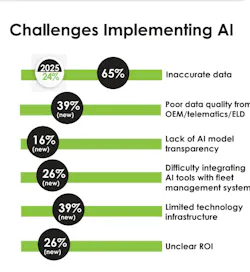
  • The 71% data wall: The primary barrier to high-value AI has inverted. High cost is no longer the issue; today, 71% of fleets are hitting a wall due to data integration challenges, with 64.5% struggling with inaccurate input data.
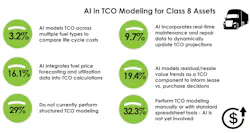
  • Impact: The TCO blind spot: The single largest financial opportunity remains untapped: 32.3% of fleets still perform crucial total cost of ownership (TCO) modeling manually. This prevents them from leveraging AI to pinpoint the "point of no return" where maintenance costs exceed an asset's value.
  • The generative paradox: While Generative AI adoption is "near-universal" at 87.1% for back-office tasks, key operational tools like robotic process automation (RPA) and computer vision registered 0% adoption.

ORLANDO—Private fleets are rushing toward AI at an unprecedented pace, yet face a massive emerging “execution gap.” While nearly 90% of fleets have adopted generative AI (such as LLMs, or large language models) for back-office convenience, they are hitting a wall with operational data—leaving significant money on the table.

The findings come from the 2026 Use of AI in Fleets survey, conducted by Fleet Advantage, which documented a widening disconnect between AI hype and the infrastructure needed to scale its impact. The report was released on the last day of the National Private Truck Council’s annual conference here. 

The AI adoption paradox facing carriers

The transportation industry is experiencing a “near-universal” shift toward AI, but it is heavily skewed toward simple text-based tools. 

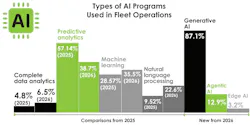
  • Generative AI dominance: 87.1% of respondents now use GenAI (LLMs) for back-office tasks, driver feedback, and extracting insights from maintenance manuals.
  • The 2025 ghost: The category did not appear in Fleet Advantage’s previous survey at all, making its sudden dominance the most significant single-year shift recorded in the study’s history.
  • Functional void: Despite clear applicability to automated invoicing and damage assessment, both robotic process automation (RPA) and computer vision registered 0% adoption.

  • Aspirational reality check: Interest in high-level “agentic AI” for procurement crashed from 57.1% last year to just 9.7% in 2026 as fleets realized the difficulty of real-world deployment.
  • “It’s kind of a buzzword for this giant thing. What exactly is AI?” Mac Hedson, senior off-lease manager at Fleet Advantage, told FleetOwner when asked how fleets can bet beyond the AI buzz. “I would really start small. How can you take out some of these easier, smaller, low-hanging fruit tasks that are more time-consuming for you … Use that to help you get more time back for yourself so you can focus on what you need to focus on.” 

The data infrastructure wall

Implementation barriers are intensifying as fleets attempt to move past the “pilot” phase. 

363147243 | Vitpho | Dreamstime.com
How AI and telematics are reshaping fleet operations and uptime
ID 413658810 | 2025 © Andy0man | Dreamstime.com
2026 trucking predictions
  • Inversion of challenges: In 2025, high costs were the primary barrier. Today, data integration (71%) and inaccurate data (64.5%) are the defining hurdles.
  • Telematics black box: 51.6% of fleets collect telematics and ELD data but do not integrate it with AI tools. Only 9.7% feed this data into AI models for real-time insights.

Fleets face an AI expertise deficit:

  • The share of respondents citing a lack of internal expertise as a barrier rose from 19% to 42.5% year over year. 

AI’s TCO blind spot

The single largest financial opportunity—AI-driven total cost of ownership (TCO) modeling—remains largely untapped.

  • Manual persistence: 32.3% of fleets still perform TCO modeling manually, and 29% do not perform it at all. 
  • Financial leak: Across the trucking industry, adoption of AI-driven TCO modeling averages just 12.1%.
  • The “point of no return”: Without advanced analytics, fleets struggle to identify the optimal replacement window before maintenance costs exceed an asset’s value.
  • “With TCO, you’ve got to pull in all the aspects of the cost of the truck—mileage, telematics, any of your maintenance status,” Hedson told FleetOwner. “AI can identify pretty quickly your areas of weakness, your areas of strengths … it kind of gives us an idea of that ‘optimal window’ for you as a customer." Because eventually, equipment reaches "a point of no return where you’re going to be spending more on the truck than it’s worth.”
  • What else: Fleet Advantage published a deep infographic this week that shows how private fleets are addressing, adopting, and exploring artificial intelligence and technology.

About the Author

Josh Fisher

Editor-in-Chief

Editor-in-Chief Josh Fisher has been with FleetOwner since 2017. He covers everything from modern fleet management to operational efficiency, artificial intelligence, autonomous trucking, alternative fuels and powertrains, regulations, and emerging transportation technology. Based in Maryland, he writes the Lane Shift Ahead column about the changing North American transportation landscape. 

Sign up for our eNewsletters
Get the latest news and updates

Voice Your Opinion!

To join the conversation, and become an exclusive member of FleetOwner, create an account today!