Benchmarking fleet maintenance: Insights from Fleetio’s industry data
Key takeaways
- The average fleet vehicle age is 6.4 years, with most vehicles owned outright and high mileage averaging nearly 140,000 miles.
- Older vehicles incur significantly higher maintenance costs, with vehicles over 10 years old costing about $1.10 per mile to maintain.
- A performance gap exists among fleets due to differences in maintenance practices, impacting downtime and overall operational costs.

How does your fleet stack up against your peers in the industry? A survey from transportation technology company Fleetio sought to determine a fleet management benchmark by taking a survey of more than 600 fleet leaders, both customers and non-customers, and by compiling anonymized fleet data within its network of 1.2 million connected assets.
FleetOwner recently published an analysis of the fleet leaders’ survey results here, focusing on the leaders’ perception of their fleet management operations. This piece, equally as insightful, will focus solely on the data of their operations, removing perceptions and opinions.
Benchmarking the industry's assets
FleetOwner has written about the sluggish trucking economy for years now, and the age of the average fleet vehicle within Fleetio’s entire connected network is a reflection of that at 6.4 years. These fleet leaders balance an aging fleet with “planned maintenance discipline” and make replacement decisions based on performance data, according to Fleetio.
Further, an overwhelming majority of the vehicles in these fleets are owned by the fleet, at 89%. Only 8% of these vehicles are leased, and 2% are rented.

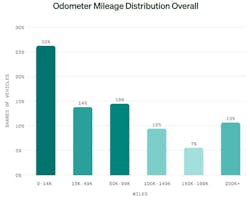
Most fleets run high-mileage vehicles, according to Fleetio data, with the average vehicle mileage nearly 140,000. Yet the data also shows that only a third of vehicles within Fleetio’s network have more than 100,000 miles, and the same is true for vehicles with fewer than 14,000 miles. The remaining third of vehicles have a mileage between 15,000 and 99,000.
 fleet leader state of fleet management report
 How maintenance impacts total cost of ownership in trucking
Regardless of the mileage these vehicles have accumulated, from the least amount of miles to assets with more than 200,000 miles under their belt, each requires maintenance. Of course, those maintenance needs will look different for newer and older assets.
Fleetio found that the average overall maintenance cost for an asset is 40 cents per mile. Fleetio's report also showed how service cost increases as vehicles age. A vehicle aged 0-5 years sees an average maintenance cost of 20 cents per mile. A vehicle aged 6-10 years sees an average maintenance cost of 47 cents per mile. The average cost to maintain a vehicle 10 years or older is $1.10 per mile, according to Fleetio data. That’s a significant cost difference.
Interestingly, the majority of the vehicles aged 10 and older account for only 12.1% of the total miles in a fleet, yet they require 33.5% of total service spend, Fleetio found.
So, when does a fleet decide to retire these older vehicles? Nearly half (41%) retire vehicles once their maintenance costs reach a certain point. Other fleets (22%) retire vehicles at a certain mileage, others (20%) at a set number of years the vehicle has been in service, and 17% of fleets retire their vehicles when they stop running.
Here's how the industry maintains its fleets
Fleetio analyzed roughly 8.85 million maintenance work orders to help determine the fleet maintenance benchmark. The company states that the data reveals a performance gap among fleets, especially among those that perform “small execution differences” that “compound into real downtime and real cost.”
Fleets perform maintenance in different ways: planned vs. reactive and scheduled vs. scrambling. Fleetio describes this as “pulling work forward” (planned and repeatable) or “absorbing work late” (reactive, disruptive, harder to schedule). Herein lies the performance gap.
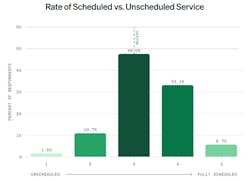
In Fleetio’s fleet leader survey, about half of fleets (48%) admit to having a mix of planned and unplanned maintenance, with only 6.7% admitting to having a “fully scheduled” maintenance program. The data backs this, revealing that 53.7% of vehicle maintenance is scheduled, 40.1% is unscheduled, and 6.2% is considered emergency.
When a vehicle does come in for service, the downtime could be considerable. Data found that the median time to start maintenance once a vehicle enters the shop is 31 minutes. That doesn’t sound too bad. However, the average time it takes to start a repair is more than six days. That’s a considerable difference and highlights where fleets can improve in their process disciplines, such as with “triage rules, approvals, communication loops,” and more, the report states.
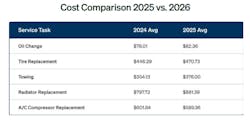
Overall—and unsurprisingly—data found that the cost of fleet maintenance is on the rise. Comparing 2024 to 2025, Fleetio determined that costs have risen in most areas, save A/C compressor replacement. See the breakdown in the graph below.
How does your fleet’s maintenance compare to the vehicles in Fleetio’s network?
About the Author
 Jade Brasher
Jade Brasher
Executive Editor Jade Brasher has covered vocational trucking and fleets since 2018. A graduate of The University of Alabama with a degree in journalism, Jade enjoys telling stories about the people behind the wheel and the intricate processes of the ever-evolving trucking industry.