Clark: Three steps fleets can take to limit nuclear verdict exposure
Key takeaways
- Growing nuclear verdicts are driving insurance costs higher, pushing fleets to tighten safety practices.
- Strong maintenance and qualified drivers are essential to reducing crash risk and legal exposure.
- ADAS and modern safety tech help fleets lower accident rates and defend against costly litigation.

Fleets today face mounting pressure to do more with less, but one risk remains stubbornly out of their control: the rise of nuclear verdicts. Advanced driver-assistance systems (ADAS) and other technologies have made trucks safer, yet accidents still happen. These are often caused by passenger vehicles. The outcome, however, is the same: lawsuits with staggering payouts. Last week, an article in FleetOwner addressed recent American Transportation Research Institute (ATRI) research analyzing tort litigation in the trucking industry.
Nuclear verdicts, defined as awards of $10 million or more, are increasing rapidly. As Oriana Senatore of the U.S. Chamber Institute for Legal Reform notes, “They’re getting exponentially larger.” In fact, the trend has escalated beyond nuclear to thermonuclear verdicts—those exceeding $100 million. Research from Marathon Strategies shows these cases surged to 49 in 2024, a 45% jump from the previous year. Even fleets that have never faced litigation feel the impact as these verdicts drive insurance premiums higher across the industry.
For an industry built on thin margins, the combination of soaring premiums, maintenance shortcomings, a consistent driver shortage, and nuclear verdicts forms an existential threat. Here’s what fleets can do to mitigate any damage.
1. Strengthen fleet safety with disciplined, data-driven maintenance programs
Despite advances in fleet upkeep, the 2025 CVSA International Roadcheck continues to show the same problems occur year after year. Brake issues accounted for slightly more than 41% of all out-of-service (OOS) violations, while tire problems added another nearly 22%. These aren’t minor oversights; they are failures that could trigger crashes.
Fleets must double down on both preventive maintenance (to catch routine wear) and predictive maintenance (to anticipate high-risk failures). A sidelined truck is more than lost revenue; it’s a potential liability sitting on the shoulder. With today’s legal stakes, anything short of a disciplined, data-driven maintenance program is a risk most carriers simply can’t afford.
2. Improve safety performance through driver qualification, training, and oversight
Behind every truck is a driver whose decisions and qualifications directly affect safety. Hours of service (HOS) violations remain the top driver-related OOS infraction. More troubling, nearly 25% of drivers inspected lacked a valid CDL.
Substance-use violations add another layer of concern. Fleets must practice strict hiring standards, robust defensive driving programs, and ongoing coaching. But with an ongoing national driver shortage, fleets face a difficult choice: maintain high standards or struggle to meet demand. Lowering the bar, however, can prove more costly in light of lawsuits and verdicts.
3. Leverage ADAS and safety tech to reduce crash risk and litigation exposure
If people and equipment form the foundation of safety, technology is a force multiplier. Newer trucks equipped with automatic emergency braking, lane departure alerts, and collision-mitigation systems have dramatically lower crash rates. The Insurance Institute for Highway Safety reports that forward collision mitigation alone can reduce front-end crashes by 44%.
For fleets already navigating sky-high premiums and litigation risks, technology may feel like a luxury. In reality, it’s a strategic investment. When a crash lands in court, demonstrating a proactive approach to safety, supported by data, can mean the difference between a reasonable settlement and a verdict that ends a business.
Positioning fleets for long-term resilience amid rising legal and insurance risks
Trucking is at a pivotal moment. Insurance is no longer a routine cost; it’s a survival factor. Fleets that invest in maintenance discipline, driver quality, and modern safety technology will be better positioned to weather an unforgiving legal climate. Because in trucking, safety isn’t just about preventing accidents (though that should be goal #1). Safety is also about safeguarding your business and the industry as a whole.
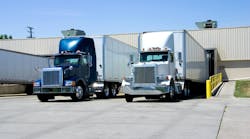 Semi-trailer trucks loading and unloading at a warehouse dock, illustrating freight shipping, logistics, and fleet operations
 Podcast: Freight recession, nuclear verdicts, and the future of trucking
About the Author
Jane Clark
Senior VP of Operations
Jane Clark is the senior vice president of operations for NationaLease. Prior to joining NationaLease, Jane served as the area vice president for Randstad, one of the nation’s largest recruitment agencies, and before that, she served in management posts with QPS Companies, Pro Staff, and Manpower, Inc.