Clark: AI is transforming transportation, but human oversight is non-negotiable
Key takeaways
- AI improves route planning, reducing delivery delays and fuel costs, but human oversight ensures practicality and safety.
- Human judgment is vital for verifying AI outputs, especially in complex or unexpected scenarios like road closures or sensor errors.
- Dispatchers and drivers play a key role in safeguarding against automation bias, ensuring AI suggestions are practical and aligned with real-world conditions.
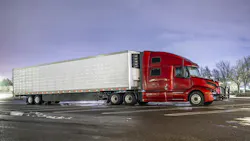
Artificial Intelligence (AI) is no longer a distant vision; it’s actively reshaping industries today. Few sectors stand to benefit as much as transportation. Rising fuel costs, global conflicts, unpredictable weather, and growing customer expectations for speed and transparency have put immense pressure on the industry. AI offers powerful tools to tackle these challenges, enabling companies to operate with greater agility and precision.
It’s essential, however, to acknowledge that while AI is powerful, it’s not perfect. At least, not yet. The human element is essential. That means companies need to be aware of and avoid automation bias. According to Georgetown University’s Center for Security and Emerging Technology report, “Automation bias is the tendency for an individual to over-rely on an automated system. It can lead to increased risk of accidents, errors, and other adverse outcomes when individuals and organizations favor the output or suggestion of the system, even in the face of contradictory information.”
The antidote is a deliberate partnership: Humans set objectives, stress-test edge cases, review exceptions, and verify AI outputs before they become actions. This approach reduces costly errors, supports fair service, and strengthens compliance.
While fully autonomous vehicles may still be on the horizon, AI is already delivering measurable improvements in logistics and fleet management. Smarter traffic management and route optimization rank among the most impactful applications of AI in transportation.
AI route optimization improves deliveries but requires dispatcher oversight
Dynamic route optimization is one of AI’s most promising applications. Unlike traditional GPS systems, AI analyzes historical GPS data, traffic patterns, weather conditions, and even unexpected events like accidents or road closures.
Research shows that AI-powered route planning can reduce delivery delays by up to 22% and cut fuel costs by 15% on average. However, these benefits only materialize when humans verify and adjust AI suggestions. For example, an algorithm might reroute a truck through a narrow rural road to save time, but a seasoned dispatcher knows that road isn’t suitable for heavy vehicles.
Human judgment ensures that AI-driven decisions are practical, safe, and aligned with business priorities.
AI boosts fleet efficiency beyond routing with predictive and operational insights
AI can predict demand surges, optimize loading schedules, and assist in preventive maintenance by analyzing vehicle performance data. It can even speed up warehouse check-ins and dock utilization. These efficiencies are game-changing, but only when humans validate the outputs.
Without human checks, AI could schedule deliveries during local restrictions or misinterpret sensor data, leading to unnecessary maintenance. Technology amplifies efficiency, but people safeguard accuracy.
AI augments drivers and dispatchers for safer, smarter fleet operations
AI delivers productivity gains, but it’s not infallible. Dispatchers, drivers, and logistics managers remain essential for interpreting data and handling complex scenarios. AI should be viewed as an augmentation tool, not a substitute for human decision-making.
The best outcomes occur when AI provides insights and humans apply judgment. This partnership ensures that decisions are not only fast but also correct, ethical, and context-specific.
AI is redefining efficiency in transportation, from real-time routing to predictive maintenance. For businesses aiming to stay competitive, investing in AI isn’t just an option; it’s a necessity. But success depends on more than technology alone. Companies that combine AI innovation with human oversight will lead the industry tomorrow. Those who don’t risk costly errors and reputational damage.
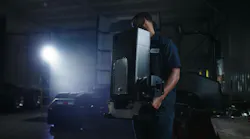 Kodiak SensorPod
About the Author
Jane Clark
Senior VP of Operations
Jane Clark is the senior vice president of operations for NationaLease. Prior to joining NationaLease, Jane served as the area vice president for Randstad, one of the nation’s largest recruitment agencies, and before that, she served in management posts with QPS Companies, Pro Staff, and Manpower, Inc.