No more compromise: Mack’s highway strategy gives carriers more ways to win
Key takeaways
- Mack’s Pioneer and Anthem give fleets purpose-built options for long-haul efficiency or regional maneuverability.
- New safety tech adds lane assist, blind-spot monitoring, and automatic braking to reduce crash risks.
- Aerodynamic gains and application-specific designs can help fleets lower fuel costs and improve operations.

ALLENTOWN, Pennsylvania—There is a distinct sense of history when you walk into the Mack Experience Center here. Originally constructed in 1975 as a research and development facility, it has been the birthplace of modern manufacturing triumphs by one of America’s oldest and most iconic brands. Today, it serves as the 126-year-old OEM’s customer experience hub, celebrating Mack Trucks’ rich history while focusing on its powerful future.
Part of that future is Mack’s reinforced focus on on-highway trucking. Until recently, the legacy Mack Anthem acted as the brand’s versatile tractor for both regional and long-haul fleets. However, with its 117-inch bumper-to-back-of-cab (BBC) length, the legacy Anthem functioned primarily as a short BBC regional truck, pulled into double duty on U.S. highways.
Last year, as the OEM turned 125, Mack told its customers they didn’t have to compromise. It launched the all-new Mack Pioneer long-haul tractor and a revamped Anthem model to solidify the Bulldog’s place in the crowded North American Class 8 segment.
Mack tractors head-to-head: Fuel vs. maneuverability
The Pioner and the new Anthem share identical DNA: the same frame rail options, interior trim choices, and underlying uptime structures. When you step into the cab, you immediately notice the increased width compared to previous legacy models, along with premium amenities and rugged controls.
The critical difference lies in the BBC spacing, creating two purpose-built tools designed to eliminate fleet compromise:
“If you want maximum fuel efficiency, the Pioneer is the answer,” Blake Routh, Mack’s senior highway product manager, explained during our visit. “If you want maximum maneuverability, the Anthem is the answer. The Pioneer, with its longer nose ... is going to be a little bit more fuel efficient because of the aerodynamics.”
By shaving 12 inches off the BBC compared to the Pioneer (and 4 inches off the legacy Anthem), the new Anthem excels on tight, urban delivery routes. Its sloped hood increases visibility, allowing drivers to see 12 feet closer to the front bumper. For bulk liquid haulers or LTL operations backing into narrow city docks, that footprint change can be the difference between a clean shift and a costly front-corner collision.
I asked Routh how mixed fleets are responding to this sudden expansion of choice. He noted that having two separate arrows in the quiver is opening up new territory for both Mack and its customers.
“We have a lot of customers where they had an Anthem—that’s all we had—and they might be going to the Pioneer because they want to prioritize getting a little bit better fuel efficiencies, or they want a 76-inch sleeper,” Routh told us. “But some of their fleet within the same customer might be more inside the city, so they want to have the shorter nose and prioritize maneuverability. We are actually seeing customers running both to maximize their applications.”
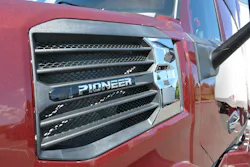
Pioneer interstate highway ride and drive
Mack Truck leaders took me out on Interstate 78 in eastern Pennsylvania in a short-sleeper variant of the Mack Pioneer.
Sliding into the passenger seat, the physical roominess of the 9-inch wider cab is immediately apparent. For the first time, Mack has introduced integrated inboard and outboard armrests that travel with the seat suspension, preventing your elbow from constantly slamming against a fixed door panel.
As we accelerated down the highway ramp, the noise isolation was striking. Even at 60 mph, engine drone and wind whistle were virtually nonexistent. We could have a conversation at normal levels as we reached highway speeds.
Another thing you notice is what you barely see: The hood. You might think you’re in a cabover if it weren’t for the ears of the bulldog hood ornament that pop into view. The forward visibility is astounding.
The Pioneer also previewed Mack’s electronic-over-pneumatic braking integration. If a distracted driver attempts to unbuckle or open the door at low speeds without setting the parking brake, the vehicle automatically applies the park brake to prevent a roll-away accident.
 Mack Logo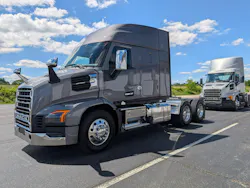
Behind the wheel of the Anthem day cab
After the highway drive experience, we visited Mack’s test track to get a taste of how the redesigned Anthem handles.
Adjusting the steering wheel is handled via a single floor-mounted kick-panel lever that controls both tilt and telescoping. Dropping into gear via the column-mounted mDrive automated manual transmission stalk is completely seamless. Moving the gear selector off the secondary dash panel onto the column means you never take your eyes off the pavement.
The Anthem track experience quickly proved that Mack has addressed cab roll stability. On tight turns, the cab tracks incredibly flat. When taking the Anthem over simulated, deeply rutted Lehigh cobblestones, the redesigned cab suspension elegantly isolated the vertical shock.
On a 20% incline grade, we tested the Grade Gripper system. Letting my foot completely off the service brake, the truck held dead-still on the steep slope. The electronic brain will safely hold the truck for up to 2 minutes and 45 seconds before automatically applying the parking brakes if it senses driver inactivity.
We also engaged Low-Speed Modulation, a specialized low-speed cruise control adjusted via thumb toggles on the steering wheel. For bulk liquid fleets hauling unbaffled tankers, this tool eliminates the violent, rhythmic “trailer slosh” that occurs during stop-and-go traffic. The engine precisely modulates throttle inputs to keep the load steady, protecting the truck from being jerked forward into a leading vehicle.

Pushing the guardrails of proprietary active safety
The definitive highlight of the track run was putting our absolute trust in Mack Protect, the OEM’s new proprietary collision mitigation system, replacing third-party technology on past models.
Routh emphasized that bringing active safety software completely in-house was a watershed moment for the OEM.
“When you want to change something that you don’t design on your truck, it’s always harder,” Routh noted during our roundtable discussion. “When you actually design it yourself, it’s integrated in the truck... and you can dictate what features you want to release without having to wait for a vendor. Functionally, the feedback we’ve heard from customers is that our system walks a really good line of being helpful without being annoying or too in-your-face.”
Beyond integration, the proprietary shift allowed Mack to implement a standard forward heads-up alert, active lane-keeping assist, and a newly added driver-side blind-spot radar to complement the passenger-side array.
To test it, we accelerated the Anthem to 20 mph, locked the cruise control, and targeted a stationary target vehicle dummy placed directly in the center of our lane.
“Just don’t touch anything,” my passenger instructor warned as the dummy loomed large through the windshield. “It’s going to wait till the last second.”
The truck’s radar and forward camera array calculated our closing rate, fired an aggressive audible warning, automatically activated the hazards to alert traffic behind us, and slammed on the brakes. The stopping sequence is violent but highly effective, bringing 16,000 lb. of bobtail steel to a dead stop exactly three feet from the target’s rear bumper.
The fleet verdict: Mack Pioneer or Mack Anthem
With 2026 order boards already full, Mack’s dual-truck highway strategy appears to be working. The market response highlights a gapless portfolio that addresses distinct pain points across fleets.
Carriers running high-mileage, over-the-road freight can leverage the Pioneer to achieve an 11% aerodynamic efficiency gain while retaining premium options such as the factory-integrated Parking Cooler APU and the massive 76-inch high-roof sleeper. Meanwhile, weight-conscious bulk haulers, regional freight, and LTL carriers can spec the shorter, steel-bumpered Anthem to maximize payload visibility and city maneuverability without giving up a premium wide-cab interior.
By stepping up to an entirely in-house safety platform and engineering their new environment from the driver’s seat outward, Mack has successfully modernized their highway lineup. They haven’t just built a new set of trucks; they have built precision tools tailored to the reality of 21st-century fleet economics.
About the Author
 Josh Fisher
Josh Fisher
Editor-in-Chief
Editor-in-Chief Josh Fisher has been with FleetOwner since 2017. He covers everything from modern fleet management to operational efficiency, artificial intelligence, autonomous trucking, alternative fuels and powertrains, regulations, and emerging transportation technology. Based in Maryland, he writes the Lane Shift Ahead column about the changing North American transportation landscape.