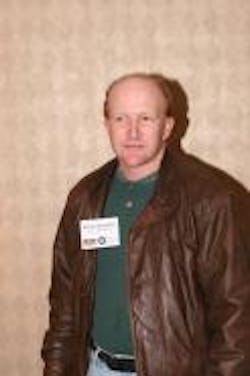
“You don’t realize how much a shop relies on its senior technicians until you become one. You feel like the weight of the world is on your shoulders at times.” –Michael Willoughby, 14-year veteran technician at Rush Enterprises’ Oklahoma City location
In my estimation, Michael Willoughby is one of those guys you want in the foxhole with you, guarding your back when the proverbial you-know-what hits the fan.
A 14-year veteran technician with Rush Truck Centers – a division of San Antonio, TX-based Rush Enterprises – Willoughby is not only exceedingly modest and quick to pass on credit for his skills to the senior technicians that trained him over his career, he always seems calm, cool, and collected during the company’s annual technician skills rodeo – even when he claims he isn’t.
Willoughby is also chock-full of interesting insights into the heavy-duty truck technician’s profession – describing what I know to be an extremely complex job into layman’s terms. “You’re really a full time student,” he told me when we spoke at the 3rd annual Rush technician rodeo. “You never stop learning something new. You’ve got to be willing to do the research, because that’s what it takes to solve vehicle problems today.”
[Willoughby explains his philosophy in this clip shot at Rush’s rodeo last week – he’s the second speaker after Sylvester Chandler, another top-botch technician from Dallas, TX]
A member of what I dubbed the “Oklahoma Crew” at last year’s competition, Willoughby also exemplifies true grit, working his way through adversity that would lay a lot of people low. In terms of his career, he never worked on trucks until he started his job at Rush – starting out in, of all things, a lawn mower repair shop, followed by a five-year stint in the U.S. Army keeping RUSSIAN and Vietnam-era U.S. Sheridan tanks up and running for the “Red Teams” (the soldiers playing the role of “bad guys”) in war maneuvers.
He had to leave the Army, however, to help his wife battle cancer – a battle she fought four separate times, finally losing her life to the disease in May 2008. It took a toll on Willoughby – he lost 17 pounds and practically didn’t sleep for two months straight as he fed her food and medicine until the end. Yet he never wanted to be anywhere else but by her side. You can’t help but admire that in this day and age, when the institution of marriage gets treated like some sort of decorative window dressing you can install or get rid of as the mood takes you.
Willoughby also told me about the support he got from his fellow Oklahoma City technicians – about how they kept trying to transfer their vacation time and sick days to him so he could be home with his wife. That also gives you an idea of what kind of place that shop in Oklahoma City is like – before you start talking about their knowledge and skills.
“There are guys on our shop floor that have forgotten more about engines and trucks than I and several other guys know put together,” Willoughby told me. One of the hardest working techs you’ll find, Willoughby is quick to point to “old timers” as some of the industry’s best – guys that didn’t grow up with the electronics and computers today’s younger techs have, yet are the ones that instinctively know engines and transmissions backwards and forwards."
[The Oklahoma City Crew for 2008 -- Pat Driscoll is in the white cowboy hat in the back, with Ken Carter on the far right standing, with Mike Willoughby kneeling in the front row wearing the black cowboy cover. The other techs are (in no particular order) Mark Dalke, Clyde Henderson, Chuck Selby, and Tom Snyder.]
And they are the guys that trained him – taking the time to make sure he understood every nuance. “I would not be here today if it wasn’t for them.” Willoughby told me.
It’s also interesting to note that Rush’s Oklahoma City shop sent six technicians to the competition this year – double their numbers from 2007, which is no mean feat considering that some 500 out of Rush’s total of 700-plus technicians nationwide were vying for the 54 slots available at the rodeo, up from 300 in 2007.
Pat Driscoll provides a good example of just how seriously these guys take their work. He’s competed in all three Rush rodeos, yet never made the finals. But there he was, observing the 12 finalists bright and early at eight in the morning, even though he had the opportunity to sleep in late and take a tour of the world-famous Jack Daniel’s distillery.
“I want to see what these guys are up against so I can get some insight for next year’s event,” he told me. That attitude speaks volumes about his work ethic and that of his compatriots, I think.
[You’ll see Pat Driscoll in several of these clips quietly observing the finalists in action, hopefully gaining some insights so he, too, can one day join the winner’s circle …]
Ken Carter, their service manager, told me one of the hardest parts about the rodeo is the competition between technicians, as they are far more used to working together to solve problems. “They are a close-knit group – they are used to helping each other out,” he explained to me. “That are not used to competing against one another – it goes against the grain of their daily work life.”
Carter (seen here on the right) has been there, done that, too – literally growing up in the business, starting around age seven helping out in his dad‘s trucking business, followed by vocational school, work for Caterpillar, running his own shop, then joining Rush about nine years ago. He knows how hard the work is and how important it is to get good people in the shop.
“Technicians need to realize how major a cog they are in trucking,” he told me. “It’s hard sometimes, especially in this economy, where customers are hanging on by their fingernails. With the economy so tough, nobody is happy – but we’ve still got a job to do.”
[Carter talked about how complex the technician’s job is today in the clip below. He follows Mike Besson, Rush’s VP of service operations …]