How Four Seasons’ private fleet is fueling 50 years of success
Key takeaways
- Dedicated private fleets improve reliability, uptime, and customer service for regional and local deliveries.
- Comprehensive driver training and flexible compensation boost safety, retention, and operational efficiency.
- Meticulous fleet maintenance and in-house services optimize costs, trailer utilization, and long-term performance.
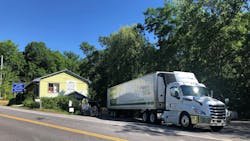
Four Seasons Produce next year will celebrate 50 years of supplying fresh food to communities throughout the Mid-Atlantic and Northeast. Sunrise Transport is an essential ingredient in its success.
The wholesale distributor’s private fleet in 2024 traveled 8.5 million miles and safely delivered 17 million cases of organic and conventional fruits and vegetables to independent retailers, food cooperatives, and local markets that value specialized customer-centric service with a fleet of 118 trucks and 115 refrigerated trailers. “Where we go and how we get there is truly unique—and really does set us apart,” said Ryan Miller, Sunrise director of transportation operations.
The company’s family-owned focus is an equally powerful differentiator.
David Hollinger founded Four Seasons in 1976 after working for his parents’ business, Hollinger’s Farm Market, with the goal of sharing his passion for cultivating crops and living healthily with a bigger base. Five decades later, he’s still growing strong. Hollinger now serves as chairman of the Four Seasons family of companies—which collectively employ over 900 people, including 125 professional drivers—and his son, Jason Hollinger, is president and CEO.
“We’re part of the family,” explained Jason Burkman, Sunrise senior manager of fleet services. “The Hollingers trust their leaders to make good business decisions. They don’t micromanage operations. They’re just good people who foster a great atmosphere for employees.
“The culture of this company can’t be beat.”

How private fleets drive operational efficiency and reliability
Sunrise is a key part of a resilient group of companies headquartered on 48 acres in Ephrata, Pennsylvania, which includes Four Seasons’ warehousing operation; transportation and storage solutions provider Sunrise Logistics; and Earth Source, the enterprise’s international sourcing division. Together, they’ve thrived amid unpredictable economic and market conditions.
With dedicated transportation and logistics services at its disposal, Four Seasons grew during the pandemic. People still needed to eat, and the wholesaler’s farm-fresh offerings—from traditional produce and prepared foods to all-natural meat and dairy products—were appealing options in a health scare that forced millions to stay home. The company is also benefiting from an uptick in grocery-store foot traffic driven by remote work, the rising cost of dining out, and social-media influencers. “There’s renewed enjoyment for cooking at home, and experiencing all these different items in new ways,” Miller said.
Four Seasons is well-positioned to meet soaring farm-to-table demand as well—thanks to its relationships with growers, its refrigerated warehouse, and fully integrated local and regional fleets. Partnerships include Amish and Mennonite farmers in the U.S., and citrus producers in Central and South America. The company’s 314,000-sq.-ft. storage facility features multiple temperature zones, ripening rooms, and quality control, and Sunrise last year executed 117,000 deliveries to clients concentrated within a 150-mile radius of Ephrata, and as far away as the Carolinas and Tennessee.
Additionally, the mutually beneficial affiliation between Four Seasons and Sunrise Transport—created in 2006 with the group’s other business units—ensures steady volumes that help insulate the private fleet from freight downturns, ensuring drivers stay busy. And customers profit from working with a direct-delivery partner that understands their singular circumstances, including smaller stores and dockless facilities, and offers value-added advantages like unscheduled fulfillments and returns thanks to its ability to handle exceptions economically.
“The level of care we provide is second to none,” Miller summarized.
“We understand what is and isn’t working for our customers, talk to them about the commodities, and work with our sales team and merchandisers to see how we can support future growth.”
Driver training strategies to boost safety and fleet performance
Sunrise pays careful attention to its drivers, too, offering them flexible scheduling, customized compensation, and expert oversight from a veteran manager who’s worked in their shoes. “I understand the different driver situations and their concerns,” shared Ray Gonzalez, senior safety and training manager, who previously drove a refrigerated truck for a larger shipper. “I can relate to what they’re experiencing and appreciate their perspective—even when I must make tough decisions.”
The company employs 35 regional drivers, 80 local drivers, and 15 part-time and independent-contractor drivers for fleet flexibility. Local Class A, B, and C drivers are paid an hourly wage that accounts for the challenges they face, including irregular workdays; tight, obstacle-filled lots; long walks to facilities without parking; and curbside pallet-jack and hand-cart deliveries to major cities. Regional drivers are paid by the mile. They also receive an hourly wage, stop and layover pay, and incentive-based pay for trips into New York City or Long Island, as well as weekend shifts.
“We’re extremely accommodating with our drivers,” Miller maintained. “We work with them as much as possible to honor their personal time while we keep the business running smoothly.”
Driver leads come from referrals, digital marketing campaigns, and local schools, including the CNS Driver Training Center and Lancaster County Career and Technology Center. New-hire training ranges from three to eight weeks, depending on experience, with four orientation days sprinkled in to avoid information overload. Training includes customer-site instruction and reefer-specific lessons like transport refrigeration unit (TRU) operation, temperature monitoring, Food Safety Modernization Act (FSMA) compliance, and detention-handling procedures. Content comes from the National Safety Council and Infinit-I’s library of stock and custom videos.
“I assign trainings monthly so our drivers keep safety top of mind,” Gonzalez said.
Samsara’s electronic-logging devices (ELDs) and forward-facing cameras, and Freightliner’s Detroit Assurance advanced driver assistance system, further protect drivers and boost safety performance.
 Texas emerges as a hub for cold chain logistics and temperature-controlled supply chains

Fleet maintenance practices to ensure uptime and cost control
Dependability is paramount, so Sunrise runs a diverse fleet of trucks and trailers meticulously maintained by a dedicated fleet services department that handles everything from licensing and credentialing to preventive maintenance and repairs, equipment inspections, cleaning, and refueling, giving the company better control over operational costs as equipment prices rise.
“Our goal is to manage everything in-house,” Burkman said.
Sunrise’s speed-governed power units are a streamlined mix of Freightliner Cascadia tractors (53 daycabs, 38 sleepers) and 27 M2 business-class straight trucks with reefer bodies and Maxon liftgates sourced from Transteck’s Freightliner dealership in Lancaster. The standard tractor powertrain includes the Detroit DD15 engine and DT12 automated manual transmission for optimized fuel efficiency.
The trailer fleet features Great Dane and Utility trailers from MH Eby in Blue Ball and Keystone Utility Trailer Sales in Lancaster, respectively. The fleet boasts 80 trailers with liftgates (four 34-footers, 40 42-footers, six 46-footers, 30 48-footers) and 35 without (33 53-footers, two 49-footers). Every trailer is a reefer with Orbcomm tracking, tire pressure monitoring, and a Carrier Transicold or Thermo King single-temp TRU from Penn Power Group in Fleetwood or Motor Truck Thermo King in Carlisle.
“That makes managing the fleet easier and enables a more efficient loading process at the warehouse,” Miller explained. “We can build fuller pallets, so it’s a better solution for customers as well.”
The company’s seven-bay workshop is staffed by 20 diesel technicians and six fuelers/washers, who refuel trucks and TRUs from a fuel island that includes two 10,000-gal. tanks for on-road use and one 6,000-gal. tank for off-road, allowing Sunrise to purchase fuel in bulk (the fleet goes through about 20,000 gallons of on-road diesel per week). Sunrise only outsources warrantied engine repairs, body work, and tire alignments. “Our equipment is a rolling billboard, so we take pride in everything we do,” Burkman concluded.
Strategies for fleet growth and maximizing trailer utilization
Sunrise now leverages a local shop’s alignment program to reduce costs. It’s also performing more parked engine regens to prevent problems with diesel particulate filters; and utilizing advanced technology, like Detroit Connect’s virtual technician, to bolster equipment maintenance as it seeks to support Four Seasons' growth via enhanced fleet utilization in 2026.
“We have several growth opportunities that we’re going after aggressively,” Miller said. “So, our goal is to increase our regional driver count and maximize the cube efficiency of our trailers.”
Furthermore, Miller and his team are keeping an eye on regulatory and legislative developments while hoping for an upward swing in the overall freight market—sooner rather than later. Miller is looking for more clarity from the Trump administration on emissions and tariff policies as he tries to plan. And Federal Motor Carrier Safety Administration topics high on Gonzalez’s radar include the agency’s oral drug testing initiative, English language proficiency guidelines, and impending launch of a new Compliance, Safety, Accountability (CSA) enforcement program with amended safety measurement system (SMS) methodology.
“There’s a lot of industry discontent with what we have now, so it’ll be interesting to see how that rolls out,” Gonzalez said.
About the Author
 Jason McDaniel
Jason McDaniel
Jason McDaniel, based in the Houston TX area, has nearly 20 years of experience as a journalist. He spent 15 writing and editing for daily newspapers, including the Houston Chronicle, and began covering the commercial vehicle industry in 2018. He was named editor of Bulk Transporter and Refrigerated Transporter magazines in July 2020.