Boomerang Industrial begins STX Frio project to expand Texas cold storage capacity
Key takeaways
- STX Frio will add 325,274 sq. ft. of cold storage space in Schertz, Texas.
- The facility will include 42 dock positions, 68 trailer parking spaces, and a 200-ft. truck court.
- STX Frio is designed for freezer, cooler storage, food processing, and food distribution operations.
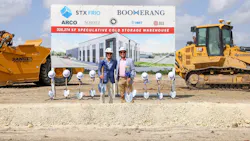
Boomerang Industrial recently began site work on STX Frio, a 325,274-sq.-ft. cold storage warehouse in Schertz, Texas. The project is a joint venture with Marble Capital and is expected to be completed in the fourth quarter of 2027.
The company is building the facility on a 25-acre site less than half a mile from Interstate 35 to serve the San Antonio and Austin markets. The location also provides access to Port Laredo, supporting regional food distribution and cross-border freight movement.
STX Frio is designed to support freezer and cooler storage, food processing, manufacturing, and food distribution. The warehouse can accommodate a single tenant or be divided into two- or three-tenant configurations to provide leasing flexibility.
The facility will include a 50-ft. clear-height warehouse, an 80-foot-deep cold dock, 42 dock positions with vertical storing hydraulic dock levelers, LED lighting, a Tyco Quell dry-fire sprinkler system, a 200-ft. truck court, 68 trailer parking spaces, and automobile parking.
"We started studying the need for modern cold storage space in Central Texas in 2021, and given the prolific population growth that has occurred and is projected to continue in the region, we believe STX Frio is well-positioned to meet the growing demand for first-generation cold storage space," Beau Bellow, co-founder and managing partner of Boomerang, stated.
What this means for the trucking industry
Additional cold storage capacity along the I-35 corridor could improve access to modern distribution space for refrigerated carriers serving Central Texas. The facility's location near Interstate 35 and Port Laredo may help fleets move temperature-controlled freight more efficiently while supporting growing food distribution demand in the region.