Key takeaways
- Cargo theft losses in 2025 surged to $725M, with confirmed incidents rising and the true impact likely much higher.
- Thieves are using strategic scams, including “Trojan horse” drivers, email infiltration, and double-brokering scheme adjustments.
- Point of pickup remains the weakest link, where high turnover and limited training increase exposure to theft.

2025 was a good year for cargo thieves and, consequently, a bad year for the supply chain and the trucking industry. According to Verisk CargoNet, estimated losses rose by 60% to approximately $725 million, though the true figure is likely 10 to 15 times higher. Confirmed cargo thefts rose 18% year over year from 2,243 to 2,646.
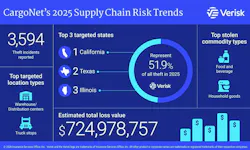
The potential silver lining here is that cargo theft awareness is on the rise. According to Andrey Drotenko, president of strategic relations for Verified Carrier, awareness of strategic theft has increased in the industry as such incidents have become increasingly relevant. And this includes best practices to prevent strategic theft.
But cargo thieves are constantly evolving. So far in 2026, cargo theft experts have noted new scams, trends, weaknesses, and more.
Trojan horse scam exploits trucking vetting systems
In response to other cargo theft schemes, the trucking industry has cracked down on verifying the legitimacy of carriers. Unfortunately, in this chess match of cargo theft, the thieves have adjusted accordingly. Freight brokers and fleets are vetting carriers, but can they realistically vet every single truck driver?
“The bad guys, instead of trying to pass through some of these vetting platforms that are out there, send one of their crew members to go work as a driver at a legitimate trucking company,” Scott Cornell, chief risk officer for SPG Cargo & Logistics and chair of TAPA Americas, explained. “So now that the trucking company is a completely legitimate company, they would pass through the vetting process of any of these platforms, no issue-type scenario.”
The driver then hauls loads while communicating with their fellow thieves until a load they want comes up. The driver parks somewhere on their route, walks away, and the thieves swoop in to steal the cargo.
According to Cornell, the truck driver in these situations is often fired for leaving the cargo unsupervised in a breach of protocol. This is what the thieves want, so the driver can get hired somewhere else, and the cycle of theft can continue.
Unaware that they were being used to bypass vetting platforms, the trucking company believes it was a straight theft, when in fact it was a strategic theft. The Trojan horse scam doesn’t become clear until the driver and/or their equipment are connected to past thefts and firings. Experts have just begun to investigate and identify this particular scam.
To prevent this type of theft, Cornell says trucking companies should conduct thorough background checks on drivers. For freight brokers, Cornell recommends requesting drivers who have been employed for more than six months for high-value loads. There are also new and emerging technologies that can help verify drivers at the point of pickup as well as their equipment.

 Holiday-season cargo theft surges as thieves expand tactics and target high-demand freight
Emerging 2026 cargo theft trends reshape freight security risks
So far in 2026, there are a few other cargo theft trends emerging that the industry needs to be aware of.
Cargo thieves use hacking and email infiltration to intercept freight
Technology is not new to cargo thieves, but the sophistication of their technological theft attempts, especially via email, is increasing.
“The level of sophistication right now is increasing, whether [cargo thieves] are trying to have a domain name that looks exactly the same or going a step further and hacking into computers to where they can essentially have a team-viewer level access of what you're doing,” Drotenko said. “And then they could go and do things from your computer, as if they're you, and then delete any trace of emails or anything that they did … And I think that's a new level of sophistication that in this industry hasn't been a trend, and we're seeing more of it.”
Cornell also emphasized increased email infiltration efforts from cargo thieves. Thieves are accessing a carrier’s email, intercepting communications, creating their own email address within the carrier’s email, and then bidding on loads. This method has also been used by thieves to commit double-brokering scams and circumvent traditional prevention methods.
Point of pickup remains top vulnerability
Cargo is at its most vulnerable at the point of pickup, a situation that hasn’t improved so far this year.
“The weakest link, though, is still going to be at the point of pickup,” Drotenko explained. “That's where you have the highest turnover. Those people aren't the ones who are going out to the conferences; they're not the ones learning about the latest trends or what to look for.”
Drotenko emphasized the importance of training employees who are primarily at the point of pickup on current cargo theft trends and how to protect themselves from these scams.
Tight freight capacity challenges cargo theft prevention practices
Trucking has seen a tight freight market in 2026, as the U.S. economy has suffered and global unrest continues. For Drotenko, this raises concerns about the industry remembering and following through on cargo theft prevention best practices.
“At the end of the day, when you're between a rock and a hard place in a tight market, you just don't have the luxury of getting to say no to a lot of carriers to find a good one,” he explained.
Still, he encourages continuing strong vetting and verification practices, even as capacity tightens.
Overexposure of theft prevention tactics risks aiding cargo criminals
The trucking industry has made great strides in becoming more knowledgeable about cargo theft and sharing insights between fleets, brokers, and carriers, but how this information is shared has become increasingly important.
“The industry has a habit of posting its solutions on social media,” Cornell said. “The intent is good; the intent is ‘we want to help each other prevent theft.’ The problem is the bad guys keep an eye on us. They watch us, and they know what we do. And I think this is a perfect example of how they make adjustments.”
Continue sharing this information, but more privately.
About the Author
 Jenna Hume
Jenna Hume
Digital Editor
Digital Content Specialist Jenna Hume joined FleetOwner in November 2023 and previously worked as a writer in the gaming industry. She has a Bachelor of Fine Arts degree in creative writing from Truman State University and a master of Fine Arts degree in writing from Lindenwood University. She is currently based in Missouri.