Rohlwing: Make roadside service safer now
Key takeaways
- Position disabled trucks to give technicians a safe workspace away from traffic whenever possible.
- TPMS can alert drivers to low tire pressure before a roadside emergency develops.
- Proper use of reflective warning devices helps improve safety during roadside tire service.
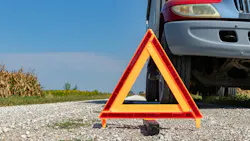
In May, the Tire Industry Association (TIA) sponsored Roadside Service Safety Week to raise awareness on the steps technicians can take to protect themselves when servicing tires and wheels on the side of the road. Over the past year, the truck tire service industry has experienced several serious and fatal accidents during emergency road service. In most cases, those accidents were preventable.
As someone who performed emergency roadside service decades ago, I can speak firsthand about the dangers of working next to traffic traveling at highway speeds. I’ve had my share of close calls and had to dive under a trailer more than once to avoid getting hit by a passing vehicle. Today’s drivers have far more distractions, speeds have increased, and the number of cars and trucks has never been higher. Just a few months ago, I was on the side of the road filming a video, and we had a couple of cars drift to the right with ample warning devices and a film crew in reflective vests on the shoulder. There’s no shortage of distracted drivers.
TIA is the industry leader in tire technician training and certification, so it felt it necessary to raise awareness of the hazards associated with servicing tires and wheels on the side of a road or highway. We produced a new training video that emphasizes the importance of positioning the service truck behind the disabled vehicle, as parking in front has been a common factor in multiple accidents. TIA made the following video available to everyone on its website.
 Truck tire prices face pressure from natural rubber, crude oil, and energy costs
 autri smart tire tech
Furthermore, fleets share some responsibility in protecting the technicians who risk their lives to repair or replace tires on the side of the road. First and foremost, drivers must be trained to evaluate the position of the tire(s) in need of service before positioning the truck on the shoulder. If the tire or tires are on the driver’s side, the truck must be positioned as far to the right as possible so the technician has room to work between the vehicle and the fog line. Conversely, tires on the passenger’s side require more room away from traffic, so the vehicle should be positioned closer to the fog line.
In situations where there is insufficient shoulder space to service the tires on either side safely, the truck should be driven to an area with sufficient space or to the nearest exit. This may require replacing the wheel or wheels, but a technician’s life is worth far more than the cost of a wheel. As emergency road service providers move in that direction, more and more will require the vehicle to be moved to a safe location, or they will decline the job.
When a vehicle is disabled on the side of the road, it is also important to ensure drivers have reflective devices and position them properly. By law, they have 10 minutes to complete that task. In one recent accident, the driver did not position their reflective devices, and the technician positioned the service truck in front of the disabled vehicle to service a tractor tire. Combined, these factors almost cost a man his life.
Tire pressure monitoring systems (TPMS) help prevent accidents during roadside tire service by typically alerting the driver when a tire is losing inflation pressure. This gives them time to find an exit ramp or area with ample shoulder room so the technician can work safely. Impact-related blowouts will happen, and TPMS cannot prevent them. But TPMS can prevent separations caused by prolonged underinflation by warning the driver that a tire or tires are losing inflation pressure.
Emergency roadside tire service is not golf, so technicians are not going to play it where it lies. If the disabled truck is not positioned where the tire(s) can be serviced safely, it will have to be moved. If that requires a wheel replacement, then so be it. If it can’t be moved, then it will have to be towed to a safe location. Serious and fatal accidents can be prevented if fleets, drivers, and service providers work together to prioritize the safety of technicians working on the side of the road.
About the Author
Kevin Rohlwing
Kevin Rohlwing is the SVP of training for the Tire Industry Association. He has more than 40 years of experience in the tire industry and has created programs to help train more than 180,000 technicians.