Verisk CargoNet releases Q2 cargo theft report to highlight rising financial losses
Key takeaways
- Cargo theft incidents fell, but estimated losses more than doubled to $304.6 million in Q2 2026.
- Metals and enterprise technology remained top cargo theft targets despite fewer overall incidents.
- Business email compromise continued enabling shipment misdirection and organized cargo theft.

Verisk CargoNet recently released its second-quarter 2026 cargo theft analysis, showing that estimated cargo theft losses more than doubled year over year despite a decline in reported incidents.
The company, which provides data analytics and technology services through its CargoNet business, documented 677 supply chain theft incidents across the U.S. and Canada during the second quarter. That represents a 26% decline from Q2 2025 and a 14% decrease from Q1 2026.
While theft volume declined, estimated losses climbed to $304.6 million, compared with $135.7 million in Q2 2025. The average reported commodity value reached $564,009, driven by several multimillion-dollar thefts involving high-value shipments.
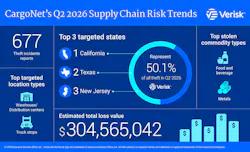
Verisk CargoNet found fewer thefts involving loaded trailers, ocean containers, and non-delivery fraud tied to recently acquired motor carriers. However, business email compromise and shipment misdirection remained steady.
The report also showed a shift in targeted commodities. Metal thefts increased from 54 to 80 incidents year over year, with copper remaining the primary target alongside aluminum, nickel, tungsten, and other industrial metals. Organized theft groups also continued targeting enterprise computer equipment, networking hardware, and cryptocurrency mining equipment, while thefts involving food and beverages, auto parts, tires, supplements, protein products, and over-the-counter medications declined overall.
“Lower incident volume should not be mistaken for lower risk,” Keith Lewis, VP of operations at Verisk CargoNet, said. “The groups driving the largest losses are not necessarily trying to steal more freight; they are trying to identify the right shipment. Their focus on metals and enterprise technology shows how closely organized cargo theft now follows value, demand, and resale opportunity.”
What this means for the trucking industry
Lower cargo theft volumes do not necessarily reduce risk for carriers, brokers, or shippers. The report suggests organized theft groups are becoming more selective, targeting shipments with higher resale value while continuing to rely on business email compromise and shipment misdirection. For fleets and logistics providers, that increases the importance of protecting shipment information, verifying load transactions, and applying additional security measures to high-value freight, particularly metals and technology products.