Customers come first for Descartes
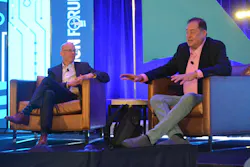
CHICAGO—Listening to customers, finding opportunities in challenges, and using the best available technology: it’s what continues to drive Descartes and it was the dominant theme at the company’s Innovation Forum across the three days of sessions in fleet performance management, transportation management, global trade intelligence, logistics service providers, and ecommerce operations.
“We’re pleased to welcome such a strong community of customers, sponsors, and speakers to this year’s Innovation Forum,” said Edward J. Ryan, CEO at Descartes. “Record participation reflects the value of bringing this community together to share
experiences, learn from one another, and explore new possibilities. The conversations we have here help us understand our customers’ priorities and shape how we continue to innovate in support of their success.”
Bringing together more than 1,000 attendees and 200 speakers this year, the Innovation Forum featured industry and customer presentations, discussions with Descartes product specialists, and hands-on demonstrations at the Technology Fair.
How AI could boost supply chains, software
Evaluating major technology shifts since he and Pagan joined the company 26 years ago—from PCs and the internet to mobile computing—Ryan suggested that artificial intelligence combined with Internet of Things (IoT) connectivity is a wave that could eclipse those prior productivity shifts.
Following up on the demonstration of the Descartes Agent Control Plane, Ryan explained that the power of AI in logistics lies in autonomous exception management across global supply networks. As an example, he referred to a container vessel carrying 20 critical shipments redirected from Antwerp, Belgium, to Rotterdam, Netherlands, overnight due to tidal constraints. Under traditional workflows, forwarding teams wake up to a crisis, spending 20 to 30 hours reactively re-routing freight. In an AI-enabled environment, autonomous network monitors detect the port diversion overnight, re-route drayage truckers, update schedules, and notify customers before human operators log in.
“That’s just one example of how AI might start to change the world materially—a life changer for our customers, a productivity changer for the world,” he said. “We're really excited about it.”
Contrary to widespread tech trends, Ryan rejectedrejects using AI primarily for headcount reduction. Instead, AI elevates workers out of repetitive data entry, keeping a "human in the loop" for high-level strategic decisions.
Internally, Ryan suggested AI tools will expand Descartes developer productivity, allowing software engineering teams to deliver up to 5,000 feature enhancements annually, up from 1,000. Furthermore, while AI models consume computing power, Ryan emphasizedemphasizes that operational energy saved through route optimization far outweighs AI processing energy, driving both financial and sustainability gains.
Descartes’ customer-centric playbook
Descartes’ pivotal growth engine emerged following post-9/11 regulatory mandates, when governments began requiring automated customs filings, Ryan noted.
“We were fortunate; we had a bunch of good ideas right out of the gate,” he said. “Our customers started to go, ‘hey, these guys are important now.’”
Recognizing an industry-wide compliance burden across early adopter nations like the U.S., Canada, and the UK, Descartes listened to customer demands for solutions and made its first targeted acquisitions. A pair of $3 million dollar businesses now bring in $150 million.
“It was quite helpful for us to have those first couple acquisitions be really, really successful,” Ryan continued. “Because we're going to say, ‘hey, I've got another idea about something we should buy, coming from customers,’” and [that success] made it easier for us. We believe that the winner in the supply chain technology space is going to collect the companies to put us in a position to do that, and I think we're well on our way.”
Indeed, with more than 80 completed acquisitions, Descartes maintains an M&A philosophy distinct from traditional financial investors. Approximately 70% of acquisition leads stem directly from customer recommendations and user forums, Ryan emphasized. Unlike private equity firms that strip costs and flip assets within four to five years, Descartes operates as a permanent strategic home.
Ryan notes that only 10,000 to 20,000 domain experts worldwide truly understand supply chain software architecture. By retaining these specialists and integrating acquired software into the company’s Global Logistics Network (GLN), Descartes enhances connectivity rather than sunsetting legacy products.
Navigating freight market volatility
For modern supply chain leaders, volatility and operational complexity have become standard operating conditions.
For Descartes, “it’s a double-edged sword,” Ryan noted. While logistics disruptions generally highlight the value of management software, extreme geopolitical friction—such as tariff wars—can temporarily freeze trade. Unpredictable trade policies cause shippers to pause operations, drying up cargo volumes. Because Descartes operates largely on a volume-based transaction model, macro declines in freight volume temporarily compress revenues.
To withstand economic downturns, Descartes relies on operational resilience and structural hedges. Historically, global trade volumes rebound to a baseline growth of 1% to 3% annually.
Furthermore, macroeconomic headwinds often balance out across product divisions. For instance, when fuel prices surge, shippers accelerate adoption of Descartes' fleet routing tools to curb fuel expenditures, hedging against pullbacks in ocean or air cargo volumes.
“We’re going to continue to operate as best we can, solve the problem as best we can, and live to fight another day,” Ryan said. “The volumes will not go down forever. Volumes for international shipping, I believe, are going to continue to go up for the rest of my life.”