How agentic AI is reshaping fleet operations
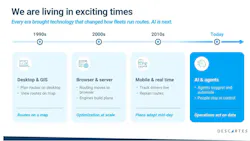
For modern fleet executives, managing daily delivery operations is no longer about accumulating more dashboards. Instead, the core challenge lies in filtering signals from noise across vast streams of operational data to make faster, better decisions.
Addressing this operational reality, James Wee, Descartes general manager of fleet solutions, and Sergio Torres, senior vice president of product management, presented the supply chain technology company’s strategic fleet performance management vision in the first of a series of presentations in the fleet management track at the 2026 Innovation Forum.
“This is an opportunity for us to shape the future together,” Wee emphasized in his opening remarks. “Many of you are here with a straightforward question, and that is: how will AI create practical value in your operations? And there's no shortage of noise and excitement around this technology. So today we will share how we're going to apply AI to solve real-world operating problems, improve decisions, reduce friction, and to deliver measurable results.”
Five stages for route planning: Closing the gap between plan and reality
At the center of this transformation is a clear operational mission: to make every mile run safer, more efficient, and more profitable. Achieving this requires connecting the entire fleet lifecycle—planning, execution, driver behavior, safety, customer engagement, and telematics—into a single environment.
Rather than viewing route planning as a static morning exercise, Wee outlined a closed-loop framework governed by five continuous stages:
Plan: Establishing the baseline operational hypothesis.
Sense: Tracking real-time performance across vehicles, drivers, and deliveries.
Decide: Unlocking AI-driven intelligence to evaluate deviations.
Act: Executing automated or recommended responses.
Learn: Feeding actual outcomes directly back into the next planning cycle.
A critical driver of this loop is closing the gap between "what happened" (telematics data) and "what should have happened" (the route plan). To evaluate new technology, fleet leaders are urged to apply two practical tests: What decisions become better or faster? and What changes in the workflow?
Intelligence embedded in the flow
To operationalize this intelligence, Torres detailed Descartes’ Fleet Data Intelligence (FDI) platform and its Agent Control Plane, which orchestrates specialized AI agents across different Descartes applications.
Torres likened it to using the Yellow Pages to coordinate a bathroom remodeling job, where you’d need to call the plumber, the electrician, and the sheetrock installer to build an estimate and assign the work.
“The Agent Control Plane will be that contractor who is actually collecting all this data from different places and who will answer what you're actually looking for,” Torres said. “We're basically going to be creating agents that can actually collaborate with each other, and then put them into practice. And we are out of the lab now. Now we want to put it in your hands.”
Grounded in data from the Descartes Global Logistics Network (GLN), these agents analyze context, suggest optimal actions, and automate routine workflows:
- René (Fleet Data Intelligence): Enables conversational, natural-language analytics. For example, when asked about spare capacity, René can analyze route histories and identify that adopting machine-learned service times would unlock approximately 10% more route capacity.
- Codi (Execution Agent): Monitors routes as they run, surfaces critical exception decisions to dispatchers, and executes approved adjustments.
- Tess (Support Agent): Automates self-serve answers from knowledge bases to resolve issues faster.
- Lyra (Onboarding Agent): Streamlines system configuration and setup to accelerate time-to-value.
- ARM (AI-Assisted Route Management): Dynamically maintains route health between major planning cycles.
Torres emphasized that these agents are strictly bounded by design. AI does not replace human oversight; rather, dispatchers and fleet managers set corporate policy and retain ultimate decision-making control, focusing human judgment where it matters most.
The future of autonomous optimization
Looking ahead, Descartes is pursuing a phased "Now, Next, Later" roadmap that advances from bounded agent assistance toward self-tuning, autonomous route optimization.
Crucially, this evolution is guided by a co-development model featuring short feedback loops, behavior testing, and customer validation gates.
For fleet leaders, the path forward requires abandoning disconnected point solutions and embracing an agentic intelligence platform that turns operational complexity into a sustained competitive advantage.