The agentic fleet: How AI-guided workflows will redefine trucking operations
CHICAGO—For modern trucking fleet executives, traditional telematics and reporting dashboards have reached a point of diminishing returns. While fleets collect massive volumes of operational data every second, raw visibility alone no longer solves the daily chaos of delayed deliveries, route overrides, and fluctuating service times.
Addressing this shift to wrap up the fleet track at the Innovation Forum, members of the Descartes team including Sergio Torres (SVP, product management), Henrique Miranda (director, product management), and Kim Bruno (product manager) presented a vision for The Agentic Fleet—a paradigm shift moving fleet management from passive reporting to active, human-approved AI orchestration.
From dashboards to a digital workforce
Rather than expecting dispatchers and planners to manually process endless reports, Descartes has introduced a unified Fleet Data Intelligence (FDI) platform . This architecture orchestrates specialized AI agents—including René (insights), Codi (predictions), Tess (execution), Lyra (routing and action), and ARM (route model support)—working cohesively across routing, telematics, safety, and driver engagement systems.
Crucially, Torres emphasized that agentic automation does not mean unconstrained AI. The framework operates under strict bounded autonomy, incorporating role-based permissions, transparent reasoning, full audit trails, and mandatory human approval before any operational change is executed. Furthermore, the platform is designed with open interoperability, allowing Descartes agents to communicate with external enterprise agents and ERP systems via standard APIs and Model Context Protocol (MCP) integrations.
The AI maturity curve
Illustrating how agentic workflows operate in practice, Henrique Miranda walked through three real-world scenarios representing Descartes' Now, development roadmap:
- Now — Insight Agents ("Why did our on-time rate drop?"): Instead of spending hours hunting through spreadsheets to explain a drop in delivery performance, the René insight agent evaluates historical execution data, identifies root causes—such as late Monday starts cascading into afternoon delays—and highlights 14 accounts requiring updated service time parameters. René recommends exact parameter adjustments and drafts an executive KPI narrative, enabling planners to fix underlying model assumptions in minutes.
- Next — Task Automation Agents ("The 2:47 PM Exception"): When a driver encounters an unexpected midday delay, specialized agents collaborate in real time behind the scenes. Execution, prediction, and notification agents evaluate driver hours-of-service, vehicle capacity, and customer time windows, formulating a single recommended fix—reassigning three stops to a nearby driver. The dispatcher approves the plan with one click, automatically updating driver mobile apps and notifying affected customers before a phone call is ever made.
- Later — Optimization Agents ("The Network That Tunes Itself"): To eliminate static route configurations, optimization agents continuously analyze the gap between planned routes and actual execution. The agents detect operational drift, simulate overnight "what-if" scenarios, and propose re-balanced territory settings. Rather than applying network-wide changes blindly, the system validates improvements through controlled pilot tests at specific depots before recommending a full rollout.
The human element: elevating fleet roles
Focusing on organizational impact, Bruno highlighted how agentic technology transforms daily job functions across the fleet:
- Planners transition from manually maintaining parameters and chasing route overrides to reviewing and approving AI-proposed structural fixes.
- Dispatchers shift from phone-based firefighting to approving optimized exception plans with a single click.
- Drivers receive real-time companion agent guidance to navigate exceptions smoothly.
- Safety and operations leaders gain proactive coaching triggers and on-demand natural language analytics, eliminating the wait for end-of-month reports.
Preparing fleets for the agentic era
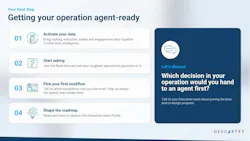
As Descartes rolls out its FDI platform and René insight beta, fleet executives are encouraged to prepare their operations by consolidating core routing, execution, and safety data.
Descartes is actively engaging fleet leaders through specialized focus groups and beta programs to co-design domain-specific agents around high-cost operational exceptions.
With AI-assisted operations expected to expand over the next 12 months, fleet operators that establish clean data foundations today will be best positioned to convert operational friction into a sustained competitive advantage.