Women In Trucking: The Numbers Tell A Story
Key Highlights
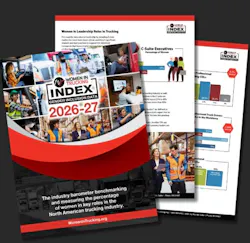
- The WIT Index is the Women In Trucking Association's industry barometer for benchmarking the percentage of women working in key roles throughout trucking
- The WIT Index (2026-27) indicates that women continue to make meaningful gains across many functions in the trucking industry, from the executive suite and boards of directors to function roles such as dispatchers, safety, and professional truck drivers.
- Representation of women as professional truck drivers with CDLs remains relatively flat, with an average of 9.5% overall truck drivers being female.
Women continue to make meaningful gains across many corners of the trucking industry, from the executive suite to safety and dispatch operations. But in other critical roles — most notably professional drivers and diesel technicians — the industry has considerable ground left to cover.
That is the picture emerging from the Women In Trucking Association’s WIT Index (2026-27), the organization’s industry barometer for benchmarking the percentage of women working in key roles throughout trucking. The latest Index measures representation in corporate management, boards of directors, functional roles and professional truck driving.
More than companies in the trucking industry participated in the research, conducted from November 2025 through April 2026. Respondents represented a broad cross-section of trucking, including for-hire carriers, private fleets, third-party logistics providers, technology companies and professional services firms. Companies of all sizes also participated, from organizations with fewer than 50 employees to enterprises employing more than 10,000.
More Women Are Moving Into Leadership
One of the strongest signs of progress is occurring in corporate leadership.
Women now account for an average 31% of C-suite executives among participating companies, up three percentage points from the previous WIT Index. Nearly half of respondents report that women hold between 20% and 49% of their C-suite positions, while 17% say women comprise between 50% and 89% of their executive teams.
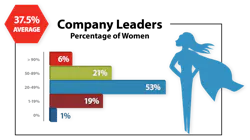
The pipeline below the C-suite also shows encouraging movement. Women represent an average 37.5% of company leaders with supervisory responsibilities, another three-percentage-point increase from the previous Index. More than half of participating organizations report that women comprise between 20% and 49% of their company leaders.
Progress at the board level is somewhat slower. Women currently represent approximately 29% of directors at participating trucking organizations. By comparison, women now occupy 35% of board seats among S&P 500 companies. Perhaps more telling, 16% of WIT Index respondents report having no women on their boards at all.
Strong Representation in HR, Safety and Dispatch
The WIT Index also reveals substantial differences depending on job function.
Women have their strongest representation in HR and talent management, accounting for an average 76.5% of professionals in those roles. Nearly 39% of participating organizations report that more than 90% of their HR and talent management workforce is female.
Women also are increasingly prominent in two functions critical to fleet operations.
Approximately 45.5% of truck dispatchers are women, representing a seven-percentage-point increase from the previous WIT Index. Women now account for an average 44% of safety professionals, an increase of 5.5 percentage points. These roles are increasingly sophisticated as technology, analytics, regulatory compliance and real-time decision-making become more integral to fleet operations.
Driver Representation Remains Flat
Progress is considerably more limited behind the wheel.
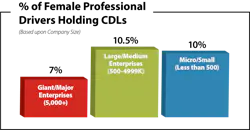
Women represent an average 9.5% of professional truck drivers holding CDLs, unchanged from the previous WIT Index. The research also reveals an interesting relationship between company size and female driver representation. Women account for approximately 10% of CDL drivers at companies with fewer than 500 employees and 10.5% at organizations with 500 to 4,999 employees. At enterprises with more than 5,000 employees, however, that figure drops to approximately 7%.
That suggests recruiting and retaining women at scale remains a significant industry challenge.
The Biggest Opportunity: Technicians
No occupational category measured by the Index has a wider gender gap than maintenance.
Women comprise just 2.5% of technicians and mechanics among participating companies. Half of respondents report employing no female technicians at all, while another 38% say women account for less than 5% of their technician workforce.
The gap is particularly important because trucking already faces a technician shortage. The Index cites approximately 291,900 diesel service technicians and mechanics working nationwide, with an estimated 26,500 openings expected annually through 2034. It also points to research showing nearly two-thirds of trucking maintenance shops are understaffed.
For employers, that challenge also represents an opportunity: Expanding the industry's ability to attract women into technical careers could simultaneously broaden the talent pool and help address a persistent workforce shortage.
Progress — And a Road Map for What Comes Next
Taken together, the WIT Index paints a nuanced picture. Women are approaching parity in functions such as dispatch and safety and represent more than one-third of company leaders. At the same time, representation remains in the single digits among professional drivers and technicians.
Those differences provide trucking companies with something potentially more valuable than a single industry-wide percentage: a road map for where progress is occurring — and where greater attention is needed.
As companies compete for talent, the opportunity increasingly extends beyond simply recruiting more women. It means creating career pathways that enable women to enter the industry, develop new skills, move into operational and technical positions, advance into leadership and ultimately remain in trucking for the long term.