Key takeaways
- AI agents can automate maintenance by diagnosing issues, booking repairs, and rerouting trucks in real time.
- Connected OEM platforms from DTNA and Volvo enable predictive maintenance and reduce unplanned fleet downtime.
- Fleets gain uptime by shifting from reactive repairs to data-driven, automated maintenance workflows.
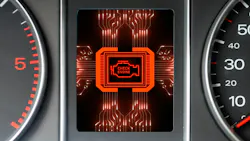
For decades, fleet managers have used vehicle diagnostics as a reactive safety net—that glowing amber check engine light on the dash signaled an immediate headache, unscheduled downtime, and a frantic scramble to find the nearest repair shop. Today, the battleground for maintenance technology is shifting.
Suppliers are no longer just focused on extracting fault codes from commercial vehicles—they are finding ways to automate the workflow. By leveraging artificial intelligence (AI), they are keeping that check-engine light dark. But when something unexpected happens on the road, diagnostics technology does more than tell your driver there’s a problem; it finds a solution for your fleet.
To understand where diagnostics are heading, fleet leaders need to understand how machine learning is becoming more powerful. Processing, now powered by transportation-focused AI, has been curating fleet data for years, identifying preferred vendors and maintenance networks, and tracking basic wear and useful-life trends. Today, AI agents are logging in to turn data into action.
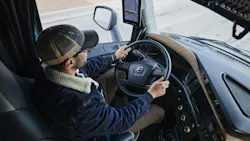
The AI agent punches in
An AI agent doesn’t just curate fleet data—it executes the next maintenance steps, Dwayne Lazarre, Trimble’s North American VP of business development for telematics, told FleetOwner.
“You're telling me I have a problem and then making suggestions on how to fix it. That's kind of the next step,” Lazarre said. “You're putting together an action plan on how to do that. You’re executing that action plan and then sending it out. That's where we are now.”
Lazarre shared this real-world scenario: A truck throws an error code on a highway outside Salt Lake City. Instead of the driver calling dispatch to trigger a manual search for an available service bay, the AI agent takes over. It identifies the error code, cross-references it with the truck’s location, and filters through the fleet’s preferred vendor list in the area. It then automatically books an appointment with the shop, sends confirmation to the back office, and reroutes the driver directly to the shop with an exact appointment number.
The automation can help fleets rethink their back-office operations. For legacy fleet managers skeptical of adopting another layer of technology, Lazarre focuses on how AI agents can deliver a return on investment, including by reallocating human capital. Rather than needing a large team to answer phones and help their drivers manage unpredictable breakdowns, a fleet could rely on a single person to oversee the automated systems. This frees other employees to focus on proactive, revenue-generating tasks that set the fleet apart from the competition.
Building a baseline
Proprietary, factory-installed nervous systems of modern commercial vehicles have never been more critical to automated maintenance workflows, because an AI agent’s intelligence is based on the data it sees. As software providers scale their predictive capabilities, the physical infrastructure that generates that data must be reliable.
Daimler Truck North America (DTNA) recently showcased how advanced connectivity can make equipment more reliable. While unveiling its new Gen 6 Detroit diesel powertrain platform to meet the stringent 2027 EPA emissions standards, the OEM emphasized that connected hardware is a baseline for predictive maintenance.
“Connectivity really represents a business tool for our customers,” Joanna Butler, DTNA’s general manager of product strategy and market development, said. “It drives that intelligence to our fleets, letting them know when they need maintenance, service, etc., and helping them run their business more efficiently, making a real impact on the bottom line.”
 lose-up of a worker with the head of match that is burned out but still smoking, representing modern worker burnout
 Freightliner Cascadia engineering concept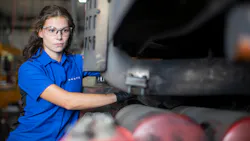
Going on offense with data
That shift toward factory-integrated intelligence is reshaping expectations for the entire Class 8 market. At Volvo Trucks North America (VTNA), the sheer scale of connected data is allowing the truckmaker to help shift fleet maintenance from defense to offense.
During a recent FleetOwner visit to VTNA’s New River Valley assembly plant in Virginia, OEM leaders detailed how the growing volume of connected trucks among its customers is changing the diagnostic equation.
Magnus Koeck, VP of VTNA marketing and brand management, noted that the Volvo Trucks platform on its new VNL and VNR models makes it “the most connected truck in the world—and the amount of data you can draw from that is just incredible.”
That data, combined with over-the-air updates, is curbing fleet downtime, Koeck said. With more than 80% of VTNA’s connected trucks now automating over-the-air updates, physical trips to the dealer are increasingly reserved for parts replacements.
Making the shop floor more efficient
While predictive artificial intelligence and connected vehicle platforms give fleet executives a high-level view of uptime, the physical reality of maintenance still happens in the repair bay. For the technicians troubleshooting these complex, software-heavy commercial vehicles, efficiency is often measured in footsteps rather than megabytes.
According to a recent report by FleetOwner affiliate Fleet Maintenance, modern commercial vehicle technicians spend so much time investigating electronic control units and OBD-II ports that they have become more "fault whisperers" than traditional wrench turners.
Because the time required to diagnose an issue is highly unpredictable, shaving minutes off the diagnostic process can significantly improve shop throughput. One of the simplest and most immediate ways to reduce that time is through proper organization—specifically, spec'ing and building an efficient diagnostic cart.
“Proper cart organization is one of the fastest and easiest ways to improve diagnostic efficiency,” Jason Hedman, product manager at Noregon, told Fleet Maintenance. “When technicians constantly need to dig around for tools or test equipment, especially when those items should always be at hand, it brings a halt to the diagnostic process.”
Spec’ing for the role
Not every cart needs to be equipped for every job. A shop must first decide if a cart is intended for quick triage or advanced, in-depth diagnostics.
A triage cart might require only basic tools, such as a simple code reader, a DEF refractometer, and test strips, to determine the initial level of repair needed. Conversely, an advanced diagnostic cart functions as a mobile command center. These custom buildouts house scan tools, laptops, digital multimeters, test leads, and provide critical access to OEM repair procedures and wiring diagrams.
Shop managers must also consider the physical environment and maneuverability. Missy Albin, a technician at Taylor and Lloyd International, discovered through trial and error that a smaller, lighter composite cart improved her workflow far more than a massive, fully loaded toolbox.
“I thought that having a larger selection of tools with me would make me more efficient, more organized,” Albin said. Instead, downsizing forced her only to carry the essentials, making the cart easier to maneuver in tight spaces without risking damage to the vehicles.
By applying lean methodology to the diagnostic cart—minimizing wasted motion and ensuring the most common diagnostic tools are always within arm's reach—fleet shops can physically complement the digital efficiencies gained through AI and predictive maintenance.
—Lucas Roberto
VTNA President Peter Voorhoeve emphasized the ROI on connectivity during a recent appearance on FleetOwner’s The Fleet Lead podcast. Instead of waiting for drivers to report an issue, Volvo Trucks’ system actively monitors fault codes for wear and tear. It can notify a fleet’s dealer, verify part availability, and connect with the owner to schedule an appointment before a minor issue causes a breakdown.
“It increases the physical awareness of what's happening in your fleet,” Voorhoeve said. "Because when your work is significantly more preventative or proactive, you increase your uptime and help your drivers keep working."
Whether the intelligence is driven by a third-party AI agent or a proprietary OEM network, the end goal is the same: Automate the workflow to keep the equipment out of the shop and on the road, making money.
Path to predictive uptime
There are more ways than ever before to connect equipment to emerging fleet technologies. Trimble’s Lazarre said bridging the gap between the shop floor and the cloud requires deep integration because a proprietary AI solution built in a vacuum is useless to a mixed-fleet operation.
When a fleet employs an AI agent, the agent must seamlessly communicate with the fleet’s dispatching system, fuel optimization program, ELD provider, and driver workflows via APIs.
This ecosystem is the foundation of predictive uptime. It’s an environment where an AI model analyzes micro-trends—such as a fractional drop in fuel efficiency combined with a slight temperature increase—to order a part before the engine ever throws a fault code.
For modern fleet executives, strategies are shifting from figuring out how to acquire as much operational data as possible to finding the optimal way to deploy technology that automatically acts on that data.
"If you were to utilize any one of these technologies in your ecosystem, you should just think of it as a payback model," Lazarre suggested.
Should the technology fail to deliver a measurable ROI within a 30- to 60-day window, a fleet can always go back to its legacy processes. Yet, as the industry’s digital transformation accelerates, those who hesitate to adopt diagnostic workflow automation risk being outpaced by competitors who have successfully evolved their maintenance operations from a reactive cost center into a proactive, automated machine.
About the Author
 Josh Fisher
Josh Fisher
Editor-in-Chief
Editor-in-Chief Josh Fisher has been with FleetOwner since 2017. He covers everything from modern fleet management to operational efficiency, artificial intelligence, autonomous trucking, alternative fuels and powertrains, regulations, and emerging transportation technology. Based in Maryland, he writes the Lane Shift Ahead column about the changing North American transportation landscape.