The human cost of a lean cycle

Equipment can be stretched, but humans have a breaking point. Leadership requires protecting the talent needed to capitalize when the market cycle turns.
April 28, 2026
4 min read

Key takeaways

  • Humans vs. machines: While equipment life cycles can be artificially extended through deferred maintenance and patching, human assets have a finite breaking point that requires active management.

  • Redefining "winning": In a lean economic cycle, leadership must shift recognition away from traditional KPIs and toward the "invisible" operational saves—like a mechanic keeping an aging unit roadworthy—that maintain fleet stability.

  • The upcycle hedge: Strategic retention during economic slumps is a competitive necessity; fleets that fail to protect their core talent will lack the human capital required to capitalize when freight demand eventually returns.

You can optimize an aging engine, retread drive tires, and squeeze an extra year out of that aging tractor. But human capital can’t simply be turned into a perfect Excel spreadsheet cell or optimized with a click. Trucking companies, like so many businesses in 2026, are deep into an era focused on protecting profit margins to survive the next fiscal quarter. 

As we watch for green shoots in this sluggish economy, the companies most likely to bounce back quickly will be those that didn’t forget the value of human capital. Many of us—myself included—have been intrigued by artificial intelligence’s potential to streamline tasks and turn data into professional power that could give an edge over the competition. While AI can optimize routes and organize data, it doesn't eliminate the potential for human burnout. 

All of the AI optimization flooding businesses, large and small, is based on technology available to you and your competitors alike—those algorithms, routing software, and predictive analytics technologies level the playing field. The real competitive advantage isn’t the tech itself, it’s the people wielding it. And right now, people are carrying the heaviest load.

Businesses freezing capital expenditures today are trying to ensure they will be set up to compete—and survive—the next fiscal quarter. But freezing capex doesn’t ease the workload; it just puts the burden on your best workers’ shoulders. 

Whether you’re running a regional fleet, a manufacturing floor, a corporate logistics team, or an industry trade publication, the downward pressure to “do more with less” trickles down across any organization. 

Left unchecked, that pressure breeds burnout. Our top performers—those carrying the heaviest loads—can start to feel like collateral damage in the corporate battle to survive and thrive. 

Carloscastilla | Dreamstime.com
Digital illustration showing semi-trucks, a logistics hub, and cargo ships with glowing data overlays and a prominent AI icon, representing the fusion of artificial intelligence and physical freight operations.
Daimler Truck North America
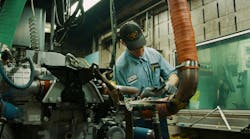
A technician conducts testing on a Detroit diesel engine at Daimler Trucks' Detroit Manufacturing Plant.

We expect our best people to step up when times get tough: take on extra hours, figure out how to get more out of aging equipment, and turn tighter budgets into operational successes. But if we fail to recognize the toll of this pressure, we risk burning out the very talent we will need to capitalize when the freight cycle eventually turns. And it always turns. 

Navigating this era requires leaders to actively foster a culture in which workers can take pride in weathering economic storms. We have to give them a reason not only to fight through the sluggishness of 2026, but also to be part of the leading charge when those economic green shoots bloom into full recovery and growth. 

So how do we actually instill that pride when budgets are frozen, costs increase, and the days are extended just to avoid falling further behind? It requires a shift in how we lead.

Why transparency matters during economic downturns

When the mandate is simply to survive, it is easy for workers to feel like they are just grinding to subsidize a spreadsheet. Change that narrative by opening the books. Explain why trade cycles are being extended, why idling metrics are under a microscope, or why you are pivoting to focus on new technology. When a technician, driver, or back office employee understands that their daily push for efficiency is the shield protecting the company’s payroll, the work transforms from a corporate mandate into a shared vision. 

Define your operation's successes despite market headwinds

In a booming economy, a win looks like opening a new facility, ordering 50 new tractors, or a double-digit rate increase. In a sluggish market, you have to redefine victory.

Celebrate the technician who conducted a miracle to keep an aging truck rolling. Recognize the driver who hit their fuel targets despite challenging routing variables. Shout out the office worker who discovered a redundancy that was costing you more than you knew. When the macro environment isn’t delivering wins, you have to redefine what winning means for your business today and how that sets you up for future success.

Employee recognition strategies that reduce burnout

Doing more with less demands extra effort. Extra effort demands extra acknowledgment. If you can’t reward your top performers with new equipment, pay raises, or bonuses this quarter, turn to other tools, such as radical recognition. Make sure your people know that their extra weight is seen, valued, and fundamentally vital to the company’s success. 

• • •

We all spend our days obsessing over the efficiency of our equipment—trying to squeeze one more mile out of every gallon of fuel or an extra year out of an aging engine. But humans aren’t machines. They can’t fit neatly into a spreadsheet. They run on purpose, recognition, and the belief that hard work matters. The fleets that win the coming recovery won’t just be those with the leanest budgets. They will be the organizations that spend this prolonged downtime fiercely protecting the people behind the wheel, in the bay, and at the desk. 

About the Author

Josh Fisher

Editor-in-Chief

Editor-in-Chief Josh Fisher has been with FleetOwner since 2017. He covers everything from modern fleet management to operational efficiency, artificial intelligence, autonomous trucking, alternative fuels and powertrains, regulations, and emerging transportation technology. Based in Maryland, he writes the Lane Shift Ahead column about the changing North American transportation landscape. 

Sign up for our eNewsletters
Get the latest news and updates

Voice Your Opinion!

To join the conversation, and become an exclusive member of FleetOwner, create an account today!