Samsara debuts paper-thin disposable asset tracker, AI upgrades for fleets
Key takeaways
- Samsara’s disposable tracking labels offer low-cost shipment visibility.
- New AI Multicam features improve blind-spot awareness and reversing safety.
- Connected Maintenance uses AI to automate repairs, warranties, and work orders.
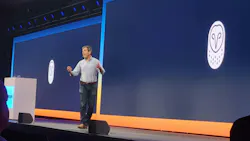
LAS VEGAS—Transportation technology company Samsara kicked off its Beyond conference with an explosion of new features and product announcements.
The key announcements are:
- A disposable asset tracking label
- Multicamera “Bird’s Eye View” support
- AI Ride-Along
- Dashcam safety event triage
- Two-way voice communication through dashcams
- Integrated maintenance workflows
- An accessible agentic AI workshop
All of the new products and features are in use today. Some are already available, some are in open betas for Samsara customers, and others are still in closed beta testing.
A disposable, paper-thin asset tracker?
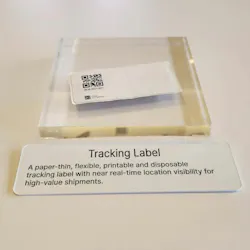
With eyes on the cargo theft crisis, Samsara is leveraging its devices’ massive Bluetooth communication network to meet the nation’s need for tracking at scale: a tracker that is easy to install, paper-thin, disposable, and economical.
“This looks like a sticker, because it is,” David Gal, Samsara’s VP of product and engineering, said.
“But this is no ordinary sticker that you’re going to find in Office Depot,” Gal continued. “Inside of this is a battery, a Bluetooth radio, an antenna, and most important of all, code that talks to the Samsara network.”
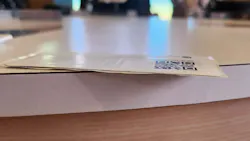
Once activated, the tiny tracking label sends out short-range radio signals at regular intervals. Devices connected to Samsara with longer-range communication capabilities (such as trucks using the Samsara gateway or phones using the company’s software) can act as part of Samsara’s Bluetooth network, constantly listening for tracking signals and communicating their approximate positions directly with Samsara.
The unique approach of a short-range radio signal offers the best of both worlds: the tracking device can be very small, low-power, and affordable, while logistics customers still receive significantly more information about their load’s location.
Every label can be instantly associated with an existing shipment identifier, a BOL, a carrier tracking number, or a warehouse license plate. The sticker's face works with warehouse optical label scanners. Label makers with near field communication (NFC) capabilities can automatically create integrated labels.
Radio communication devices, such as many warehouse scanners or smartphones, can then activate the label whenever they are ready for loading. The battery lasts about 45 days once it’s activated.
Though a concrete price tag is elusive, Samsara touts the tracking labels as economic. The labels’ broad pricing is “designed to be in the single-digit dollars,” Sanjit Biswas, CEO and co-founder of Samsara, said.
To accompany the labels, Samsara launched a smartphone app and tracking dashboard. The app, Samsara Shipper, can scan and activate labels. The tracking dashboard, called the Shipment Center, allows users a detailed view of label locations and movement history.
AI Multicam: “Bird’s Eye View” and rear collision warning features
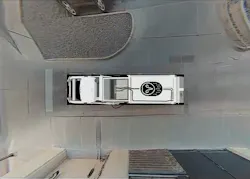
Samsara’s AI Multicam received new capabilities. Drivers can now see their trucks from above and better understand the proximity of objects in their blind spots.
Bird’s Eye View
Vehicles using a special version of the AI Multicam have access to a top-down composite view of their cameras. The feature stitches together the feeds from each directional camera into a single, elevated perspective.
The perspective helps give a clear picture of the truck from all angles during difficult maneuvers. Samsara also demonstrated how the view uses AI object detection, highlighting at-risk objects in red, such as nearby pedestrians.
Bird’s Eye View will be available “by the end of this summer,” according to Johan Land, EVP and chief product officer. The feature requires a special fisheye-lens version of the AI Multicam.
Blind spot proximity, rear collision warning
The AI Multicam system is also receiving dynamic visual and audio alerts when reversing or changing lanes.
AI Dashcam overhaul: Two-way voice communication, enhanced safety evaluations
 dreamstime_l_53605143
 Quiz: How much do you know about cybersecurity threats facing trucking fleets?
Samsara has new features to streamline driver communication and better automate safety evaluations.
Two-way voice chats
The company’s AI Dashcams can now use two-way voice to bring drivers into conversations with AI assistants or human managers.
“When you need to reach a driver, you pick up the phone [and] call your drivers, right? But we don’t want drivers to be tempted by all the distractions that come with phones,” Arpan Podduturi, VP of product safety, said.
With the new communication capability, fleets can provide drivers with personalized start-of-shift briefings while drivers can enjoy hands-free messaging. AI assistants can automatically warn drivers when they enter a geofenced area, such as lower speed limits or known towing risks.
The two-way communication opens some interesting questions around how fleets govern drivers’ conversations with AI chatbots. Biswas said that Samsara makes it easy to set guardrails for the AI chat feature, such as limiting conversation length or allowing only specific topics.
AI driver observation expanded
Samsara also announced two new features for its driver behavior analysis.
An “AI Ride-Along” feature can provide fleets with a more detailed assessment of driver performance over a fixed period—capturing overall driving behavior, both good and bad.
A new coaching priority feature automatically assigns risk levels to drivers’ events, allowing fleets to easily identify their highest-risk drivers for in-depth coaching.
The AI ride-along and coaching priority features are available now as an open beta.
AI workshop makes agentic workflows easy
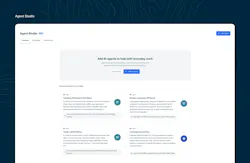
Most transportation technology companies today boast some form of AI chatbot. Samsara’s new Agent studio helps users easily build elaborate, agentic AI workflows.
“What we started with a few years ago was this sidebar chatbot where you could ask questions about the operations. We’ve seen great usage of that,” Biswas said. “We realized that appetite for experimentation was massive; people had lots of ideas they wanted to try, so that’s why we created this idea of templates and the studio, where you can experiment.”
The studio is Samsara’s new central hub for AI workflow management. Users have access to both preconfigured agents and the option to build agents from scratch. The agents can manage tasks such as preparing weekly KPI reports, communicating with drivers, and working with vendors.
“It makes it easy to bring AI into your operations, and it’s easy to build,” Biswas said. “You don’t need to write code. It’s all in plain English, and it’s powered by the Samsara data that you’ve already got in the system.”
As a demonstration, Biswas spent only a few seconds on stage to set up a geofenced alert in which the two-way AI agent will give drivers a heads-up when they enter a customer site: “Enter dock 5, expect traffic, and follow site-specific safety procedures.”
"This is the kind of call that every one of us would like to have for a driver, but no one can practically run because you'd have to make thousands of these calls a day,” Biswas said. “But, like I said, the AI doesn’t mind, and it’s infinitely scaled. We can make as many calls as we need to with this scale.”
The Agent Studio is available as a test for all customers. Users can click a checkbox in a settings menu to participate in the open beta.
Connected maintenance: fault insights, shop Planner, PO automation, and warranty claims
Samsara is throwing its hat into the ring of maintenance workflow integrations, calling its innovation “Connected Maintenance.”
A new Shop Planner dashboard gives managers a real-time view of every asset requiring attention, ranked by urgency. The company’s AI agents can connect fleet data to maintenance operations with several automations:
- AI fault code interpretation
- Repair cost estimates
- Automatic work order drafting
- Warranty coverage interpretation
The integrations can help close the gap between data and operations, freeing up back-office labor.
About the Author
 Jeremy Wolfe
Jeremy Wolfe
Editor
Editor Jeremy Wolfe joined the FleetOwner team in February 2024. He graduated from the University of Wisconsin-Stevens Point with majors in English and Philosophy. He previously served as Editor for Endeavor Business Media's Water Group publications.