As the cycle turns: Time to get even?
Key takeaways
- Long-term partnerships are increasingly vital as the industry shifts from a purely cost-driven focus to service and relationship quality.
- Market fragmentation means supply and demand fluctuations are inevitable, but collaboration can soften these impacts.
- Industry leaders emphasize working together through ebbs and flows, fostering trust and mutual support during both downturns and recoveries.

I’ve been covering trucking for 20 years, and early on was introduced to the volatility of the freight cycle. I had the opportunity for several years to sit on a big 3PL’s annual shipper conference that always featured a session on shipper-carrier relations, with both sides well represented in discussions that would get lively.
I vividly recall a trucking exec's being exasperated to hear shippers talk about “partnerships” when the bid cycle was turning in the carriers’ favor.
“I don’t get mad, I get even,” he told me.
Is it about that time this time around for truckload fleets? I’m hearing a lot of talk about partnerships lately.
The thought occurred to me during the recent presentation of “Forged in Disruption,” the 2026 State of Logistics Report from the Council of Supply Chain Management Professionals (CSCMP). The annual report is a well-regarded, big-picture take on the supply chain. And while trucking is a small portion of the analysis, the coverage doesn’t come anywhere near the 70% of freight the industry moves. (See more about the report here: What a supply chain ‘Forged in Disruption’ will mean for trucking.)
So, since no one else brought it up, I virtually passed a final question to Rob Haddock, CSCMP board chair, who was moderating the panel discussion about the report’s findings.
In trucking, the cycle has historically seen shippers/carriers press their rate advantage when they had it. Shippers have been on top for several years now. Is there any reason to believe that the dynamics have changed in any significant way (AI taking out inefficiencies, for instance) or will truckers be coming back with a vengeance when demand picks up?
Haddock got a good laugh from the audience on hand at the Empire State Building for the presentation when he emphasized that the word “vengeance” came from me, not him.
Doug Cantriel, head of North American transportation and modernization at Ford, immediately chimed in.
“I’ll jump in on this one because this is something that is very near and dear to my heart,” he said. “When you’re in an industry where you can potentially put trucking companies out of business with network bids, you’ve got to be very, very cognizant of what you’re doing. When the last bids went through, it was very much a shipper’s market. That is shifting back. This is about the relationship, and this is where you work together when there are ebbs and flows in this relationship.
“It’s very critical that you build those relationships, and don’t look at it as a hostile environment.”
Cantriel insisted that shippers have supported their carrier partners through the downturn and have not pushed for the lowest rates to maintain that relationship—but shippers expect the same consideration now that the market is turning.
“I know people are going to the carriers now and saying, ‘hey, I was good to you, and I’m giving you more volume, so I’m looking for lower rates.’ In speaking to my counterparts, I don’t see the hostility coming back at all,” he said. “It’s like, ‘hey, let’s all play in the sandbox together and work together,’ as opposed to what I have seen in the industry in the past.”
 Fleet Lead podcast roundtable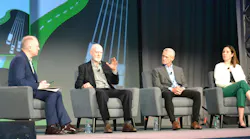
The report’s lead author and Kearney partner Korhan Acar conceded that the previous six freight cycles have seen a rapid rate decline and ensuing recovery, and “that’s where the word ‘vengeance’ is coming from.”
“So, when you look at these freight cycle recoveries, people think it’s going to come back and come back hard, especially this one,” he said. Except, he noted, his team put together a report two years ago that predicted an “elongated” recovery this time around, and he supported Cantriel’s suggestion that partnerships will prevail. “When recoveries like that happen, it’s more of a collaborative, conversational environment with the shipper and the carrier. There’s a long runway for the rates to come back, so during that time you actually become stronger friends.”
Stacy Schlachter, SVP of sales at Penske Logistics, agreed.
“From the 3PL or provider perspective, I would not use the word ‘vengeance.’ What I would say is we’re focused really on long-term partnerships; they ebb and flow,” she said. “Digging into where the carrots are and finding all these opportunities means that we work together through the highs and the lows. I think that’s generally the approach that companies that want long-term partnerships take to handle these moments.”
But, you know, there’s still that pesky supply-and-demand equation, pointed out Andres Mendoza-Pena, a partner at Kearney and another report author.
“We shouldn’t forget that truckload, specifically, is a highly fragmented market,” Mendoza-Pena said. “There are an extremely large number of carriers. The top 10 companies account for less than 5% of the market, right? And the shipper side is also extremely fragmented, so it’s almost like a perfect capital market. As long as there is one company, one carrier willing to take the load for a lower rate, if shippers are only focused on cost, that dynamic is going to happen. And then, vice versa: In the upcycle, that dynamic is also going to happen.
“So, from an economic incentive, you still have the structure that will lead to those fluctuations in the market. But, in terms of how we all manage the supply chain, it does look like we are shifting away from only cost to other elements—service and long-term relationships—that could soften this fluctuation going forward.”
Of course, I’m not privy to current bid discussions, so I can’t say whether this shift is actually happening or whether it’s the same song, just the next verse.
To date myself even further, I’ll borrow from the band Journey, “Who’s cryin’ now?”
So many stormy nights
So many wrong or rights
Neither could change their headstrong ways…
About the Author
 Kevin Jones
Kevin Jones
Editor
Kevin has served as editor-in-chief of Trailer/Body Builders magazine since 2017—just the third editor in the magazine’s 60 years. He is also editorial director for Endeavor Business Media’s Commercial Vehicle group, which includes FleetOwner, Bulk Transporter, Refrigerated Transporter, American Trucker, and Fleet Maintenance magazines and websites.
Working from Beaufort, S.C., Kevin has covered trucking and manufacturing for nearly 20 years. His writing and commentary about the trucking industry and, previously, business and government, has been recognized with numerous state, regional, and national journalism awards.