Trimble’s strategy for AI agents in fleet software
Key takeaways
- Trimble is overhauling its products to integrate AI and improve layouts.
- New system updates include web-based interfaces, APIs, and model context protocols to make legacy data accessible to AI agents.
- Features like dynamic routing, autonomous dispatch, and yard orchestration may improve fleet efficiency.
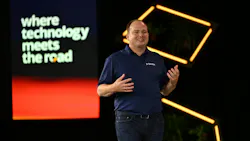
SAN DIEGO—For the opening general session of Trimble Insight 2026, Trimble CEO Rob Painter used the Industrial Revolution to describe commercial transportation’s next big challenge.
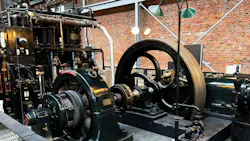
At the end of the 19th century, factory owners often used a single giant steam engine to power a multi-floor building. A circulatory system of drives and belts would transmit the central engine’s power to devices across the building. The introduction of electric motors promised massive productivity boosts. Still, for nearly 30 years, industrial productivity barely budged.
"Why? Because factory owners did the obvious thing at the time: They ripped out the steam engine, and they put in the big electric motor in the same room and ran the same exact belts and pulleys," Painter told the audience. "New technology, old architecture. Nothing changed because nothing was redesigned. Today, AI is our electric motor, and the trap that every company faces today is the same: bolting a new power source onto an old operational architecture ... and wondering why the gains are marginal."

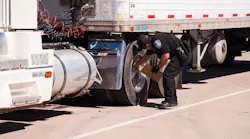 Arizona roadside inspection
Rather than asking carriers to undergo costly, risky software migrations to access modern capabilities, Trimble spent the session outlining how it is overhauling its core product architecture to improve user experience and AI integrations—highlighting a suite of new updates and upgrades under what the company calls its Trimble NEXT Showcase.
The systems’ new AI integrations bring Painter back into the Industrial Revolution.
"Anybody can buy raw AI intelligence today, but raw intelligence without a logistics network moves no freight, and it just becomes a bigger engine sitting in that older factory," Painter said.
Agent-ready architecture for the TMS
For truckload carriers, the showcase included several transportation management system (TMS) modernizations to help fleets reach those coveted efficiency gains.
To improve user experience and add large language model (LLM) integrations, the company’s systems received modern web interfaces, standard APIs, and model context protocol (MCP) layers directly on their backends.
- Innovative: The update added browser-based workflows and a redesigned layout that makes legacy data structures accessible to AI agents. Barry Smith of Stevens Trucking noted during the session that the update allows teams to "see driver and assist performance more clearly, respond to trailer pull issues sooner ... and make more informed pricing and financial decisions."
- TruckMate: Gained a cloud-hosted, mobile-responsive web interface for customer service representatives, allowing personnel to work remotely while spending "less time navigating to find the information they need."
- TMW.Suite: Introduced browser-based billing workflows that unify order details, charges, paperwork, and references into a single view. The objective is to reduce friction, make exceptions easier to see, and make the system ready for agents that can automate repetitive tasks.
- Fuel Dispatch: Refreshed its interface to modernize dispatcher workflows.
New fleet software features, AI integrations
Beyond back-office TMS updates, Trimble showcased how AI integration is altering daily execution across fleets:
Dynamic routing
Celebrating PC Miler’s 40th anniversary, Trimble introduced the ability for fleets to set customized route preferences.
"Instead of giving your team the default practical PC Miler route ... now, based on time, distance, totals, total cost, or safety, you can select the best route for your operation in a simple web experience," Michael Kornhauser, sector vice president of transportation for Trimble, told the audience.
Dispatchers can save those routes with a few clicks to ensure drivers execute the same planned lane every time.
In the cab, CoPilot expanded into a voice-activated safety tool. Drivers can tell CoPilot they need a break, and the system evaluates their route, hours-of-service limitations, and real-time parking data to find and reserve overnight stays.
"It allows the driver to remove the worry of the route from their head," Kornhauser said.
Autonomous route planning
For private fleets managing multi-stop delivery puzzles, Appian Fleet Assistant now offers autonomous route planning.
Appian's AI can ingest fleet operational rules, driver preferences, and customer commitments to build optimized dispatch plans in seconds. Human planners retain full control, choosing to review AI recommendations or letting the system execute autonomously.
Faster maintenance invoice scanning
Last year, Trimble introduced AI Invoice Scanning for TMT Fleet Maintenance. This year, Trimble upgraded its batch processing to handle 10 times as many invoices.
Shop accounting teams can now batch-process up to 100 PDF repair invoices simultaneously, with the AI automatically extracting line items and mapping parts and labor directly to VMRS codes. Trimble claims that the batch processing can save more than 136,000 minutes across 19,500 invoices compared to manual data entry.
Cross-party yard orchestration
To combat facility gate congestion and driver detention, Trimble Dock & Yard introduced Advanced Trailer Orchestration. By synchronizing real-time truck ETAs, facility slot capacity, and yard moves, the system eliminates status calls between shippers and carriers.
"There's no more guesswork," Kornhauser said, giving both sides "a shared vision of what's actually happening when the truck reaches the yard."
Human decisions are still key
Rather than abandoning their core software for standalone AI applications, Trimble’s updates help customers modernize their existing architecture.
The updates are one component of what Kornhauser calls “the value equation for the next era of logistics:” You + AI.
"Volatility is not going away. Uncertainty is not going away,” Kornhauser said. “AI changes how quickly we can solve these problems, but you determine which problems are worth solving. That's why the most important part of 'You + AI' is still you."
About the Author
 Jeremy Wolfe
Jeremy Wolfe
Editor
Editor Jeremy Wolfe joined the FleetOwner team in February 2024. He graduated from the University of Wisconsin-Stevens Point with majors in English and Philosophy. He previously served as Editor for Endeavor Business Media's Water Group publications.