
The for-hire market is rewriting broker-carrier relations
Key takeaways
- The for-hire market's drastic changes have also changed broker-carrier relations.
- Regulatory crackdowns increased operational hurdles for the industry's shadier carriers and 3PLs.
- The Montgomery decision helped prompt stricter carrier vetting among brokers.
- Cargo theft and fraud surged in 2025-2026, prompting brokers to rely more on authority and safety data.
- Fewer carriers due to market recession and enforcement actions have led to increased load-to-truck ratios.

When Jamie Hagen launched Hell Bent Xpress in 2010 and leased to another carrier, the freight market was very different. Over the next decade, Hagen grew the operation to three trucks and got his own operating authority in 2020.
Getting his own authority was when he “figured out the brokerage game,” he said. That game started with the COVID surge and then trudged the long, painful trough of the freight recession.
“2025 being the disaster that it was—that was the worst of it. People were laughing at you. They didn’t care. They’d hang up on you if you asked for anything,” Hagen told FleetOwner.
The freight recession was characterized by excess truck capacity and enthusiastic fraudsters. Brokers had plenty of options: Many carriers competing for the same load would accept rates well below their operational costs.
But things have started to look up. Hagen saw the market improve substantially this year and now finds that working with brokers has been easier.
“Things have definitely changed since December. It’s been profitable; it’s been nice … It’s changed for the positive a lot,” Hagen said. “I don’t know if it’s the placebo effect, but it feels different.”
Today, Hell Bent Xpress has 10 trucks running dry van loads. The fleet gets most of its loads from smaller brokerages with only a couple of employees, some of whom are friends with Hagen.
The market shift became apparent in the fleet’s negotiations on loads, even for details like pickup times.
“You just feel that everyone’s trying to work with you—versus the way it kind of used to be, them being like, ‘Well, you can’t do this, then screw you,’ and they would just hang up on you,” Hagen said. “Now, they’re like, ‘Well, let’s work this out, and let’s see what we can do here.’ Whether it’s money, whether it’s time, whatever it takes—they’ll usually go back to try to get the shipper to change this or that around so that it can fit with you.”
Broker relations was one of fleet executives’ top industry issues in 2025. Now, regulatory crackdowns, major judicial rulings, and bankruptcies are changing the for-hire market. Negative operating margins and shifty chameleon carriers are becoming much less common. Brokers’ options have shrunk, and established carriers can enjoy greater negotiating power.
What changed? Markets, lawsuits, crackdowns
The for-hire landscape changed significantly over the last year. Federal enforcement began to focus on transportation. Legal and fraud risks prompted brokers to avoid new carriers. Changes in supply and demand led to a new market cycle.
Federal crackdowns
The second Trump administration brought a massive crackdown across language proficiency, self-certification, training, and identity verification.
English language proficiency
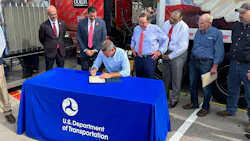
The administration restarted English Language Proficiency (ELP) enforcement in mid-2025 with an executive order, an update to the Commercial Vehicle Safety Alliance's (CVSA’s) out-of-service (OOS) criteria, and new ELP orders for the Federal Motor Carrier Safety Administration's (FMCSA’s) roadside assessments.
For the rest of 2025, FMCSA recorded over 12,000 driver OOS violations for ELP. So far in 2026, FMCSA recorded over 17,000 OOS violations for ELP. That’s a lot of interruptions to carrier operations—and a lot of stalled loads to the frustration of brokers and shippers.
Non-domiciled licenses
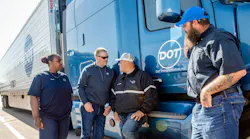
FMCSA also began a campaign against non-domiciled commercial driver's licenses (CDLs). Following Trump’s April 2025 executive order, the agency last September issued an emergency rule restricting how states could issue or renew non-domiciled licenses.
Legal challenges stalled the rule, and FMCSA began repeating a different type of state-by-state enforcement: The agency would point out that a state’s non-domiciled CDL expiration dates exceeded the drivers’ lawful presence expiration dates. Then the agency would order the state to halt all non-domiciled CDL issuance or else lose federal funding. California alone canceled approximately 20,000 non-domiciled CDLs in early 2026.
In February this year, the agency issued a new rulemaking to again restrict how states can issue or renew the licenses. The rule ambitiously estimates that the rulemaking would remove 194,000 CDLs from the nation’s driver pool. The real number will likely be lower, and truck drivers would only make up a fraction of that.

CDL trainer self-certification
The federal government also began investigations into CDL training schools. So far, since December, nearly 10,000 CDL training schools have been removed from FMCSA’s Training Provider Registry.
Motus identity verification
FMCSA’s new carrier registration system, Motus, includes more advanced fraud detection tools. The system uses third-party business validation and the same identity verification software used at TSA checkpoints. The system has encountered several technical problems but is still better equipped to combat fraudulent carrier registrations.
The Montgomery decision
Brokers’ risk profiles were changed by the Montgomery decision on a national scale, providing another reason for them to work with established carriers.
“It was picking up steam because of the ELP enforcement, and then that [Montgomery] decision came along. It just felt like everyone was really ready to tie themselves to a good carrier,” Hagen said.
In 2017, a carrier working for C.H. Robinson crashed into the truck of Shawn Montgomery, injuring him. Plaintiffs filed complaints on behalf of Montgomery against the driver, the carrier, and C.H. Robinson. C.H. Robinson tried to claim that it was protected against negligent hiring tort suits by the Federal Aviation Administration Authorization Act (FAAAA).
FAAAA, also known as F4A, in 1994 declared that federal laws preempt states’ transportation regulations that would burden interstate commerce—with an exemption for motor vehicle safety. Whether or not FAAAA’s exemption applied to brokers was ambiguous—and U.S. district courts had split opinions about that ambiguity.
The Transportation Intermediaries Association (TIA) has represented third-party logistics providers (3PLs) since 1978 and now has 1,800 industry members. The outcome of the case would have a significant impact on the industry group’s members.
“The decision of the case centered around: Can states find that brokers are what’s called negligent in their selection of a trucking company?” Chris Burroughs, TIA president and CEO, told FleetOwner. “There were split decisions at a couple of different district court levels, so that obviously became a case that the Supreme Court was interested in.”
In May, the Supreme Court unanimously ruled that FAAAA does not preempt state negligent hiring torts against brokers. TIA is working with its members to mitigate the consequences of the Supreme Court’s actions for 3PLs.
The decision is important, but it isn’t as dramatic as some might suggest. The FAAAA preemption was only a valid defense in less than half of U.S. states before the Montgomery decision. Broker hiring liability cases have dated back around two decades, according to Burroughs. In 2004, a Maryland district judge allowed a plaintiff to pursue C.H. Robinson for negligent hiring claims.
“These cases really date back to 2004 as the kind of landmark case—there were a few before then, too, but that was the big decision back in 2004—which also involved C.H. Robinson,” Burroughs said. “So, this is nothing new.”
Burroughs and TIA argue that the Montgomery decision maintains a messy state-by-state regulatory patchwork where there is no national standard of what a “safe” carrier looks like or how a crash’s legal battle could unfold.
“Depending on where the crash occurred, depending on sometimes where the companies are based, if it was a plaintiff’s lawyer-friendly district, they would try to get the court case in their district—it was just this unknown,” Burroughs said. “And that’s kind of what we’re faced with now.”
Still, the decision is another point for plaintiffs in the age of nuclear verdicts. Plaintiffs operating in districts that previously observed FAAAA preemption may be more motivated to go after brokers. Some cases were waiting for the Supreme Court decision and can now move forward.
“Certainly, there’s going to be an influx of cases, but I’m not sure of the magnitude compared to where they were,” Burroughs said. “Some of our larger members have eight to 10 of these cases at all times, so it’s nothing new.”
The greater problem for brokers may be in insurance markets, where underwriters can raise premiums in response to the new legal exposure.
“The major concerns from our membership were not necessarily the number of cases. I think you’re certainly going to see an increased amount of cases, but that’s just normal with the plaintiff side of things,” Burroughs said. “I think the concern was also around rising costs of insurance. Insurance is obviously very quick to react to changes in markets, and they usually go in one direction: up.”
To protect against liability claims, brokers are tightening their carrier selection standards. While all of TIA’s 1,600 members operate differently, Burroughs did note some trends among brokers for the changed environment.
“I think they’re looking at a variety of different things,” Burroughs said. “They’re utilizing a lot of the technology that’s out there, whether it be Highway or Blue Wire or many of the different platforms to look at carriers and set a baseline to figure out what the profile of a ‘safe’ carrier would look like.”
Based on a recent survey of TIA’s members, 91.6% of broker respondents would not use a carrier with a ‘Conditional’ rating after the Montgomery decision.
“‘Conditional’ is bad, but you’re not bad enough to get shut down. It creates that gray area—and if you’re a plaintiff’s lawyer, you love gray areas because gray area confusion is what they want to shine a spotlight on,” Burroughs said.
The survey also found that since the Montgomery decision, 85.2% of respondents made changes to their carrier selection that would eliminate up to 20% of their carrier pool.
“There’s going to be potentially large segments of trucking companies within a broker’s capacity that they’re utilizing that may, to no fault of their own, be eliminated from the viable pool because there isn’t enough reliable data that exists on these carriers,” Burroughs continued.
Since more than 90% of the overall carrier population has no safety rating, TIA lobbies to change FMCSA’s safety rating away from exclusively physical audits to a new carrier safety selection standard. Strong indicators for that standard might include out-of-service violations, paperwork compliance, or insurance validity. TIA amplified its calls for the standard post-Montgomery.
Cargo, carrier fraud

Alongside legal liabilities, rampant cargo theft and strategic fraud are growing operational risks for fleets and 3PLs. It is difficult to gauge the true national scale of U.S. trucking cargo theft, but two industry groups have alarming estimates:
- The American Transportation Research Institute (ATRI) released an October 2025 study finding that 2023’s cargo theft cost motor carriers (including both direct and indirect costs) between $1.83 billion and $6.56 billion annually.
- The most frequent industry data comes from Verisk CargoNet, a company that sells cargo theft prevention solutions. The vendor releases quarterly reports on its cargo theft findings—its latest annual report estimated cargo thefts surged to $725 million in 2025.
On the broker side, TIA has several published statements on the urgency of cargo theft, double brokering, and other types of fraud. TIA’s Burroughs noted that this issue, again, is a disadvantage for newer carriers.
“Some of the cargo theft that was going on was a lot of new entrants,” Burroughs said. “And those [good carriers] may have been weeded out unintentionally because all these fraudulent folks were coming in, and they had new authority. If you were a new carrier coming in, you didn’t have any data yet, you had a brand new authority, and folks were probably turning you away from business because of that concern of cargo theft.”

It seems this fraud became a much larger concern in the last year. Google Trends data shows that the terms “cargo theft,” “cargo fraud,” and “double broker” exploded in popularity in 2025 and 2026. Most brokers would be well aware of cargo theft risks long before 2025, and Google Trends only tracks term searches across the general population—but the trend suggests that 3PLs would be more aware now than ever.
Some brokers have used authority age and roadside inspections as proxies for valid operations. Likewise, the terms “operating authority,” “authority age,” and “carrier age” all boomed in Google Trends around 2025 and 2026.
If brokers care more about this issue, established for-hire carriers with clean track records should have an easier time finding business.
Brokers' financial responsibility rules
FMCSA also updated financial responsibility rules for brokers, which took effect January 16. Previously, some brokers could accrue claims even if they had no money and no intention to pay carriers.
The new rule makes it more difficult for brokers to gamify the $75,000 financial responsibility requirements: Brokers would have a harder time operating without meeting financial security requirements or manipulating the agency’s surety bond/trust fund paperwork.
The story here is mostly about carrier capacity reductions, but FMCSA’s actions are cutting out shady actors on the 3PL side, too. Fewer insolvent brokers would mean that the overall population of brokers has more fair players.
Shrinking driver/carrier population
The for-hire market entered a capacity-induced upturn. Spot rates began to rise around November and December last year, and they increased dramatically for several months straight. Freight demand had not improved much, but the supply of available trucks dropped significantly.
Federal enforcement might be the most attention-grabbing factor, but the capacity reduction is also due to the years-long market recession. Many carriers went out of business: The net change in the carrier population was mostly negative from late 2022 to the end of 2025. Throughout 2025, any Google search could find an abundance of stories about carriers suddenly shutting down overnight. Some carrier shutdowns left their drivers stranded with no communication.
Fewer carriers also mean more loads for the survivors. Load-to-truck ratios, according to DAT Freight & Analytics as of August, are up 70-90% year over year across its three main trailer types.
The market to come
With all these factors limiting brokers’ viable partners, established carriers like Hell Bent Xpress are reaping the benefits.
“Everyone seems to be a little more open to the conversation—versus before, where there was no conversation. They didn’t need to have a conversation; they just moved on to the next person,” Hagen said. “Their whole attitude changed around the situation, and it’s a huge win.”
And those trends that redefined broker-carrier relations are likely here to stay.
Federal enforcement will continue to squeeze capacity. Lawsuits will pressure brokers away from fresh or questionable carriers. The for-hire market’s upturn this year ended the brutal carrier culling, but with no change to freight demand, spot rates are more subject to driver and equipment availability.
About the Author
 Jeremy Wolfe
Jeremy Wolfe
Editor
Editor Jeremy Wolfe joined the FleetOwner team in February 2024. He graduated from the University of Wisconsin-Stevens Point with majors in English and Philosophy. He previously served as Editor for Endeavor Business Media's Water Group publications.