How private fleets built their 2026 defense amid freight doldrums
Key takeaways
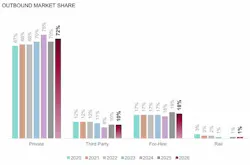
- Supply chain control: Private fleets expanded outbound market share to 72%.
- Record utilization: Despite dropping average annual mileage to near-historic lows, fleets pushed daily power-unit utilization to an all-time high of 13.1 hours.
- Leasing and maintenance shift: Driven by advanced emissions and diagnostic complexities, fleet preference for full-service leasing spiked to 42%.
- High pay, stable retention: Private fleets maintained a low 17.1% turnover rate by replacing sign-on bonuses with predictable schedules and high base pay.
- Universal safety tech: With safety ranked as the top operational challenge by 73% of fleets, 89% have adopted in-cab cameras, collision warnings, and adaptive cruise control.
As for-hire carriers battled margin compression and excess capacity throughout last year, the nation’s private trucking fleets quietly cemented their supply-chain dominance. After spending the start of the decade reinforcing their defenses against uncertainty, private fleets spent 2025 expanding market share, tightening operations, and proving themselves as indispensable assets for their corporate parents.
According to the newly released National Private Truck Council’s (NPTC) 2026 Benchmarking Survey Report, private carriage has evolved from a simple tactical cost center into a sophisticated strategic hedge. Outbound market share captured by private fleets rebounded to 72% (second highest in the survey’s history), while inbound volume share held steady at 42%.
NPTC EVP Tom Moore, who authored the report based on member fleet surveys of 2025 operations, described the private fleet community’s steady climb to supply chain control as “the untold success story in trucking” during a September media briefing.
After years of splitting the U.S. over-the-road freight market evenly, private fleets began eating into for-hire share as they built networks after pandemic supply chain problems five years ago. That share shifted from 50/50 to 55/45 in favor of private fleets, which used their expanded capacity to strengthen customer service and reduce empty miles by hauling for hire.
For-hire volatility vs. private fleet stability: Navigating 2026 rates
That success is being tested this year as operational costs rise and the driver pool tightens.
The benchmarking data reflects 2025, a calendar year marked by economic uncertainty and soft for-hire spot markets; however, 2026 has created different challenges.
Recent broker-posted spot rate data from FTR and Truckstop show a dramatic market reversal. Total spot rates (including fuel) surged through this spring and summer, climbing well past $3.50 per mile before settling around $3.22 per mile in August, outpacing the depressed 2025 market.
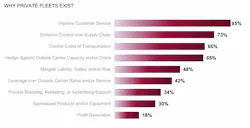
For corporations that stood by their private fleets during the longest freight recession on record, their long-term vision is paying off. Rather than chasing cheap, volatile third-party spot capacity, NPTC fleets insulated their parent corporations from 2026’s rate spikes by keeping core freight under internal transportation controls. A record 76% of survey respondents now report using their private fleets explicitly as leverage against for-hire carrier pricing.
 Peninsula driver award
 Why fleet safety programs should recognize drivers, not just flag risks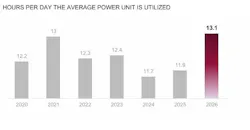
Regional networks and power unit utilization grow
In 2025, private fleets operated closer to their customers than ever before. Survey respondents reported operating out of an average of 48 facilities, with 35% expanding their terminal footprints over the past year to get closer to end markets.
That regionalization drove heavy-duty truck and tractor mileage to 80,750 miles in 2025, near historic lows for NPTC members. But driving fewer miles didn’t mean working less:
- Power-unit utilization: Surged to a new record of 13.1 hours per day, up from 11.9 hours in 2024.
- Trailer dormancy: Dropped to 32% from 39%.
- Weekly trips: The average trailer completed 7.6 trips per week, up from 5.7.
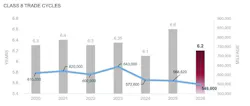
- Trade cycles: Accelerated to 6.2 years and 549,000 miles, marking the shortest equipment replacement cycle in the survey’s history.
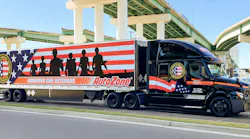
Marley Bebout, AutoZone’s supply chain logistics director, noted during the media briefing that her company’s private fleets maximize asset productivity by heavily utilizing slip-seating and running dedicated night deliveries across their 12 U.S. distribution centers.
Bebout said that her fleet (which in 2026 ranked just outside the FleetOwner 500: Private) tends to run equipment “slightly longer in years but a lot longer in mileage.”
AutoZone can do this because of its own maintenance facilities. “We do a lot of our own maintenance—we invest in the maintenance side of it to be able to extend the life of our vehicles,” she said.
Maintenance complexities and shift to leasing
While AutoZone works hard to keep its maintenance technicians certified and up to date on the latest vehicle service needs and technologies, the complexities of modern trucking equipment are pushing some operations to seek outside services.
Nearly three in four NPTC fleets own their Class 8 tractors going into this year; however. more fleets are turning to full-service leasing options, which spiked from 28% in 2024 to 42% in 2025.
Facing advanced powertrain electronics, emissions compliance, and high diagnostic demands, 77% of fleets outsourced at least part of their maintenance budget last year. Full-service lessors captured 43% of that outsourced volume, overtaking OEM dealer networks.
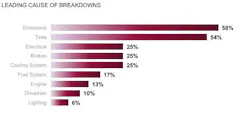
Roadside reliability remains a priority. Roadside breakdowns ticked up slightly for private carriers last year to an average of 4.7 per 100,000 miles. Emissions equipment (58%) and tires (54%) drove this increase. However, when breakdowns did happen, private fleets reduced average repair costs to $1.083 and sharply reduced average delay times from 20 hours to 12.1.
Driver stability and compensation rise
While their for-hire brethren battled more labor churn, private fleets maintained a 17.1% driver turnover rate in 2025 across all operations (just 12.1% for medium-duty fleets).
Behind the numbers: How the NPTC Benchmarking Survey is conducted
To understand the scope of the National Private Truck Council’s (NPTC) annual Benchmarking Survey Report, it helps to look at how the data is gathered and protected.
- Participants: The report compiles operational, financial, and safety data from 89 private fleet member companies representing a broad cross-section of the U.S. economy. Food manufacturing, grocery, and retail sectors account for 40% of participating fleets.
- Confidentiality: All proprietary operational data is treated as strictly confidential and analyzed exclusively by Tom Moore, CTP, NPTC EVP. Data is never shared outside individual company representatives, and published figures are presented entirely in aggregate without corporate attribution.
Private fleets have also moved away from short-term recruitment gimmicks. Sign-on bonuses dropped to just 28% of fleets, averaging $4,000. But private fleets continued to focus on simply paying more, with the average NPTC fleet paying drivers more than $92,000 annually.
These fleets also focused on work-life balance to help entice their professional drivers: 58% of NPTC drivers are home every night; drivers averaged 51.9 hours of total work weekly (32.5 behind the wheel, 19.4 handling non-driver tasks).
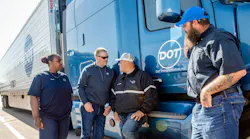
Tim Eckhardt, Dot Transportation senior safety director, emphasized that successful private fleets are building a “buffet of jobs”—offering flexible schedules, alternative work weeks (such as four-on/four-off), and home-time options for drivers based on their stages of life.
Active tech adoption keeps crash rates low
Safety landed as this year’s No. 1 operational challenge for NPTC members, cited by 73% of respondents.
What is a private fleet?
A private fleet is a transportation network owned and operated by a company whose primary business is not trucking (such as retail, manufacturing, or distribution). Rather than hauling freight for the general public, a private fleet moves the parent company’s own goods.
Crucially, private carriage is not a for-hire carrier, 3PL, or outsourced “dedicated fleet.” While dedicated fleets are operated by third-party commercial carriers, true private fleets are embedded directly into the corporate structure, serving as an in-house strategic asset to guarantee capacity, control supply chain costs, and protect customer service.
Although the DOT recordable crash rate ticked up slightly to 0.65 per million miles, private fleets continue to operate at roughly three times safer than the general motor carrier industry average, according to NPTC.
At AutoZone, Bebout noted that her fleet’s preventable accidents went down in 2025, but they saw an increase in accidents with at-fault motorists, particularly distracted passenger car drivers.
To insulate against nuclear verdicts and escalating liability, private fleets are nearing near-universal adoption of active safety systems:
- 100% run automated transmissions
- 89% utilize collision warning, adaptive cruise control, lane departure warnings, disc brakes, and in-cab cameras
- 68% employ dual-facing in-cab cameras
Eckhardt, whose fleet is the transportation arm of Dot Foods, said his operations are combating safety concerns with technology and training.
“It’s really the safety technology we invest in, the training we invest in our drivers—it is to give them awareness of everything around them,” he said. “With the amount of distractions that are out there now, the comfort of vehicles and the speed of vehicles, it’s up to us to put as much technology as we can in our trucks to give those drivers a 360-degree view around it—any kind of technology that can help keep them safe.”
Additionally, 84% of fleets carry insurance coverage above the minimum DOT requirements, with 77% maintaining self-insured retention levels averaging $7 million.
Where private fleets see themselves in five years
As freight markets absorb rising rate pressures through the back half of 2026, the NPTC report signals that private fleets are locked in for sustained growth. Looking five years ahead, 71% of respondents expect their fleet to expand in the next five years; only 9% anticipate contraction.
“The private fleet continues to prove itself as more than a tactical tool—it functions today as a reliable and flexible strategic asset and vital link in the supply chain,” Moore said.
Penske Transportation Solutions and Tenstreet sponsor the 2026 NPTC Benchmarking Report.
About the Author
 Josh Fisher
Josh Fisher
Editor-in-Chief
Editor-in-Chief Josh Fisher has been with FleetOwner since 2017. He covers everything from modern fleet management to operational efficiency, artificial intelligence, autonomous trucking, alternative fuels and powertrains, regulations, and emerging transportation technology. Based in Maryland, he writes the Lane Shift Ahead column about the changing North American transportation landscape.