EPA finally unveils relaxed NOx rule—and plans to remove DEF derates
Key takeaways
- After a year and a half, EPA's regulatory rollback for MY 2027 diesel engines' NOx emissions was finally unveiled as a proposed rulemaking.
- The relaxed NOx standard removes warranty extensions and delays useful life extensions
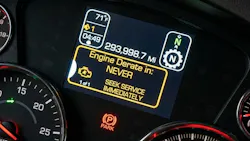
- The rulemaking also proposes removing the DEF derate, replacing the derate with only visual/audible cues.
The U.S. Environmental Protection Agency (EPA) has finally unveiled its proposed rulemaking to reduce the costliness of Model Year 2027 NOx standards.
The new rulemaking is an update to the 2023 NOx rule for MY 2027 engines, designed to reduce the costliness of the upcoming emission standards. Trump officials first suggested the rulemaking about a year and a half ago. EPA estimates that the relaxed rulemaking will save up to $6,000 per diesel vehicle from warranty savings alone.
For traditional diesel truck fleets, the new proposed rulemaking makes three significant changes to help engine manufacturers:
- Removes the warranty extension
- Postpones the useful life extension
- Adds a noncomformance penalties framework.
The Biden NOx rule
The Biden EPA first introduced the 2027 NOx rule in 2022, titled “Control of Air Pollution from New Motor Vehicles: Heavy-Duty Engine and Vehicle Standards,” and adopted the final rule in early 2023. Some experts estimated that the rulemaking would increase the cost of a new power unit in MY 2027 by as much as $15,000 due mostly to three aggressive requirements:
- The rulemaking aggressively reduced emissions limits for heavy-duty diesel engines, most notably reducing nitrogen oxide (NOx) limits from 0.20 grams per brake horsepower-hour (g/bhp-hr) to only 0.035 g/bhp-hr—an over 80% reduction.
- The Biden NOx rule also introduced testing based on low-load and idle cycles, which forced manufacturers to keep aftertreatment systems functioning when the engine is running relatively cold. The testing modification required manufacturers to add large heating elements to their aftertreatment systems.
- The last additions were warranty and useful life extensions: EPA required emissions systems to maintain compliance for 50% longer (up to 650,000 miles) and required manufacturer warranties to be 450% longer (up to 450,000 miles).
What stays the same in the new NOx rule?
EPA is keeping the same overall emissions standards for 2027, as well as the new test cycles—meaning heating components will still be a part of new aftertreatment systems.
Goodbye, warranty extension
To reduce overall vehicle prices, the proposed rulemaking would throw away the warranty extension, instead maintaining the MY2026 warranty mileage requirement: 100,000 miles or five years.
EPA estimated that the original 450% warranty mileage increase would have accounted for 50% of MY 2027 equipment price increases—and that removing the warranty would spare engine buyers up to $6,000 in regulatory costs.
No more DEF derates
Faults with a diesel exhaust fluid (DEF) system today can quickly handicap a truck. EPA is using this rulemaking to propose removing DEF derates altogether. The derates would instead only require visible or audible notifications when SCR systems encounter faults.
EPA is also considering separate guidance to allow manufacturers to modify engines already in use to remove derates.
Delayed useful life extension
EPA’s requirement to extend emissions systems’ compliance would be delayed by three years.
The original NOx rule’s 50% longer emissions compliance mileage would apply for MY 2030 instead of MY 2027.
Nonconformance fees for manufacturers
EPA is also proposing a framework to allow manufacturers to continue selling MY2026-compliant engines for a small fee, called Nonconformance Penalties (NCPs). Engine manufacturers selling MY 2027 engines can pay the penalty to sell nonconforming engines.
EPA’s reasoning for the framework is that “some manufacturers’ MY 2027 medium and heavy-duty engine development programs have experienced technical challenges, and a few diesel engine models/families are at risk of not being completed in time for a January 2027 introduction.” The NCPs would allow manufacturers to continue to sell noncompliant products while they develop compliant engines.
 Dry van and reefer spot rates reach new highs as the truckload market tightens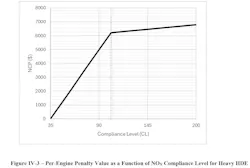
An NCP is only available for engines that comply with MY 2026 emissions standards. The formula for calculating the NCP is based on EPA’s estimates of the average cost of compliance and ramps up according to the engine’s NOx emissions.
The proposed penalty structure peaks just under $7,000 for a power unit that complies with MYH 2026's 200 g/bhp-hr limit. At around 100 g/bhp-hr, the proposed penalty would be slightly over $6,000. At 90 g/bhp-hr, the penalty drops to only $5,000.
Production volume allowance
A boon particularly for low-volume vehicle manufacturers, EPA is making it easier to use the 5% production volume allowance.
Originally, the NOx rule would have allowed manufacturers to certify engines that do not meet the MY 2027 standards, but would have limited those certifications to up to 5% of their average production over three years (MY 2027 to MY 2029) and required NOx emission credits to earn them.
The new rulemaking removes the NOx emission credits requirement but keeps the 5% production limit. The agency noted that this change is particularly helpful for specialized vocational vehicles, such as fire trucks, refuse trucks, concrete mixers, emergency vehicles, heavy‑haul tractors, urban buses, and custom‑chassis motor homes.
EPA also requested input on other leniencies around emissions credits for MY 2027 and later.
What happens next for the rulemaking?
EPA’s information about the proposed rulemaking is available on its website here.
EPA is accepting public comments on the proposed rulemaking until August 29, 2026. The agency in this rulemaking requested input on specific questions about emissions credits management, NCP calculations, and more.
The final rule will be published sometime after August 29, to take effect shortly after. Since it concerns MY 2027 equipment, the rule will very likely take effect before the start of 2027.
About the Author
 Jeremy Wolfe
Jeremy Wolfe
Editor
Editor Jeremy Wolfe joined the FleetOwner team in February 2024. He graduated from the University of Wisconsin-Stevens Point with majors in English and Philosophy. He previously served as Editor for Endeavor Business Media's Water Group publications.