Class 8 orders stall as EPA 2027 uncertainty lingers

Class 8 truck orders in September were a weak start to the annual order season. Regulatory uncertainty and manufacturers' shifting strategies likely subdued demand.

Key takeaways

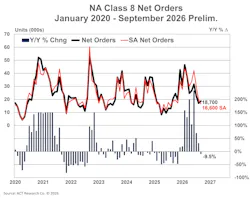
  • September Class 8 net order totals diverged between major research firms. ACT Research reported a 9.5% year-over-year decline and FTR reported a modest 3% gain.
  • The formal transition to Model Year 2027 ordering has begun as surcharge-free MY 2026 build slots are effectively sold out.
  • Disrupted order boards and lingering uncertainty around EPA’s final 2027 NOx rule are likely causing fleets to delay commitments.
Kicking off the Class 8 market’s traditional fall order season, truck orders were mixed.

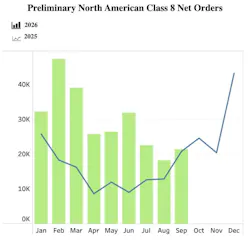
ACT Research estimated North American Class 8 orders were roughly 18,700 units in September, down 9.5% year-over-year. FTR Transportation Intelligence estimated preliminary orders were around 21,300 units—up 3% year-over-year.

Truck demand is likely healthier than last year, but regulatory certainty and manufacturer capacity are a different story.

“The 2027 regulatory engine transition is clearly impacting order seasonality this year, but the underlying demand for new equipment remains robust, supported by strong spot rate momentum,” said Carter Vieth, research analyst at ACT Research. “Fleets are eager to replace aging equipment and prepare for cost increases on the horizon, but the lack of regulatory clarity is making it difficult for them to plan effectively.”

Order season disrupted: September typically marks the opening of order books for the upcoming model year, but the seasonal uptick was muted this year. Manufacturers had not fully opened their 2027 order boards, according to ACT, which disrupted normal seasonal patterns. OEMs are still finalizing pricing and production strategies for next year’s equipment. That uncertainty is driven mostly by EPA's pending NOx regulation.

OEM compliance strategies vary: September’s orders also captured original equipment manufacturers’ (OEMs’) evolving strategies for 2027 emissions regulations. 2027 engine production and pricing will vary depending on a manufacturer’s attitude toward nonconformance penalties and emissions credits—assuming nonconformance penalties remain in EPA’s final rule.

Pricing clarity needs a final rule: Because truck manufacturers are employing varying approaches—and the EPA has yet to issue its finalized rule on NOx standards—equipment pricing could be subject to change over the coming months. Analysts from both firms expect order intake over the next one to two months to remain subdued until the final regulatory terms are published and OEM strategies fixed.

“Truck and engine manufacturers have announced varying strategies for handling the emissions transition, and some have not yet made their plans clear,” Moyer said. “The final EPA rule could still materially alter the economics of these strategies. Higher NCPs would narrow the cost advantage of current-generation engines while lower NCPs would make that pathway more attractive. That major issue, along with other potential changes, could affect 2027 engine availability, fleet acquisition costs, and the mix of technologies ultimately selected.”

About the Author

Jeremy Wolfe

Jeremy Wolfe

Editor

Editor Jeremy Wolfe joined the FleetOwner team in February 2024. He graduated from the University of Wisconsin-Stevens Point with majors in English and Philosophy. He previously served as Editor for Endeavor Business Media's Water Group publications.

Sign up for our eNewsletters
Get the latest news and updates

Voice Your Opinion!

To join the conversation, and become an exclusive member of FleetOwner, create an account today!