The Great EPA27 Engine Pivot: OEMs, fleets shuffle plans due to last-minute regulation changes
Key takeaways
- The NCP fault line: Major engine builders are split between selling fully certified EPA 2027 engines and utilizing proposed Non-Conformance Penalties (NCPs) to phase in new equipment.
- Cost vs. penalty gap: FTR estimates NCPs could add $6,000 to $7,000 per truck, compared to an $8,000 to $12,000 upcharge for fully compliant 2027 engines.
- Order book disruption: With 2026 build slots sold out, unfinalized EPA rules and shifting OEM powertrain options are clouding the fall Class 8 order season.
- Consensus on relief: Every major OEM supports EPA proposals to eliminate the 10-year/450,000-mile warranty mandate and scrap crippling DEF engine derates.
The trucking industry has some consensus on how to handle the Environmental Protection Agency’s (EPA's) looming 2027 heavy-duty emissions regulations—at least when it comes to rolling back the most expensive red tape.
In July, the EPA proposed an extensive amendment package to its incoming model year 2027 low-NOx rules. Across the board, North America’s major commercial vehicle and engine manufacturers agree on the list of changes EPA might finalize:
- rescind costly extended warranty mandates
- delay longer useful-life requirements until 2030
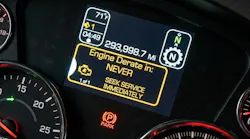
- replace engine derates with audible dashboard warnings
The changes are expected to save fleets thousands of dollars per truck and alleviate significant service bay headaches.
While the industry is united on those cost-saving measures, 2027 powertrain strategies vary as manufacturers still face the EPA’s requirement to reduce nitrogen oxide (NOx) emissions to 0.035 grams per horsepower-hour starting January 1, 2027. That is a more than 85% NOx reduction from current standards.
The division centers on the EPA’s proposed non-conformance penalties (NCPs). If finalized, NCPs would serve as a financial safety valve, allowing manufacturers to pay a per-engine fee to sell equipment that falls short of the stringent new standard. OEMs can also use banked emissions credits earned in recent years for selling equipment that is more efficient than the EPA rules currently on the books.
This regulatory limbo is already disrupting the traditional fall order season. Preliminary September Class 8 net orders hovered between 18,700 and 21,300 units, according to ACT Research and FTR Transportation Intelligence. While underlying demand remains solid because of aging equipment and firmer freight rates, the end of the 2026 prebuy has kept the industry in a state of uncertainty, dating back more than a year to when the Trump Administration began a large deregulation push.
With surcharge-free 2026 engine build slots effectively sold out, OEMs are opening their 2027 order boards before the EPA finalizes its rules—meaning pricing is still fluid. FTR estimates that utilizing NCPs could result in a $6,000 to $7,000 pass-through cost for fleets, compared to an $8,000 to $12,000 upcharge for 2027-compliant engines.
While NCPs could help fleets save some initial costs in 2027, the only OEM opposed to the penalty option is reminding its customers that past NCPs were vacated during 2012 regulations transitions when a federal judge ruled they are not designed to bail out manufacturers that choose not to adopt a compliant technology.
“Fleets are eager to replace aging equipment and prepare for cost increases on the horizon, but the lack of regulatory clarity is making it difficult for them to plan effectively,” noted Carter Vieth, an ACT Research analyst.
The NCP pathway has forced OEMs to choose between two strategies: rely on the penalties to buy time and ease the financial burden on customers, or push ahead with compliant, premium-priced engines.
FleetOwner reviewed manufacturer regulatory filings in response to amendments and reached out to the major North American heavy-duty engine makers to map out their 2027 compliance plans. Here is how the market is splitting. You’ll find links to past FleetOwner coverage for the OEM’s that have announced their EPA 2027 powertrain specs and their public comments to regulators.
EPA 2027 Regulatory Roadmap
The EPA published its Notice of Proposed Rulemaking (NPRM) in the Federal Register in July. Fleet leaders and industry stakeholders can review the full 1,000-page proposal, the regulatory impact analysis, and thousands of submitted OEM and public comments via the links below:
- Federal eRulemaking Portal: Docket ID EPA-HQ-OAR-2026-0728
- EPA official hub: Proposed Rule Amendments and Nonconformance Penalties overview
- Federal Register notice: Amendments and Nonconformance Penalties for Model Year 2027
Cummins
Cummins, the industry’s largest independent engine supplier, told regulators it would rely on NCPs and banked emissions credits to meet the 35 mg NOx standard. Noting that its X15 engine is supplied to 17 OEMs and 29 different chassis serving dozens of applications, the engine maker stated it needs more time to ramp up production in 2027.
“Cummins supports a phased transition to the 2027 low-NOx requirements that maintains product availability, supports OEM production schedules, and meets customer needs,” a Cummins spokeswoman told FleetOwner. “NCPs are one of the proposed implementation flexibilities that can support this measured transition as we scale production and industrialize new HELM engines. Our long-term product strategy has not changed.”
Daimler Truck North America: Freightliner, Western Star, and Detroit
Daimler Truck North America (DTNA), parent company of Freightliner and Western Star trucks and Detroit powertrains, opposes the NCP pathway. The Detroit-branded manufacturer told FleetOwner this week that it is confident in its approach to meeting EPA 2027 requirements with its Detroit Gen 6 powertrain.
The company, whose Freightliner brand holds the largest Class 8 market share, warned regulators that NCPs create a legal risk, arguing that using penalties for economic preference rather than technological limitations invites federal litigation. DTNA is sticking with its compliance strategy and advises fleets eyeing 2027 build slots to do the same.
“We believe meeting the EPA 2027 emissions standards is the path forward,” Daniel Potter, DTNA’s head of regulatory affairs for emissions, said during a recent media briefing. “Buying a Detroit engine and a Freightliner provides you certainty today. We meet the only law that’s on the books today, and that means you can guarantee you will have an engine, and you can guarantee you know what that engine is going to be and what it’s going to cost.”
The new Detroit Gen 6 engines meet the 2027 EPA standards already on the books, according to DTNA, while also improving fuel efficiency up to 3% compared to the Gen 5 powertrains.
When asked by FleetOwner if the new Detroit Gen 6 engines will strictly emit 35mg NOx/hp-hr out of the factory, or whether DTNA plans to lean on banked emissions credits alongside the new hardware, a DTNA spokesman clarified the company’s position:
“Credits have always been a legitimate and established part of our overall compliance strategy, consistent with regulatory frameworks and industry practice. They are widely used across the industry and provide important flexibility. By leveraging credits responsibly, we are able to support compliance across our entire product portfolio while continuing to invest in clean, efficient powertrain technologies. Credits complement, not replace, our engineering efforts and help ensure a balanced, compliant approach.”
What’s currently on the books for EPA 2027?
If EPA does not finalize its proposed amendments, the original 2027 Clean Truck Plan regulations finalized in 2023 would take full effect on January 1, 2027. Under this baseline rule:
- Stricter NOx limits: Nitrogen oxide (NOx) emissions must drop from the current 0.2 grams to 0.035 grams per horsepower-hour (an 85% to 87% reduction).
- Stricter PM limits: Particulate matter (PM) limits are cut in half, dropping from 0.01 to 0.005 g/hp-hr.
- Extended warranty mandates: Emissions warranty coverage would see a massive hike, extending from the current 5 years/100,000 miles to 10 years/450,000 miles for heavy-duty diesel engines.
- Extended useful life: OEMs must immediately validate that their emissions control systems will function for an extended "full useful life" period.
- Strict DEF inducements: Engines must be programmed to institute severe speed limits and engine derates if the vehicle runs out of diesel exhaust fluid (DEF) or if the system detects tampering or malfunction.
International Motors
International Motors (recently rebranded from Navistar under parent company Traton Group) was the first OEM to announce its powertrain—the S13 Integrated Powertrain—will be 2027 compliant. But the manufacturer told regulators it generally supports NCPs next year but opposes combining them with emissions credits.
When asked about 2027 production plans if NCPs are not approved or become more expensive, an International spokeswoman told FleetOwner the company is “prepared to adjust our plans to meet customer demands if the final rule differs significantly from the NPRM language.”
The OEM is currently taking orders for Q1 2027 production of S13-powered units using the flexibility provided in the proposed rule. “Our Huntsville Powertrain Plant has been assembling prototype versions of the updated S13 on the same production line as the current S13 engine,” the spokeswoman said. “This reflects the approach International took to remain flexible for new regulations since we first launched the S13 Integrated Powertrain in 2022. This helped us prepare for a smooth transition to the EPA27 S13 and keep up with the growing customer demand for this powertrain.”
Navigating the next 15 months will require heavy dealer involvement, the company added: “We recommend our customers research available options to discuss with their International dealer. The uncertainty makes for a challenging landscape, and we stand ready to assist customers with reviewing the best options to meet their needs.”
What would the proposed EPA27 amendments change?
If finalized, the EPA’s July 2026 proposed amendments would maintain the strict new emissions caps but offer significant financial and operational relief to both manufacturers and fleets.
- Warranty relief: The costly 10-year/450,000-mile emissions warranty mandate would be canceled, reverting to the current 5-year/100,000-mile standard for HHD engines. The EPA estimates this alone could lower the cost of new diesel trucks by $4,000 to more than $6,000.
- Useful life delay: The planned increase in full useful-life requirements would be pushed back from 2027 to 2030.
- DEF inducement relaxations: Mandatory vehicle speed limits and engine derates for DEF issues would be eliminated. By 2029, they would be replaced entirely with an audible dashboard chime and visual warnings.
- The NCP loophole: The EPA would authorize non-conformance penalties (NCPs). This would act as a financial safety valve, allowing OEMs to continue selling pre-2027 baseline engines by paying a per-engine fee (expected to land between $6,000 and $7,000) instead of meeting the 35mg NOx standard.
Paccar: Kenworth and Peterbilt
Paccar—parent company of Kenworth and Peterbilt trucks—told regulators it would not be able to meet the stringent standards by 2027 because of an “immature” supply base to support its chosen technology.
However, during a second quarter earnings call in July, Paccar leaders told analysts they believe the NCPs would give customers a cost advantage.
“We are planning on selling the current product to our customers,” Paccar CEO Preston Feight said. “That’s the engagement we’ve had with many, many customers—is that their preferred approach is to ease into this thing.”
He noted that customers want to ease into 2027 after years of market volatility, calling the EPA’s proposed amendments “a great approach for the industry.”
A Paccar spokesperson declined an opportunity to speak with FleetOwner about its truck brands’ plans.
Volvo Group: Mack and Volvo
Volvo Group, which includes Mack Trucks and Volvo Trucks North America (VTNA), detailed each OEM’s 2027 engine compliance plans at ACT Expo in May. The company told regulators it could offer customers some 2026 carryover configurations where capacity permits through NCPs as its factories ramp up compliant engine production to meet demand.
Mack Trucks is positioning its 2027 roadmap around transition flexibility and customer choice. Throughout 2027, Mack customers will continue to have access to the OEM's legacy portfolio—including the Granite, Pinnacle, Anthem, and Pioneer—with a next-generation EPA27 powertrain, with deliveries of the fully compliant 35mg engine slated for the end of Q1 2027.
“Our strategy is centered around the customer’s choice throughout the transition to EPA27,” a Mack Trucks spokeswoman told FleetOwner. “At the same time, we recognize the market and regulatory concerns surrounding the new technology, and believe the flexibility provided by the NPRM will allow the industry to make this transition in a stable way… By utilizing the transition provisions available with the proposed rule, we can continue supporting existing customer needs while enabling a measured adoption of new technologies. This balanced approach reduces customer risk, builds confidence in new engines, and provides additional time to strengthen product performance and reliability further.”
Mack’s 2027-compliant MP13 engine could deliver up to 3% in additional fuel savings, depending on the application, Mack leaders said in May.
VTNA is taking a parallel track, keeping order books open for compliant equipment while leveraging proposed federal flexibility as a buffer.
“Sustainability has always been a core focus for Volvo Trucks, and EPA 2027 marks another step toward reducing environmental impact across the transportation industry," Magnus Koeck, VTNA VP of strategy, marketing, and brand management, told FleetOwner. "Importantly, customers can order our fully compliant, 35mg NOx, EPA27 engine today. With EPA's proposed 2027 regulations, our customers will now have the flexibility to choose between our EPA24 solution and our new EPA27 solution. We remain committed to helping customers navigate the evolving regulatory landscape while providing guidance on the technical solution that best supports their business needs."
VTNA’s 2027 engine builds will continue to produce the EPA 2024 D13 version, along with the introduction of the EPA 2027 Volvo D13 platform for the Volvo VNL and Volvo VNR tractors, which supports its previous fuel efficiency gains of up to 10%.
About the Author
 Josh Fisher
Josh Fisher
Editor-in-Chief
Editor-in-Chief Josh Fisher has been with FleetOwner since 2017. He covers everything from modern fleet management to operational efficiency, artificial intelligence, autonomous trucking, alternative fuels and powertrains, regulations, and emerging transportation technology. Based in Maryland, he writes the Lane Shift Ahead column about the changing North American transportation landscape.