EPA 2027 explained: What unresolved regulations and NCPs mean for future truck orders
Key takeaways
- The 2027 emissions countdown: The EPA's low-NOx rule is on schedule for January 2027, mandating an 85% to 87% reduction in nitrogen oxide emissions down to 0.035 grams per horsepower-hour.
- Costly compliance vs. unfinalized loopholes: Fully compliant 2027 engines are expected to add up to $15,000 to vehicle costs. Meanwhile, proposed non-conformance penalties (NCPs) are expected to cost $6,000 to $7,000 and offer a cheaper but legally uncertain alternative.
- Regulatory volatility: Proposed EPA amendments aimed at providing financial relief—such as canceling a 10-year emissions warranty mandate and removing DEF engine derates—have no legal effect until the EPA publishes a final rule.
- A fractured OEM market: While several major engine builders filed comments supporting the NCP pathway to shorten production timelines, Daimler Truck North America is pushing ahead with its fully compliant Gen 6 Detroit powertrain to give fleets regulatory and ordering certainty.
MADRAS, Oregon—The trucking industry’s low-NOx heavy-duty future is just three months from ignition. Fleets and OEMs were originally given years to plan for the Environmental Protection Agency’s (EPA) massive 2027 nitrogen oxide (NOx) emission regulations. But unresolved EPA amendments injected more volatility into fleet planning as 2026 fades.
Daimler Truck North America (DTNA) detailed how its 2027 powertrain—the Detroit Gen 6—reduces NOx emissions from 200 milligrams to 35 milligrams per horsepower-hour before a potential federal loophole emerged. Some truck competitors support the EPA’s proposal to allow fleets to buy pre-2027 equipment next year, with price penalties below EPA27-compliant factory costs. The Freightliner and Western Star parent is sticking with its compliance strategy and advises fleets eyeing 2027 build slots to do the same.
“We believe that meeting the EPA 2027 emission standards is the path forward,” Daniel Potter, DTNA’s head of regulatory affairs for emissions, said during a media briefing at the OEM’s High Desert Proving Grounds. “Buying a Detroit engine and a Freightliner provides you certainty today in any DTNA product… When you buy our product, we meet the only law that’s on the books today, and that means you can guarantee you will have an engine, and you can guarantee you know what that engine is going to be and what it’s going to cost. All of that can’t be said for anybody else who’s relying on a theoretical rule change.”
The “theoretical rule change” Potter referred to is part of a Trump EPA-proposed amendment package published in July. The proposal maintains the strict 2027 NOx emission limits and January 1 implementation but also offers the industry a financial extension.
The EPA is weighing provisions to rescind costly extended warranty requirements, delay longer useful-life mandates until 2030, and replace engine derates with audible driver warnings. The proposal also introduces non-conformance penalties (NCPs) for medium- and heavy-duty diesel engines, allowing manufacturers to pay per-engine fees to sell equipment that falls short of the 35mg NOx mark.
The potential NCP fee could be about half the expected cost increase for compliant engines, based on various OEM and industry estimates. But no manufacturer has announced final engine pricing as it waits to see what regulators do with the proposed amendments.
But with most 2026 Class 8 build slots spoken for across North America, fleets face an equipment squeeze heading into 2027.
Here is an explainer, based on conversations and briefings with DTNA executives in the Oregon desert, outlining the current regulatory landscape, the financial stakes of proposed non-conformance penalties (NCPs), and where OEM compliance strategies are beginning to fracture.
Federal regulatory reality: Navigating the NHTSA and EPA divide
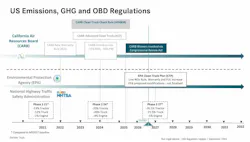
The Trump EPA fundamentally altered the emissions landscape when it eliminated all CO2 standards for heavy-duty vehicles and engines. When the agency rescinded its 2009 endangerment finding, it effectively vacated existing greenhouse gas rules. But that did not mean the trucking industry could shift its focus away from efficiency.
The National Highway Traffic Safety Administration (NHTSA) oversees its own vehicle and engine fuel economy regulations parallel to the EPA’s Greenhouse Gas Phase 2 requirements. This means OEMs, such as DTNA, are still legally obligated to meet those standards.
As regulatory uncertainty continues—NHTSA issued an interpretive rule in August stating it lacks the statutory authority to set fuel economy standards for engines—the broader vehicle fuel economy rule remains firmly in effect.
According to Potter, the anticipated removal of engine-specific fuel economy regulations will not pause industry-wide product evolution. NHTSA vehicle fuel economy rules will continue to govern truck design and drive spec’ing restrictions for fleets buying newer vehicle models.
State-level pressure also shifted this year. The California Air Resources Board’s (CARB) heavy-duty transport requirements were deprioritized for this planning cycle after Congress revoked California’s regulatory waivers in 2025.
Proposed EPA 2027 amendments and fleet relief
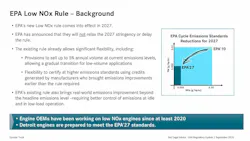
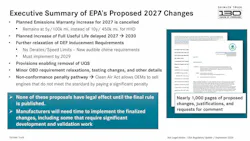
Despite the CO2 rollback, EPA’s 2027 low-NOx rule remains on schedule for January 2027, reducing NOx from 200 mg to 35 mg per hp-hour—an 85% to 87% reduction. However, EPA proposed significant amendments to reduce costs and create fleet flexibility. DTNA officials emphasized that none of these proposals have legal effect until EPA publishes a final rule.
The proposed EPA 2027 amendments include:
- Warranty relief: Cancels the planned emissions warranty increase for heavy-duty engines, retaining five years/100,000 miles instead of 10 years/450,000 miles.
- Useful life delay: Pushes the planned increase for full useful life requirements from 2027 to 2030.
- DEF inducement relaxations: Removes derates and speed limits for diesel exhaust fluid (DEF) issues and replaces them with an audible chime requirement by 2029.
- Sensor removal: Implements provisions to enable removal of urea quality sensors (UQS).
Non-conformance penalty (NCP) loophole
The most debated element of EPA’s proposed changes is adding a non-conformance penalty (NCP) pathway that allows engine manufacturers to continue selling non-2027-compliant powertrains with a monetary penalty. The Clean Air Act permits NCPs when a new standard is technologically infeasible for a manufacturer to meet.
The original 2027 rule already permitted manufacturers to sell up to 5% of their annual volume at current emissions levels alongside emission credit-banking provisions.
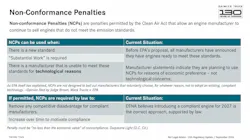
However, DTNA leaders warned that the current push for full NCP allowance carries legal risk. Potter outlined key risks associated with NCPs:
- Economic vs. technical constraints: DTNA argues competitors plan to use NCPs for economic preference rather than technological limitations. Before EPA’s amendment proposal, all major truck OEMs had publicly said they could meet the 2027 standards. (Those that have not released details yet on their 2027 engine have said over the past 18 months that they would be ready.)
- OEM stances: Comments submitted to the EPA docket reveal that at least two U.S. manufacturers said they cannot meet the 35mg standard or would have to stop engine production if the NCP is not finalized.
- Cost discrepancy: Industry estimates suggest a fully compliant 2027 engine could add $10,000 to $15,000 to vehicle costs. With proposed NCPs expected to cost $6,000 to $7,000 per truck, DTNA believes the penalties are priced too low and create an artificial economic advantage for non-compliant engines.
- Litigation history: Federal courts have litigated and vacated NCPs before, most notably in 2012, when a judge ruled they “are not designed to bail out manufacturers that voluntarily choose, for whatever reason, not to adopt an existing, compliant technology.”

 Ken Vieth at the National Private Truck Council
DTNA’s 2027 strategy: A compliant Gen 6 powertrain
To insulate fleets from regulatory uncertainty and the legal risks related to NCPs, DTNA certified its 2027 equipment to the rules currently in effect. The manufacturer of Freightliner and Western Star trucks plans to launch its fully compliant Gen 6 Detroit powertrain on January 1, 2027.
- Vision and testing: Gen 6 will enter production after more than 9 million real-world test miles and 60,000 bench hours. Tests spanned highway, regional, pickup-and-delivery, and vocational applications.
- Familiar technology: Replacing the Detroit Gen 5 platform, the Gen 6 provides a clear path forward for orders and planning without customers depending on an uncertain NCP pathway.
- Performance focus: According to Steve Collins, head of Detroit field sales engineering, the new engine prioritizes “performance, efficiency, reliability, and doing all of that while sticking with known, proven, and familiar technology.”
About the Author
 Josh Fisher
Josh Fisher
Editor-in-Chief
Editor-in-Chief Josh Fisher has been with FleetOwner since 2017. He covers everything from modern fleet management to operational efficiency, artificial intelligence, autonomous trucking, alternative fuels and powertrains, regulations, and emerging transportation technology. Based in Maryland, he writes the Lane Shift Ahead column about the changing North American transportation landscape.