Class 8 prebuy window slams shut as 2026 build slots sell out

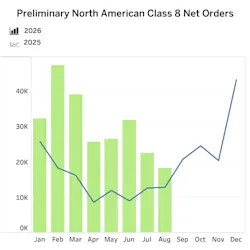
The prebuy scramble to secure current equipment ahead of EPA 2027 reached its limit this summer. August Class 8 orders dipped noticeably from earlier summer highs, but analysts emphasize the slowdown reflects sold-out 2026 build slots rather than cooling carrier demand.

Key takeaways

  • Seasonality and sell-outs: Class 8 preliminary orders retreated in August compared to July but surged 42% year over year.
  • Capacity crunch: 2026 backlogs are heavily oversubscribed, meaning weak monthly orders reflect a lack of available build slots rather than weak demand.
  • Medium-duty strength: Classes 5-7 orders reached 20,000 units, marking a marked improvement over early 2026 trends.
  • The 2027 shift: With the 2026 order season over, fleets must now weigh the costs of fully compliant EPA 2027 engines against current-technology engines with noncompliance penalties.
The 2027 Class 8 prebuy is over.

The scramble for 2026 commercial vehicles reached the OEM production capacity limit this summer, according to industry research firms that track truck orders.

While North American fleets placed fewer Class 8 vehicle orders in August than earlier this summer, the decline largely signals the end of the 2026 order season—not a collapse in underlying demand, according to the data.

August Class 8 preliminary orders retreated month over month as manufacturers prepared to open 2027 order boards, closing the door on the EPA 2027 NOx prebuy window.

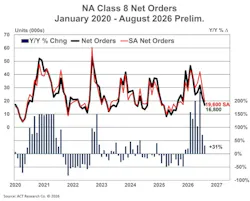
Summer slowdown or sold-out boards: Preliminary data from FTR Transportation Intelligence shows Class 8 orders totaled 18,200 units in August. ACT Research’s preliminary data pins the order board at 16,800 units. While FTR’s figures are down 19% from July, they remain up 42% year over year. Through August, orders in 2026 were up 111% from the same period in 2025, according to FTR.

The backlog bottleneck: The month-over-month decline does not indicate a sluggish equipment market. Fleets are now running into oversubscribed 2026 backlogs and a lack of open build slots. July-ending data showed the second-half 2026 backlogs were oversubscribed by about 35,000 units.

What analysts think: “Demand for new equipment remains strong, supported by meaningfully improved freight rates,” Carter Vieth, research analyst at ACT, said. “While largely driven by severe contractions in the driver supply earlier this year, the Montgomery SCOTUS decision, stricter ELD/HOS rule enforcement, and new carrier registration rules have also added to supply constraints and rate improvement through 2026.”

  • Fleet profits: Aiding the equipment demand is a recovery in fleet profitability; Q2 earnings from publicly traded truckload carriers highlighted aggregate net profit margins hitting a nearly three-year high.
  • Economic tailwinds: Despite headwinds in housing and consumer spending, Vieth noted that the “recovery in U.S. manufacturing and the data center/utility buildout are marginally aiding the demand side of the freight equation.”

The ‘27 engine dilemma: Now that 2026 build slots are largely full, fleet attention turns to Model Year 2027 equipment prices and OEM capacity. Carriers could face a choice between fully compliant EPA 2027 technology and current-generation engines supported by noncompliance penalties (NCP).

Fleets face higher costs: EPA’s proposed flexibility could reduce transition risk—but at a premium. A fully compliant 2027 powertrain adds an estimated $8,000 to $12,000 to Class 8 price tags, while noncompliance penalties could add $6,000 to $7,000 per engine.

“The main issue now is incremental cost,” Dan Moyer, senior commercial vehicle analyst at FTR, noted. “OEM strategies are diverging as some have decided to offer both EPA 2027-compliant engines and current-technology engines with NCPs while at least one manufacturer plans to offer only a fully compliant option.”

He cautioned that EPA’s July proposal could still see changes to the NCP levels and provisions, impacting the final compliance framework and associated costs.

Commercial vehicle market notes

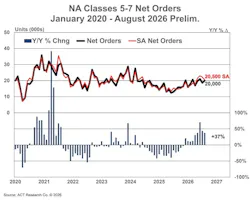
  • Medium-duty keeps pace: Medium-duty preliminary orders rose 37% year-over-year in August, hitting 20,000 units. ACT noted this marks four months of orders north of 20,000 units, a significant jump from the 16,000-unit order trend at the beginning of 2026. This timing suggests fleets and dealers are also working to get ahead of 2027 regulations in the medium-duty segment.

  • End of the 2026 order season: Over the past 12 months, Class 8 orders totaled 350,677 units, according to FTR. The close of the 2026 order season marks the “effective end of the EPA NOx prebuy,” Moyer said.

  • Still preliminary: Both research firms expect to finalize these figures by midmonth.

About the Author

Josh Fisher

Josh Fisher

Editor-in-Chief

Editor-in-Chief Josh Fisher has been with FleetOwner since 2017. He covers everything from modern fleet management to operational efficiency, artificial intelligence, autonomous trucking, alternative fuels and powertrains, regulations, and emerging transportation technology. Based in Maryland, he writes the Lane Shift Ahead column about the changing North American transportation landscape. 

Sign up for our eNewsletters
Get the latest news and updates

Voice Your Opinion!

To join the conversation, and become an exclusive member of FleetOwner, create an account today!