What makes this freight market cycle strange?
Key takeaways
- For-hire trucking is just out of the bottoming phase of a market cycle.
- Heating freight demand would normally complement the next phase of the market cycle, but demand remains subdued.
- Pockets of freight demand, such as data center construction, remain good news for some carriers running flatbeds.
- ACT Research says the market's supply-driven nature could make it more sensitive to seasonal changes.

For-hire rates are up, and contract rates are following. Trucking capacity remains low, and federal enforcement shows no signs of letting up.
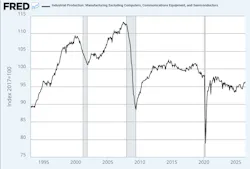
A traditional freight recovery would probably see freight demand rising, but that isn’t the case so far. Low supply and flat demand, if both persist, could create an interesting market cycle—perhaps a slower one, more subject to seasonality.
"We think the cycle is going to be stronger for longer," ACT Research's Tim Denoyer, VP and senior analyst, told attendees at the firm's recent Market Vitals seminar.
Here are some of the mechanics driving this unique freight cycle, with a focus on freight demand.
A market cycle with flat demand?
The end of the long freight recession means the beginning of an upcycle for for-hire trucking. What does that mean for a market with flat demand?
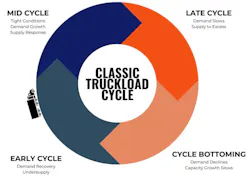
Standard truckload cycles can generally be split into four phases: bottoming, early cycle, mid cycle, and late cycle. As illustrated by ACT’s graph, for-hire trucking is just out of the bottoming phase.
“We spent a good three years in that bottoming phase, roughly 2022 to 2025. It was late last year that we made that transition to early cycle, and we think it was a reduction in both equipment supply and driver supply that led to it,” Denoyer said.
According to Denoyer, trucking’s early cycle is typically sparked by shrinking for-hire supply. The shift to mid-cycle relies on strengthening freight demand. Today, that demand remains muted.
Following the latest American Trucking Associations Truck Tonnage Index, for example, ATA’s Chief Economist Bob Costello called freight levels “choppy” and “lackluster.”
Shrinking contract rate lag
An important sidebar from Denoyer’s presentation in the seminar: Shippers are turning to shorter-term contract windows.
Spot rates typically tend to lead contract rates by a few months, but the lead time is shrinking. As for-hire rates are more volatile, shippers and carriers are compressing the typical lag between contract and spot rates.
“The [spot-contract] lag was longer in the past but, this time around, it has tightened up quite a bit,” Denoyer said. “That is basically a result of shortening lengths of contracts. Contracts aren’t really holding up. Shippers are holding a lot of mini bids. Contracts are lasting three months instead of a year, and so contract is catching up faster.”
Denoyer called it “Generally good news for the for-hire profitability and equipment demand, because it used to take longer for their [contract carriers’] finances to improve.”
“We typically see undersupply as the main factor driving the early cycle transition, but we typically see demand lead the transition from early cycle to mid cycle, and we’re not seeing that yet. I worry a little bit about some macro risks that could push us backward,” Denoyer said. “But the cycle is pretty good about moving forward, and arguably we should have a demand recovery at some point.”
However, “in general, demand is still not great,” Denoyer said. “Income is not growing very much. Population is not growing very much. There are pockets of strength, of course.”
Pockets of strength for freight demand
ATA's Costello used the same phrase in that latest Truck Tonnage Report. Dean Croke’s recent DAT Freight & Analytics blog succinctly used the same phrase as Denoyer, too: “Outside a few pockets of strength, most notably data center construction tied to the AI buildout, the underlying freight economy remains soft.”
For those pockets, the news isn’t all bad. The ISM Manufacturing Purchasing Managers’ Index, for example, has expanded for seven consecutive months.
“Even if freight volume is broadly flat, recovering the ISM Manufacturing Index this year—after three years neutral to down—is a welcome reprieve,” Carter Vieth, analyst for ACT Research, noted during the seminar.
Vieth also pointed to the other good freight news: a massive national data center buildout.
 ken vieth ACT Research video thumbnail
 Diesel prices drop, but trucking fleets face continued fuel market volatility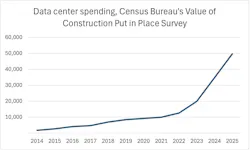
The Census Bureau’s Value of Construction Put in Place Survey has recorded an explosion of data center spending since the centers became a standalone category in 2024. Those builds are driving heavy-haul and flatbed demand, offsetting the construction market’s cold single-family housing environment.
Seasonality a major factor for this freight cycle
Denoyer predicts that capacity constraints will continue to dictate rate behavior. Major factors could include federal enforcement and seasonal lulls in driver availability.
With CDL and driver qualification crackdowns, the industry’s eyes remain on the federal government’s ability to squeeze for-hire capacity.
“The question from here is: Are they going to stay at this level [of enforcement]? Because if they stay at these kinds of levels for the next two years, which is possible, we’re going to see a much tighter driver market and much higher freight rates,” Denoyer said.
And, with higher load-to-truck ratios, calendar swings could have much larger impacts on rates.
“I think a general feature of this cycle is, because it’s supply-driven, it’s going to be more sensitive to seasonality,” Denoyer said.
Denoyer suggested rates would be soft throughout Q3, a seasonally soft time for demand, and could heat up near Thanksgiving when for-hire supply tends to tighten.
“I think this year we’re going to see it in an amplified fashion because truckers are not profit maximizers,” Denoyer said. “Many are … but the average driver takes more vacation when they’re making more money and drives more when they’re making less money.”
About the Author
 Jeremy Wolfe
Jeremy Wolfe
Editor
Editor Jeremy Wolfe joined the FleetOwner team in February 2024. He graduated from the University of Wisconsin-Stevens Point with majors in English and Philosophy. He previously served as Editor for Endeavor Business Media's Water Group publications.