Is there a trucking capacity illusion?
Key takeaways
- Capacity Squeeze vs. Demand Growth: Rising freight rates are driven by a sharp contraction in carrier supply rather than organic volume growth, as Q2 national shipments fell 2.8% year over year.
- Macro Headwinds Ahead: Sustained diesel prices, compounding tariff friction, and ongoing USMCA uncertainty continue to pressure fleet operating margins through late 2026.
- 2027 Strategic Priorities: Long-term carrier success into 2027 depends on internal cost control, AI-driven dispatch efficiency, and driver retention rather than relying on rate hikes alone.

The freight market is showing signs of life as we head into the final months of 2026. But don’t mistake a capacity squeeze for a true demand boom.
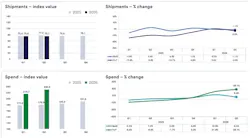
Summer data shows a market defined by contraction—not growth. According to the U.S. Bank Freight Payment Index, national shipment volumes fell 1.1% in the second quarter of 2026 and are down 2.8% year over year. American Trucking Associations’ (ATA's) For-Hire Truck Tonnage Index followed a similar path, dipping 1% in July.
Despite this lackluster freight volume, rates and shipper spending surged in the first half of 2026. U.S. Bank reported that shipper spending jumped 28.1% year over year in Q2. While broker-posted spot rates declined this summer, a severe, ongoing supply-side squeeze is driving the upcycle. Uncertainty still looms deep into 2026.
“Tonnage levels have been choppy recently, and this trend was reflected in July’s decline,” noted ATA Chief Economist Bob Costello. “Aside from a couple pockets of strength, including the boom in data center construction for AI, freight has been lackluster. It is also true that the industry is seeing a recovery, but that is nearly all due to excess capacity leaving the market.”
Regulatory crackdowns accelerate capacity exits
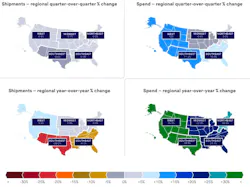
After undercapitalized carriers that couldn’t survive the more than three-year freight recession left the market in recent years, 2026 has seen regulatory actions continue to push more fleets out of business or into consolidation. Increased English-language provisions, non-domiciled CDL revocations, and a crackdown on Mexican B-1 visa cabotage violations sidelined significant capacity—particularly in the Southwest. The region saw Q2 shipments fall 20.2% year over year, yet shipper spending rocketed 39.9%.
Adding to this was the Supreme Court’s Montgomery v. Caribe Transport II ruling in May, which clarified that brokers nationwide could face scrutiny over carrier selection. Risk-averse brokers spent the summer reassessing independent owner-operators and other small carriers, driving many to partner with larger, better-vetted fleets.
“When demand jumps up, shippers really need capacity because they’re missing sales ... and so they’re a bit more willing to pay rate increases to get that capacity,” Knight-Swift CEO Adam Miller recently explained to analysts. “In the market today, we’re moving the same goods for the same sales [but with] a lot fewer trucks to service that. And so you have to really negotiate and push to get the rates that you need.”
Macro headwinds cloud the road to 2027
While a tightened driver pool bolsters rates, artificial capacity constraints cannot shield fleets from broad macroeconomic drag:
- Persistent fuel costs: The U.S.-Iran quagmire, which has stretched for over half a year and kept diesel prices high, is just the latest hurdle thrown in front of motor carriers living on the edge of economic stability.
- Depressed consumer demand: More than a year of compounding tariffs has slowed overall economic growth and driven up replacement equipment and parts costs, leaving consumers buying less.
- Cross-border turbulence: The United States-Mexico-Canada Agreement (USMCA) faces a contentious review process, casting doubt over the $1 trillion cross-border trucking market as the U.S. and Canada exchange aggressive tariffs in an escalating trade dispute.
Even with all these policy hurdles creating more freight market recovery speed bumps, the trucking industry is still looking at a gradual, linear recovery for the most efficient operators.
“We expect the market to be favorable for carriers throughout our two-year forecast horizon, but the recovery appears to be stabilizing,” Avery Vise, FTR Transportation Intelligence VP of trucking, said this month. “For example, spot rates in July softened as seasonally expected even though fuel prices rose sharply—quite a different dynamic than what occurred in March. Even if spot rates have peaked, contract rates likely will continue to rise well into 2027.”

 lose-up of a worker with the head of match that is burned out but still smoking, representing modern worker burnout
Strategic priorities for 2027
To protect operating margins against rising equipment procurement and maintenance costs, carriers cannot rely on rate hikes alone. Fleets must focus on:
- Driver retention: Protecting core driver pools before competition tightens further next year.
- Asset optimization: Prioritizing preventive maintenance schedules to curb unexpected capital outlays.
- Operational efficiency: Exploring and deploying the right AI tools to improve dispatching and dynamic routing to minimize empty miles.
Fleets that spend the final months of 2026 optimizing operations and capacity will be the carriers set up to win 2027.
About the Author
 Josh Fisher
Josh Fisher
Editor-in-Chief
Editor-in-Chief Josh Fisher has been with FleetOwner since 2017. He covers everything from modern fleet management to operational efficiency, artificial intelligence, autonomous trucking, alternative fuels and powertrains, regulations, and emerging transportation technology. Based in Maryland, he writes the Lane Shift Ahead column about the changing North American transportation landscape.