USMCA uncertainty looms over cross-border freight
Key takeaways
- USMCA's non-renewal by the U.S. has led to an annual review process that could make North American trade uncertain for several years.
- Ongoing negotiations could result in major revisions to USMCA rules.
- The U.S. has met with Mexico several times to negotiate, but not so much with Canada.
- Economic uncertainty from trade disputes causes businesses to delay investments, hiring, and expansion plans.
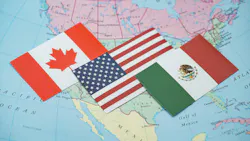
COLUMBUS, Indiana—The United States-Mexico-Canada Agreement (USMCA) is no longer reliable. The countries failed to ratify the agreement for the next 10-16 years, triggering a more chaotic annual review process.
That means more uncertainty for business investment and a less steady market for cross-border freight, according to an ACT Research workshop on North American trade as part of the company’s 75th seminar.
“We have an agreement that’s meant to have long-term certainty over the next years … but the story has changed,” David Teolis, chief economist for ACT Research, told attendees.
The next decade or more of North American trade is open for revision as the countries enter what will likely be a long negotiation process. The U.S.’s $1 trillion cross-border trucking market hangs in the balance.
 Private fleets grow as shorter hauls reshape trucking operations and efficiency
 Diesel prices surge as U.S. diesel market tops $100 per barrel for first time
The USMCA non-renewal story so far
USMCA’s ratification deadline passed, so what does that mean?
The North American countries implemented the United States-Mexico-Canada Agreement (USMCA), the successor to the North American Free Trade Agreement, in 2020 and designed it to last 16 years, until 2036.
One of USMCA’s stipulations was that the three countries would convene in 2026 to decide whether to ratify the agreement for its final years. In July, Mexico and Canada opted to ratify the agreement for 16 years through 2042, while the U.S. declined to renew the USMCA.
Because of the U.S.’s rejection, USMCA now faces an annual ratification process. The agreement remains effective, but the countries must conduct additional annual joint reviews. Those annual reviews last either until USMCA terminates in 2036 or until the countries agree to extend USMCA for another 16 years.
The rejection has also prompted negotiations between the countries—at least between Mexico and the U.S.
Where does this hit truck freight?
The U.S. refusal to ratify is an ill omen for business confidence in a major sector of international commerce and freight demand.
North American transborder trucks moved $104.4 billion in goods in June of this year alone, up 23% year over year. Roughly 16% of the U.S.’s total exports go to Canada, and 14% of U.S. exports go to Mexico. About 75% of Canada’s exports and 80% of Mexico’s exports go straight to the U.S.
USMCA insulates North American trade from most tariff impacts. U.S. Customs and Border Protection’s measure of trade agreement utilization rates estimates that over 80% of total imports are covered by USMCA. Covered goods include anything from agriculture to commodities, software, manufactured goods, and, naturally, automotive activity.
Any major revisions to USMCA could have multibillion-dollar repercussions. Those imports and exports matter for cross-border fleets, but they also have huge repercussions for large swathes of other U.S. businesses—and, ultimately, their freight demand. Just as several companies bunkered down in wait-and-see mode around tariff chaos since Trump’s inauguration, USMCA chaos could further disturb investment confidence.
What will happen to USMCA, cross-border freight?
For now, the countries plan to continue discussions around changes to the trade agreement.
According to Reuters, Mexico and the U.S. have already held three talks on USMCA and have a fourth discussion planned for September, but the countries are still far apart on their sticking points. The latest talks have excluded Canada. The U.S. and Canada are still working through separate (but equally messy) trade talks over tariffs.
U.S. Trade Representative Jamieson Greer has suggested that the U.S. will try to make interim trade deals with Mexico and Canada by the end of this year, dragging negotiations for USMCA proper into 2027.
Depending on how those negotiations shake out, any changes to USMCA could broaden or shrink the range of goods protected from U.S. tariffs. Those changes could affect the price and demand of goods.
The fruits of those USMCA talks might be a lasting agreement for the next 16 years. The talks may bring no breakthroughs, dragging the countries through 10 more years of uncertain, year-by-year negotiations. Maybe the countries will agree to scrap USMCA altogether. It's anybody's guess.
Teolis optimistically thinks that whichever way the next iteration of USMCA may shape out, North American trade will continue to deepen.
“I’m going to be very optimistic that trade will continue in North America … and integration might get even deeper than what we get today,” Teolis said.
One negotiating strength for the U.S. is how much Canada’s and Mexico’s exports rely on U.S. business.
“The leverage is more or less on the U.S. side … but it’s going to get tense at times,” Teolis said.
Some likely sticking points from the U.S.: The government likely wants to introduce new provisions to raise regional content requirements for covered goods and prevent restricted Chinese goods from participating in North American Trade.
“I think [the U.S.] want higher North American content, maybe even higher U.S. content … less Chinese content … stricter automotive rules because automotive trade is huge within North America … and broader international rules,” Teolis said.
More uncertainty for decision-makers
Economic uncertainty and business paralysis were major topics in the wake of the 2025 tariff chaos. USMCA is shaping up to be another source of investment-averse fog.
“This kind of annual review bakes in a period of uncertainty every year,” Carter Vieth, research analyst for ACT Research, told attendees.
When there’s high uncertainty, Teolis said, “you’re going to delay decisions about factories, distribution centers, contracts, hiring workers, capital spending … We want to get rid of that uncertainty and get back to the rules of the game between the countries.”
About the Author
 Jeremy Wolfe
Jeremy Wolfe
Editor
Editor Jeremy Wolfe joined the FleetOwner team in February 2024. He graduated from the University of Wisconsin-Stevens Point with majors in English and Philosophy. He previously served as Editor for Endeavor Business Media's Water Group publications.