
Despite order delays, Daimler plans no significant Q1 downshift
Key takeaways
- EPA 2027 engine uncertainty is prompting some fleets to delay truck orders.
- Daimler Truck expects steady production as freight rates and replacement demand support 2027.
- Supply chain constraints involving engines and axles could shift planned truck production into early 2027.
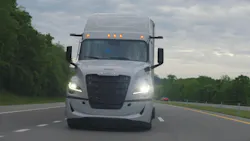
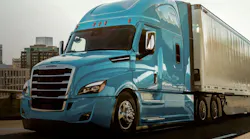
Daimer Truck executives say they do not plan to significantly flex production at their North American plants early next year despite customers placing fewer orders this fall because of uncertainty around final EPA 2027 engine regulations and their effect on prices for the coming year.
On the heels of Daimler Truck’s third-quarter earnings report last week, President and CEO Karin Rådström and CFO Eva Scherer told investors and analysts they are confident in demand well into next year as fleet operators look to replace some of their equipment. On a November 6 conference call, Rådström called freight rates “the most important KPI” for the parent of the Freightliner and Western Star brands and said the fact that they have substantially improved in the past year means “we walk into 2027 quite comfortable that the fundamentals are good.”
That’s despite North American customer orders in the third quarter coming in at about 29,400 units, down from more than 35,000 in Q2 and more than 59,000 in the first three months of 2026. (The Q3 numbers put Daimler’s market share at about 35%, a few points below the company’s long-term average.)
Echoing recent comments from their peers at Paccar and Volvo, the Daimler executives said uncertainty around EPA27 engines and the scale of non-compliance penalties is leading some customers to hold off on ordering at least some of the trucks they otherwise would have committed to by now.
 trucking numbers concept
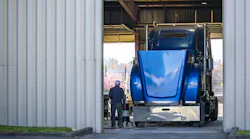
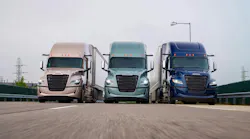
Daimler’s ’27 powertrain, the Detroit Gen 6, complies with the new generation of emissions rules and is being marketed as at least 3% more fuel-efficient. The company has committed to selling only that engine going forward, unlike other manufacturers that are offering customers the flexibility to buy current-year engines and pay a penalty, which they expect the EPA to decide in the next few weeks.
Paccar CEO Preston Feight told analysts late last month that he expects any uncertainty around order flow and engine mix “will show up in the first part of the year, and then clarity will be through the second, third and fourth quarter.” That, he said, will lead to a stronger market for OEMs.
Rådström and Scherer said on November 6 that Daimler’s pace of operations won’t change much from today’s solid levels because of the possibility of something like an air pocket from the recent drop in orders.
“Customers might be waiting a bit where market prices land for next year’s engines and then trucks as a result […] We have to see how quick orders will come in, and that will ultimately determine how the ramp-up then next year will be,” Scherer said. “What I can tell you when I actually look at the fill rates for quarter one, it is filling up nicely now and the fill rate is actually higher than it was a year ago in 2026 […] So it is not something that I am concerned about, and we do not plan now to significantly ramp down our production program after a full quarter four because that would be inefficient.”
What will help Daimler Truck North America smooth any potential production bumpiness early next year is that it is, along with several other OEMs, dealing with some snarls in its supply chain that’s likely to push some planned production into the first quarter. Rådström said that “a pretty crazy year” that started with very low volumes and quickly ramped up has stressed out some suppliers.
The axles and engines Daimler buys from Cummins are a particular challenge today, she added without specifically naming the Indiana-based company. But she did say that she’s hopeful the issues can be resolved in early ’27.
On her team’s earnings call the day before Daimler’s, Cummins Chair and CEO Jennifer Rumsey said the engine maker and the supplier sector more broadly “are managing through some supply hiccups and challenges” from ramping as quickly as they’ve needed to. Cummins, she added, is itself working through supplier issues around some components and axles but is optimistic about next year just as truck OEM leaders are.
“We believe the fundamentals have improved, and the demand out there is real and will continue, and [we] are really just focused on trying to execute through the big step-up we’ve seen,” Rumsey said.
About the Author
 Geert De Lombaerde
Senior Editor
A native of Belgium, Geert De Lombaerde has more than two decades of experience in business journalism. Since 2021, he has written about markets and economic trends for Endeavor Business Media publications FleetOwner, Healthcare Innovation, IndustryWeek, Oil & Gas Journal, and T&D World.
With a degree in journalism from the University of Missouri, he began his reporting career at the Business Courier in Cincinnati. He later was managing editor and editor of the Nashville Business Journal. Most recently, he oversaw the online and print products of the Nashville Post and reported primarily on Middle Tennessee’s finance sector and many of its publicly traded companies.
Related
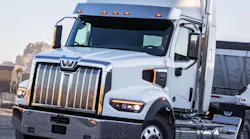 Dtg Western Star 1
 dtg_freightliner_4

