How GM is standardizing active safety systems for work trucks
Key takeaways
- Active safety features like automatic emergency braking are available across Chevrolet's lineup, including fleet vehicles.
- Testing at Milford's proving grounds demonstrates the effectiveness of safety technologies in real-world scenarios, such as obstacle avoidance and pedestrian detection.
- GM's data shows a 57% reduction in rear-end collisions with injuries and an 86% decrease in backing crashes due to safety features.
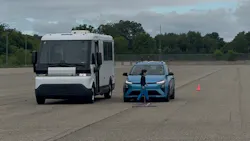
MILFORD, Michigan—If there’s one thing journalists were to take back with them from Chevrolet's safety showcase at the manufacturer’s proving grounds here, it’s that safety is part of General Motors’ company culture.
“Product safety is not just something that is a feature; it's not something that we talk about just as a messaging or a poster on the wall,” Regina Carto, GM VP of global product safety, systems, and certification, told a group of media invited to attend Chevrolet’s safety product program. “It is a core value that's embedded into who we are and how we work.”
Carto and her team of safety product engineers showcased Chevrolet’s lineup of active safety features, which are available across Chevrolet’s vehicle portfolio. Of course, these features are available in the OEM's top trims and more expensive vehicles, but for this showcase, Chevrolet used its more affordable models to highlight that safety should be attainable for everyone. That includes fleets. Even the Chevrolet Silverado 1500 WT, the brand’s more basic Work Truck trim, comes standard with the features highlighted in the showcase.
Chevrolet showcases active safety features

GM’s Milford proving grounds rest on more than 4,000 acres of land, and more than 52 acres are reserved for active safety feature testing and autonomous development. This particular program was held on the site’s 16-acre “dynamics pad,” reserved for testing robot-controlled and autonomous vehicles.
Each test allowed me to experience Chevrolet’s automatic emergency braking in a different situation—all using dummies in the form of two vehicles, a motorcycle, and even dummy children (the engineering team affectionately called one Timmy).
The vehicles tested during Chevrolet’s safety program included a 2026 Chevrolet Traverse, 2026 Chevrolet Blazer EV, and 2027 Chevrolet Bolt. Each vehicle showcased a different form of active safety, but each showcased the brand’s automatic emergency braking.
While demonstrations took place only on these three models, the safety team assured me that these features are available across the Chevrolet lineup—including pickup trucks and fleet vehicles.
Testing Chevrolet’s automatic emergency braking in three scenarios
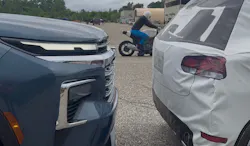
The first test I experienced was inside the Chevrolet Traverse, demonstrating automatic emergency braking with stationary obstacles, including a dummy quarter-car (the rear end), a motorcycle, and a child pedestrian. Because only GM engineers were allowed to drive the vehicles, I rode along in the front passenger seat. The first obstacle we aimed for was the dummy motorcycle.
Even with full trust in the system (manufacturers don’t invite media to demonstrations unless the technology has been tested thousands of times) and the fact that I’ve experienced these tests before both as a passenger and behind the wheel, nothing prepares you for that heart-stopping feeling as you inch so close to an obstacle that you know you’re going to hit.
Regardless of my feelings, the technology performed just as expected. We traveled about 100 yards at roughly 22 mph. The driver kept his foot on the gas pedal the entire time, and as we neared the dummy motorcycle, audible and visual alerts signaled a potential collision before the automatic emergency braking took over. We came to a halt with a nice “skkkrt” of the wheels. Yes, both the driver and I were jolted forward, but with our seatbelts fastened, we were completely safe.
If this test were a real-world scenario, the automatic emergency braking could have saved the motorcyclist's life.
We repeated the same test two other times, once behind a stationary dummy car and once behind a stationary dummy child. The automatic emergency braking performed both times perfectly and stopped within a foot and a half of the dummy car.
 GM Envolve is now GM Fleet
 GM's logo at Hudson's Detroit
The second test was in the Chevrolet Blazer EV, demonstrating automatic emergency braking in the event of cross traffic at an intersection. Because the test required a moving obstacle—a dummy vehicle approaching across the Blazer EV’s path—the dummy car rested on top of a remote-controlled robotic “skateboard” platform controlled by an engineer.
Starting a football field’s distance away, the engineer driving the Blazer EV and the engineer controlling the dummy car communicated over a phone call to ensure the dummy car crossed the Blazer’s path at the right moment. We took off, traveling down the test lane at about 25 mph. As we approached the make-believe intersection, the dummy car began heading toward our path. Nevertheless, we continued at a constant speed. As we got closer, the dummy car had completely crossed in front of us, and the automatic emergency braking kicked in, shifting us forward in our seats, but keeping us from a collision.
My final test experience was in the Chevrolet Bolt, demonstrating front pedestrian braking in a scenario where a pedestrian is partially hidden before crossing into the vehicle’s path. Again, we ran the test, and the automatic emergency braking performed flawlessly, saving the little dummy “Timmy” from any injury.
Safety that’s proven: automatic emergency braking
While GM engineers work to ensure its safety tech is accurate in nearly every instance, it's not designed as a driver replacement. There were two instances when we witnessed it fail: the dummy motorcycle had to be reset after the Traverse slowed but didn’t come to a complete stop, and the quarter-car also had to be reset after a small bump at the Traverse’s grille. But while the technology didn’t bring the Traverse to a complete stop in those two instances out of dozens that day, it did slow the vehicle down considerably. And even slowing by a few miles per hour can significantly reduce the severity of a collision.
GM has the data to back this up. GM and the University of Michigan Transportation Research Institute (UMTRI) analyzed data from 12 million GM vehicles MY 2020-2024, connecting them to more than 700,000 police-reported collisions across the nation. The data reveal that safety technology like this has helped reduce rear-end collisions resulting in injuries by 57% over that timeframe.
Further, “86% of backing crashes have been reduced with GM safety features,” Pam Walz, senior marketing manager, Chevrolet Crossovers and SUVs, told the group of journalists.
Yet, these statistics aren’t just numbers. For fleets, those statistics also represent insurance costs, repairs, downtime, and brand reputation. Even more important, behind each statistic is a family member, a friend, a coworker, or a stranger who was able to live another day. And Carto said GM won’t stop working to improve safety until there are no more crashes.
“Our work here is never done,” she said. “As long as there’s a crash, there’s more work to do. We continue to remain committed to earning customer trust, and building confidence, and making sure that the roads are safer for not only our customers, but everyone we share the road with.”
About the Author
 Jade Brasher
Jade Brasher
Executive Editor Jade Brasher has covered vocational trucking and fleets since 2018. A graduate of The University of Alabama with a degree in journalism, Jade enjoys telling stories about the people behind the wheel and the intricate processes of the ever-evolving trucking industry.