The powertrain debate: No single winner
Key takeaways
- Fleets are evaluating diesel, natural gas, and electric trucks as MY2027 emissions rules approach.
- Natural gas adoption is expanding as engine performance and fueling options improve for more applications.
- Electric trucks remain focused on specific duty cycles due to range, charging, and cost challenges.
For the last several years, the trucking industry’s powertrain debate has focused on a single question: Can anything replace diesel as trucking’s primary fuel?
As the U.S. Environmental Protection Agency’s MY2027 emissions regulations approach, the answer is becoming more complicated. Fleet owners and OEMs are confronting the reality that there isn’t an obvious standalone successor. Instead, they’re juggling a mix of diesel, natural gas, and electric powertrains—each with different trade-offs in cost, maintenance, and operational fit.
Ahead of MY2027, fleets are facing higher equipment costs as OEMs redesign diesel engines to meet looming emissions requirements. In this period of uncertainty, operators are evaluating multiple powertrain options based on economics and availability rather than committing to a single path.
Diesel trucks face higher costs and complexity ahead of MY2027 rules
While diesel still dominates freight, operators continue to seek alternatives due to regulatory pressure and rising costs. According to the U.S. Energy Information Administration (EIA), a gallon of on-highway diesel fuel commanded $5.64 in early May, up $2.14—about 61%—from a year earlier. Such cost increases are adding more strain on fleet economics, prompting operators to take a closer look at fuel efficiency as they weigh long-term powertrain investments.
As fleets attempt to navigate these challenges, engine manufacturers are redesigning their platforms ahead of MY2027 to balance costs, efficiency, and emissions compliance, with a particular focus on reducing nitrogen oxides (NOx).
“The EPA 2027 heavy-duty NOx standards have pushed us to rethink how we deliver emissions reductions without adding unnecessary complexity or cost for fleets,” Jim Nebergall, executive director of market strategy at Cummins, said. These efforts have led to the development of the company’s HELM platform, which focuses on “achieving ultra-low NOx with proven, serviceable technology.”
Such redesigns may come with measurable costs. The Manufacturers of Emission Controls Association expects that meeting NOx targets could add between $1,500 and $2,050 per MY2027 Class 8 tractor (less than 1.2% of the total cost of a compliant truck).
While these engineering changes can help fleets meet compliance requirements, they’re ultimately judged by the total cost of ownership. OEMs such as Cummins understand this and are aiming to improve emissions efficiency without significantly impacting operating costs or maintenance requirements. Striking the right balance is critical as fleet owners decide whether to replace aging equipment ahead of MY2027 or extend the life of existing assets.
Natural gas trucks gain traction among fleets ahead of MY2027
In response to rising diesel costs and MY2027 uncertainty, some fleets are evaluating alternative powertrains—and natural gas is seeing renewed interest.
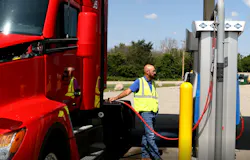
The U.S. Department of Energy estimates that there are roughly 175,000 natural gas vehicles on U.S. roads across all classes, including medium- and heavy-duty trucks. To support that growth, more than 1,400 natural gas stations are now available nationwide, expanding fleet access to both compressed natural gas (CNG) and liquefied natural gas (LNG).
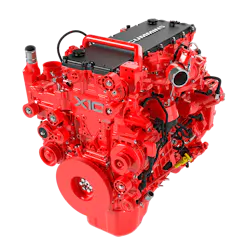
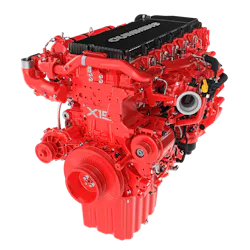
“We’re seeing natural gas move beyond pilot programs into broader, scaled adoption—particularly in line-haul and regional-haul applications with the [Cummins] X15N,” Nebergall said. “Fleets that came early are now returning to expand their natural gas fleets, which is a strong indicator that the economics and performance are working in real-world operations.”
Momentum is also expanding beyond early adopters.
The X15N’s “higher power and torque, along with improved performance and GVW [gross vehicle weight] capability, are making natural gas viable in applications where it wasn’t before,” he said. “Looking ahead, we expect that shift from pilots to scaled deployment to continue, with orders increasing significantly over the next few years as more fleets gain confidence with the technology.”
Why natural gas adoption is growing in heavy-duty trucking fleets
While engine improvements are making natural gas more viable for fleets, advancements in infrastructure and flexible fueling options also support broader adoption.
Instead of being pigeonholed into a single fueling model, fleets are increasingly able to combine several different strategies—including depot-based fueling, public stations, and mobile refueling—depending on route structure and deployment size. This flexibility has had a direct impact on natural gas uptake by reducing one of the biggest barriers that has historically prevented fleets from adopting the fuel at scale: the need for significant upfront infrastructure investments.
“CNG was primarily considered for regional haul, return-to-base applications,” Ian MacDonald, SVP at Hexagon Agility, explained. “But the increased power and torque of the X15N—combined with continued strategic growth in fixed tractor-trailer compatible fuel infrastructure and the option of mobile refueling—have vastly increased the potential applications of [natural gas], including long-haul sleeper routes. It’s quite common to see CNG trucks with enough onboard fuel storage to achieve a range of 1,200 miles.”
Despite such advancements, some fleets still underestimate how much natural gas technology has evolved over the last decade.
“Some fleets might have tried CNG 10 years ago and believe the technology has not drastically improved,” MacDonald said. “This is a big misconception, as all the technology from engine to fuel system to transmission integration has dramatically improved, providing what many fleets have described as ‘like diesel.’”
 Simplicity drives interest in battery electric trucks for commercial fleets
 Rising congestion forces fleets to shift to real-time routing and data-driven planning
Battery-electric trucks remain limited to specific fleet applications
In addition to natural gas, battery-electric powertrains are also part of the industry’s emissions conversation—particularly for urban and regional fleets. However, compared to diesel and natural gas, long-haul adoption remains relatively limited.
According to Calstart data, just 1.32% of new trucks deployed in the first half of 2025 were zero-emission vehicles.
“What we’re seeing with natural gas is that it can meet sustainability goals without requiring the same level of operational change or disruption associated with a full transition to battery electric in heavy-duty applications,” Nebergall said. “That makes it an attractive option for fleets looking to reduce emissions while maintaining familiar operating models.”
While fleets continue to explore electric options to build more sustainable operations, nascent charging infrastructure, vehicle range limitations, extended charging downtime, and high upfront costs remain significant obstacles.
As a result, many operators are treating electric vehicles as one part of a larger fleet strategy and are basing deployment decisions on specific duty cycles and operational needs.
Fleets choose mixed powertrains as trucking evolves beyond diesel
As fleets prepare for MY2027, they’re increasingly opting to rely on a mix of powertrains instead of fully transitioning to one dominant solution. By doing so, they’re able to deploy specific powertrains based on routes, duty cycles, and cost structures—the right tool for the job.
While regulatory pressures are influencing this approach, fleet owners are also using infrastructure readiness, fuel pricing trends, and total cost of ownership to inform their strategies. As OEMs continue refining their diesel platforms for compliance and alternative fuels like natural gas gain slow but steady traction, fleets are assessing powertrain options based on where they fit best into operations—with no single solution proving itself a panacea.
“The industry is moving toward a more mixed-fleet reality rather than a single dominant powertrain,” Nebergall said. “Different duty cycles, vocational needs, and regional operating conditions mean there is no one-size-fits-all solution for decarbonization.”
About the Author
 Justin Reynolds
Justin Reynolds
Contributor
Justin Reynolds is a B2B technology writer and editor with 20 years of experience telling stories about innovation and its impact on the way we work and live. He started his career in journalism, spent two years at a B2B tech agency, and has worked as a full-time freelancer since 2015. He lives in Connecticut.