FMCSA's enforcement outlook for 2026
Key takeaways
- Trump 2.0 is moving quick on commercial carrier safety enforcement, sometimes circumventing the slow rulemaking process.
- FMCSA's quick-hitters for safety enforcement are on English proficiency, non-domiciled CDLs, driver training providers, and ELD certification.
- For 2026, carriers can expect the driver crackdowns to continue, likely removing tens of thousands of CDLs from the industry.

The first year of the second Trump administration revealed an interesting character of the new federal government: It is defined, simultaneously, by deregulation and rapid regulatory crackdowns.
As fleets look ahead to 2026, what will this deregulation—and these crackdowns—look like?
“Even though I do think we’re in a deregulatory environment, what we have heard from the leaders at FMCSA [Federal Motor Carrier Safety Administration] and DOT [Department of Transportation] is that there is going to be an increased focus on enforcement of driver qualification requirements,” Sue Lawless, partner with Scopelitis Law Firm and former chief safety officer and acting deputy administrator for FMCSA, told FleetOwner. “That includes all the licensing issues, increased oversight over entry-level driver training schools, and looking at increasing focus on better managing the electronic logging device process.”
Looming over it all is legal uncertainty. Many open regulatory questions around these changes will have to wait for their answers from the judicial system.
“Some of this is going to be dictated by what happens in the courts. There is existing litigation that, should the administration lose some of the cases, it’s going to have its hands tied at least temporarily until it figures out a different approach,” Prasad Sharma, partner with Scopelitis Law Firm, told FleetOwner.
Fast-paced driver safety crackdowns
The Trump 2.0 administration showed interest in moving very quickly on specific topics. The new regulatory environment can make changes within days or weeks, finding ways to institute changes without a lengthy rulemaking process.
“I think it’s speed-centric more than anything else. Everything is sped up and moving at a faster pace than traditionally we’re used to, in terms of a regulatory environment,” David Heller, SVP of safety and government affairs for the Truckload Carriers Association, told FleetOwner. “There’s not an abandonment of the regulatory process … But, at the same time, there are these quick-hitters out there that they’re trying to address as expediently as possible.”
Those quick-hitters include safety-sensitive enforcement on English proficiency, licensing, and training providers.
Roadside enforcement for drivers' English proficiency
Federal regulation 49 CFR 391.11(b)(2) requires commercial vehicle drivers to read and speak English sufficiently. Enforcement of this general qualification has changed over time, but the Trump administration made clear last year that it wants to crack down on drivers’ English proficiency.
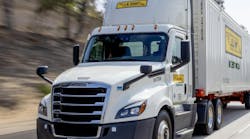 jbht_truck_3
 Dreamstime red truck The Fleet Lead
The history of English requirements
Since the first federal regulation of trucking 90 years ago, English Language Proficiency (ELP) has only been truly enforced on roadsides for about 10 years.
The federal government required English proficiency among drivers for as long as it has regulated interstate trucking—the Interstate Commerce Commission’s (ICC) first set of motor carrier regulations in 1936 required English as a basic driver qualification—but enforcement was a different story.
Roadside enforcement varied widely by state until the federal government's Motor Carrier Safety Assistance Program (MCSAP) was first ratified in 1982. The MCSAP helped to ensure uniform enforcement across states, with enforcement standards often dictated in partnership with the Commercial Vehicle Safety Alliance (CVSA).
Limited English was not considered an out-of-service violation until 2005, when CVSA added English proficiency to its out-of-service criteria. In 2007, the Federal Motor Carrier Safety Administration (FMCSA) issued its first guidance instructing inspectors to cite drivers and motor carriers for violations of the ELP requirement. In 2008, FMCSA provided enforcement personnel with the first tools to evaluate a driver’s ability to understand highway traffic signs, but drivers were allowed to explain the traffic signs in languages other than English.
In 2015, CVSA removed English proficiency from its out-of-service criteria. The alliance claimed that it “could not substantiate the safety impacts.” After that, FMCSA formally canceled its policy of roadside ELP assessments. FMCSA maintained that drivers could be cited for violating ELP requirements but allowed drivers to use various communication tools, including cue cards and smartphone applications.
In April 2025, Trump signed an executive order for stronger ELP enforcement. A week after, CVSA announced it would bring ELP back to its out-of-service criteria; a few weeks after, Transportation Secretary Sean Duffy directed FMCSA to resume roadside ELP assessments.
Last year, Trump issued an executive order calling for stronger enforcement of English language requirements, CVSA re-added English proficiency to its out-of-service criteria, and FMCSA issued a new policy for inspectors to assess drivers’ English proficiency. For 2026, highway enforcement personnel will likely continue to place drivers out of service if they cannot pass an English assessment.
“There has been, up until this point, I’d say, a relaxation of that particular regulation. Previous administrations had allowed for things like Google Translate for a driver to use at a roadside inspection if they weren’t proficient in the English language,” Heller said. “This has wiped all of that away; there is now a proficiency standard that they have to abide by and be able to converse in.”
An FMCSA presentation using BLS data estimated that, between 2020 and 2022, about 3.8% of CDL holders had “limited English proficiency.” That classification does not definitively mean that those roughly 136,000 drivers have such limited English that they would fail a roadside English inspection—but it is likely that at least tens of thousands of those drivers know too little English to meet federal standards.
In 2025, with the crackdown beginning in late June, FMCSA recorded 12,308 OOS violations for inadequate English proficiency. Previously, in 2023 and 2024 combined, FMCSA recorded only 14 OOS violations under the English requirement. A little over a decade ago in 2013, before FMCSA had stopped enforcing ELP, the agency recorded only 3,864 drivers placed OOS for not speaking English.
FTR Transportation Intelligence, annualizing 2025’s OOS numbers, estimated that the English crackdown could take roughly 25,000 drivers off the road in a year—approximately 0.6% of the total driver population.
Removing the nation's non-domiciled CDLs
The same executive order calling for an English proficiency crackdown also ordered a review of non-domiciled CDL issuance. FMCSA’s enforcement ran into complications but is already influencing carrier operations.
In September last year, FMCSA published an emergency interim final rule to immediately limit states’ authority to issue or renew non-domiciled CDLs. Under the rule, applicants for non-domiciled CDLs faced additional paperwork requirements, and license renewals had stricter requirements.
FMCSA estimated that there are roughly 200,000 non-domiciled CDL holders nationwide, representing 5% of the 3.8 million total CDL holders in 2024. FMCSA also, assuming that state licensing agencies would issue only 6,000 non-domiciled CDLs per year, boldly projected that the rule would remove 194,000 non-domiciled CDL holders within about two years.
However, the emergency rule did not stay for long. The rule prompted a legal challenge from Rivera Lujan et al. The petitioners convinced the D.C. Court of Appeals to pause the rule while the legal challenge continues.
The Court found that the petitioners would likely succeed in their arguments against the rule. The petitioners argued that: FMCSA lacked the required “consultation with the states” for the rule; the final rule lacked a strong enough reason to bypass the notice-and-comment periods; and the rule’s justification (that tightening non-domiciled CDL issuance would promote safety) was lacking.
However, FMCSA still has sway over states’ authority to manage non-domiciled CDLs and will continue to exercise that influence in 2026.
“The courts have gotten involved and effectively paused the rule, but at the same point, you’re still seeing it happen at the state level, and you’re seeing a lot of lawsuits chime up with that,” Heller said.
Before the emergency rule, Transportation Secretary Duffy in June announced an audit into state practices in issuing non-domiciled CDLs. Since then, FMCSA has reported that several states issued non-domiciled CDLs illegally.
FMCSA’s enforcement across states follows a similar pattern: The state must immediately pause issuance of all non-domiciled CDLs or commercial learner’s permits, rescind all noncompliant licenses, conduct an internal audit, and then provide FMCSA with evidence of compliance.
The agency has so far reported illegal non-domiciled CDLs across nine states: California, Pennsylvania, Minnesota, New York, Texas, South Dakota, Colorado, Washington, and North Carolina.
Regarding the rulemaking to narrow states’ non-domiciled CDL authority, Lawless thinks that the rule could be wrapped up in litigation for more than a year.
“What FMCSA is doing is going through 8,000 comments and trying to craft a final rule,” Lawless said. “They’re going to try and get that final rule out before their first report to the court is due, which is sometime early March. Once they issue that final rule, what’s going to happen is there’s going to be another challenge to that final rule. I think you’re looking at a protracted legal battle on the final rule from FMCSA’s position … I don’t think that that litigation is going to resolve within the next year.”
Regardless of the litigation’s outcome, however, FMCSA’s crackdown already has apparent effects on the industry.
“The longer [the lawsuits] move on, the more questions surrounding the issue. But fleets are acting accordingly right now, based upon the executive orders that the administration has issued,” Heller said.
Ultimately, DOT may successfully reduce the industry’s use of non-domiciled drivers through its messaging alone.
“It may not matter as to whether they win or lose, because they have succeeded in messaging that these are not desirable drivers because of the uncertainty around their licensing status,” Lawless said. “You have states that are kind of self-selecting to not issue those kinds of licenses anymore; you have people who are fearful of employing those drivers.”
The audit has already caused several states to pause issuance of non-domiciled CDLs. California is embroiled in a conflict that could remove licenses from over 17,000 drivers.
Audit of CMV driver training schools
FMCSA is also aggressively cleaning up its Training Provider Registry by removing schools that do not appropriately train commercial drivers.
FMCSA is “really trying to get a handle on all of these training schools,” Lawless said. “I think they have long known, based upon reports that they have gotten from reputable training organizations, that there are people out there selling training but not delivering training. You pay your $500, you get a license—and that is dangerous.”
FMCSA announced in December that it removed nearly 3,000 training providers from the Training Provider Registry for noncompliance and placed 4,500 providers on a 30-day notice for potential noncompliance.
“They did the first pass at removing those training schools that didn’t even meet the bare minimum requirements. They didn’t have a proper address, or maybe they weren’t registered in the state to provide training,” Lawless explained. “The next step that they took was they notified a bunch of these schools, based upon analysis of the data that they were looking at, and said, ‘We need to come in and do an audit of your operations to make sure that you are actually providing training.’”
According to FMCSA’s removed training provider database, the agency removed 2,766 providers in November, 96 in December, and 3,872 in January. There are 179 providers in FMCSA’s “proposed removal” list.
There are currently 15,711 active training providers in the Training Provider Registry, suggesting that the agency had purged 30% of the names from its provider database in three months. However, it is not as clear how many of those providers were active or well attended.
The provider purge will certainly affect the number of drivers entering the industry, though whether that effect is significant is another question. Further refining the provider list could take longer than the initial purge and might require considerable labor for the necessary oversight. Alternatively, fundamentally changing the regulations and requirements for training providers might require another lengthy rulemaking process.
“It’s a resourcing issue,” Lawless said. “There are so many registered entry-level driver training schools. How do you go about exercising oversight? … I’ve heard some interesting ideas about whether there should be a different regulatory scheme for regulating entry-level driver training—some more oversight, not just ‘Tell us that you’re in compliance, and you get to be up on our website.’ … That would add just more rulemaking.”
ELD review overhaul
Electronic logging device (ELD) revocation announcements might become less common this year. FMCSA is implementing an overhaul to how it verifies the devices that track commercial drivers’ hours of service.
The current ELD self-certification process has led to frequent ELD revocation notices from FMCSA after the agency discovered a device provider did not meet federal requirements.
FMCSA’s current list of registered ELDs includes 1,003 devices—with about 30 devices revoked annually this decade. Meaning, on average, each year 3% of FMCSA’s registered devices require replacement under threat of OOS violations.
The agency announced in December a more rigorous process to reduce the number of non-compliant devices entering FMCSA’s list of ELDs.
“ELDs, you basically write in and say, ‘Yeah, I meet all these minimum requirements.’ There is some oversight that’s exercised through FMCSA and Volpe,” Lawless said. “I think they’re looking to really shore up those areas where there’s a lot of opportunities for bad actors to misuse the system, to commit fraud, to basically harm truck drivers, motor carriers, and the traveling public.”
FMCSA claimed that the new vetting process prevents registration of non-compliant devices and re-registration of devices that had been revoked.
Overall, rapid changes for carriers
The federal government's new administration has shown that when it comes to certain aspects of carrier safety, it's willing to circumvent traditional rulemaking. The new crackdowns on driver qualifications have been fast and disruptive—and will continue into 2026.
“I’ve been doing this for 20 years for TCA and, for 20 years, the regulatory process had always been somewhat lengthy,” Heller said. “You could almost time it with a calendar rather than a stopwatch, but that whole philosophy has sped up quite a bit.”
The rapid speed of these enforcement changes, however, comes with friction. Beyond lawsuits, both the English proficiency and non-domiciled CDL crackdowns brought FMCSA into drawn-out conflicts with California. But that's a topic for part two.
This is the first part in a series of articles on the 2026 regulatory outlook. Click below for:
About the Author
 Jeremy Wolfe
Jeremy Wolfe
Editor
Editor Jeremy Wolfe joined the FleetOwner team in February 2024. He graduated from the University of Wisconsin-Stevens Point with majors in English and Philosophy. He previously served as Editor for Endeavor Business Media's Water Group publications.