How Schuster Trucking handles capacity swings and profitability pressure
Key takeaways
- At Schuster Trucking, freight cycles and emissions timelines shape when new tractors are ordered.
- Cost control at Schuster Trucking relies on fuel tools, McLeod Software, and tire monitoring systems.
- Schuster Trucking maintains focus on driver compliance and retention as enforcement tightens and capacity shifts.
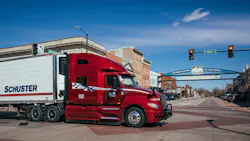
A test of industry knowledge and foresight, navigating the freight market is always a challenge. At Schuster Trucking Company, that ship is being steered effectively today by Steve Schuster, president of the 70-year-old refrigerated carrier.
“The freight market has had a challenging couple of years,” Schuster said. “We had to address times when there was more capacity than freight and others when the volume of freight was larger than the number of trucks available to haul it. Those ups and downs impact profitability, and when trucking companies aren’t making money, it also impacts a number of things, including vehicle replacement plans.
“Unlike many carriers that have reduced their number of trucks, we’ve been fortunate, but we haven’t increased our fleet size either,” Schuster continued. “At the same time, while we try to buy new trucks every year to maintain our expected equipment service life cycle, we didn’t purchase any tractors for 18 months; however, that’s changing because freight volumes are up.”
Freight cycles, capacity swings, and equipment planning at Schuster Trucking
Part of the drive to replace equipment at Schuster Trucking is also to secure 2026 vehicles before manufacturers switch to 2027 emissions-compliant models.
“Our thinking is that order boards for this year will be full by the start of the third quarter,” Schuster explained further. “With engine and truck manufacturers unable to provide pricing for 2027 models yet, ordering for this year and not waiting until the first half of 2027 will protect us financially.”
The 420 company power units in the Schuster Trucking fleet are mainly International LT625 models with Cummins X15 engines and Eaton Cummins Endurant automated transmissions. The carrier’s 1,200 trailers consist primarily of Great Dane SuperSeal reefers with Thermo King S-700 refrigeration units. Schuster noted that the manufacturer’s most powerful model ensures the integrity of ice cream loads, which make up 30% of the company’s freight revenue and must be kept at -20 degrees F.
Operating out of one terminal at its Le Mars, Iowa, headquarters location allows the company to benefit from long-standing relationships with key suppliers, Schuster related. Included are Cornhusker International, Jim Hawk Truck Trailers, and Thermo King Christensen.
 Arka Express fleet trucks
 titan primary
“With local vendors in the Sioux City area as well, we can also control parts and tire costs,” Schuster said. “Their proximity means our inventory levels are down in our 20-bay tractor shop and our eight-bay trailer service facility.”
While Schuster Trucking’s programs for company drivers and a roster of about 80 dedicated owner-operators—including competitive pay and benefits, late model equipment, wellness initiatives, and driver-friendly policies—have helped keep seats filled, recent federal crackdowns aimed at CDL reform, together with increased freight volumes, have made finding operators somewhat challenging.
“Compliant drivers who meet our requirements are still out there,” Schuster said. “We applaud the rules that have removed illegal drivers. That has helped the whole industry.”
Compliance and cost control shape Schuster Trucking operations
Schuster, who also supports regulatory efforts to improve safety, noted as well that the carrier has maintained a Federal Motor Carrier Safety Administration (FMCSA) satisfactory rating, indicating it has management controls in place to meet safety fitness standards prescribed by the U.S. Department of Transportation (USDOT).
“We review inspections weekly and look at our records so we can avoid violations for things that can be addressed with effective driver pre-trip and shop inspections,” he said. “It can be very frustrating to have great equipment and be cited for something avoidable.”
Fuel economy is a key focus at Schuster Trucking. Currently, the carrier’s trailers are fitted with Hendrickson TireMaxx Pro tire inflation and monitoring systems, and they are evaluating solutions for tractors from Revvo and PressurePro. Some recent tractors have also been spec’ed with the International S13 Integrated Powertrain, which, according to Schuster, has exhibited impressive fuel economy.
“We’re also prepared to deal with higher fuel costs,” Schuster said. “That can always impact our bottom line, but fuel surcharges cover the majority of our increases. And with good operations management practices using the McLeod Software we’ve had for over 12 years, we can address that issue.”
For Schuster, relying on his experience is what will keep the family-owned company, which was founded in 1956 with a single truck hauling grain, a premier provider of customer-focused transportation services, and a leader in the industry.
“Looking ahead,” he said, “we’re very excited about 2026 and beyond.”
About the Author
 Seth Skydel
Seth Skydel
Seth Skydel, a veteran industry editor, has more than four decades of experience in fleet management, trucking, and transportation and logistics publications. Today, in editorial and marketing roles, he writes about fleet, service, and transportation management, vehicle and information technology, and industry trends and issues.