Accurate Transport uses AI to cut freight processing costs and improve delivery performance
Key takeaways
- Accurate Transport uses AI to help process about 4,000 bills of lading monthly, reducing manual data entry.
- AI-powered BOL processing cut administrative costs by 40% and improved shipment data accuracy.
- Freight management technology helped reduce truck needs by more than 10% while maintaining 96% on-time delivery.
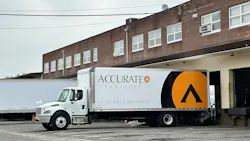
Like many trucking operations, it all began with one truck. In 1997, Accurate Transport opened for business. Today, the carrier, headquartered in Carlstadt, New Jersey, operates across 12 states through a network of terminals located in New Jersey, Maryland, and Connecticut.
“We specialize in seamlessly transporting goods from ports in New York, New Jersey, Boston, Philadelphia, and Baltimore,” Jay Irons, director of strategic planning, said. “Our services include less-than-truckload (LTL) and last-mile delivery, intermodal solutions, and distribution. Our average transit time for deliveries is one day.”
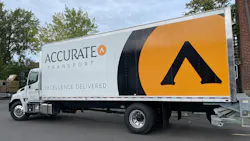
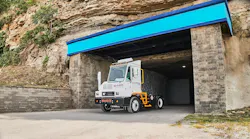
Accurate Transport’s local and regional operations are handled with a company fleet of approximately 200 tractors, CDL and non-CDL straight trucks, dry van trailers, and container chassis. The asset-based fleet, Irons noted, allows the carrier to monitor and control every shipment and to ensure equipment reliability and safety.
At the same time, the company continues to invest in and utilize management technologies. For example, the latest systems allow customers to track and trace loads in real time, create and submit orders, get rates and spot quotes, and receive email status updates.
With palletized LTL freight, Irons related, each LTL trailer load at Accurate Transport includes several shipments, each with its own bill of lading (BOL).
“The inherent challenge in that operating model is that order entry requires entering shipment data into our freight management system by working from paperwork submitted by drivers or collected at terminals,” he said. “Relying on a fully manual process to manage BOLs comes with inefficiencies.”
“This approach created two significant issues, including high labor requirements from dedicating multiple employees to focus on order entry tasks, increasing administrative costs,” Irons continued. “In addition, accuracy concerns result from manual entry that led to errors and incorrect data capture. Together, these caused operational disruptions, customer service issues, and lost revenue when billable services were not properly recorded.”
 lazer_logistics_fleet_owner_photo4_june_22_2026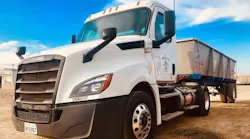
To address these challenges, Accurate Transport implemented the AI-powered BOL Extraction module from Carrier Logistics (CLI), which is fully integrated with its freight management system. AI BOL extracts shipment data directly from BOLs, eliminating manual entry by automatically creating shipment records.
AI BOL from CLI now processes about 50% of the freight volume at Accurate Transport. The module handles around 4,000 BOLs per month by scanning orders in batches at terminals or by drivers.
“The Carrier Logistics AI BOL solution has significantly reduced the manual effort required to process shipment orders, cutting our administrative costs by 40% while also improving accuracy,” Irons said. “Overall, the freight management system has helped us realize up to a 50% reduction in dispatch labor time and costs.”
“We’re also seeing improved on-time delivery performance, minimized operational disruptions, and fewer customer service issues,” Irons added. “Additionally, since implementing the AI BOL module, we’re preventing lost revenue by capturing all billable services.”
The AI BOL module complements Accurate Transport’s broader use of the CLI freight management system, which supports the full shipment life cycle from pickup requests through delivery confirmation.
The CLI solution provides dispatch and route optimization tools that are optimizing Accurate Transport’s operations. For LTL and last-mile delivery, an integrated planning tool identifies restrictions based on routes and customer location types.
Furthermore, the provider’s rate engine is credited with improving pricing accuracy, a mobile dispatch integration facilitates communication with drivers, and a dock management system streamlines terminal cross-dock efficiency.
“Overall, improved processes have led to a reduction of more than 10% in the number of trucks needed to handle a growing volume of loads,” Irons said, “and improved visibility into freight and assets across our operations has increased 90th percentile Service Level Agreement scores for on-time deliveries. Today, we’re maintaining an on-time delivery percentage of 96%.”
“All of our efforts are ultimately focused on helping customers find the right solution among our many transport options for their specific shipping needs,” Irons added. “It’s all about leveraging our people, experience, equipment, and technologies, including expanding our use of AI tools, to grow and adapt with the times so our customers have a better and more positive experience.”
About the Author
 Seth Skydel
Seth Skydel
Seth Skydel, a veteran industry editor, has more than four decades of experience in fleet management, trucking, and transportation and logistics publications. Today, in editorial and marketing roles, he writes about fleet, service, and transportation management, vehicle and information technology, and industry trends and issues.