Tom McLeod's cautiously positive outlook for the industry in 2026
Key takeaways
- The industry faces economic headwinds with consumer debt and fuel prices impacting freight demand and consumer spending.
- Capacity is shrinking due to stricter enforcement of safety regulations, leading to increased freight rates and market stability.
- Legal cases reveal the importance of thorough vetting processes for brokers and carriers to mitigate liability and nuclear verdicts.

NASHVILLE—Be careful. Those are Tom McLeod’s words of advice to transportation leaders here at the McLeod Software User Conference.
The McLeod Software president and CEO has been part of the industry for decades. Here’s what he said is currently affecting the industry and why leaders should exercise caution even with elevated freight rates.
The three big impacts on trucking
The trucking industry has been in a slump for several years. The COVID-19 pandemic saw an influx of freight movement, which led to an increase in truck capacity. Once the freight market slowed, too many trucks were in the market without enough freight to move. With the current economy, McLeod doesn’t predict an upturn in freight movement.
Overall economy
“The economy is annoying,” McLeod said in his keynote, which kicked off the conference. “Seventy percent of the economy is driven by the consumer, and what does consumer spending look like? People are maxed out.”
McLeod also mentioned high consumer debt, with consumers relying on their credit cards to keep spending. This keeps freight steady, but as consumers max out their credit limits, it doesn’t point to a positive outlook for increased freight movement anytime soon.
Then there’s the issue of fuel prices and their effect on consumers. “Fuel prices are affecting consumers just like they’re affecting transportation companies,” McLeod said. This also contributes to lower consumer spending.
While they’ve subsided as the most popular topic at transportation conferences in 2025, tariffs and trade talks remain on the table, adding uncertainty to market predictions. Yet, business activity has expanded, McLeod said.
Something to watch, however, is the correlation between jobs and interest rates.
“If jobs go up, interest rates are going to go up; if jobs go down, interest rates are going to go down,” McLeod said, referring to insight a friend had given him. “That’s very much the way it has tracked.”
So while the overall economy and consumer spending have kept freight movement down, the industry has seen some positive momentum concerning freight rates.
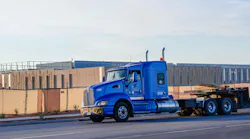 Flatbed semi truck passes a large data center campus under construction
 Truckload spot rates rise across dry van, reefer, and flatbed markets
Freight movement and transportation economy
Many industry players have spent the last three years hoping for a significant capacity exit because when too many trucks are on the road, freight rates are low. When the right number of trucks are on the road, freight rates increase. McLeod outlined this at his 2024 user conference.
“Freight rates are up, and the reason is we’ve got the right number of trucks on the road,” McLeod said this year.
Industry players have been waiting a while to see capacity shrink. While smaller industry players have been exiting for years, what’s made the biggest difference since mid-2025 is the enforcement of regulations “that have been in the books the whole time,” McLeod said.
He was referring to the crackdown on CDL mills, making English proficiency an out-of-service violation, and changes to non-domiciled CDL requirements. These efforts by the Federal Motor Carrier Safety Administration (FMCSA) have led to a long-awaited contraction in capacity.
“If these great regulations had been enforced all along, the rate recession would not have been nearly as deep, not nearly as long,” McLeod said.
While capacity is coming down, few market forecasts show freight increasing, as stated above. But McLeod sees this as stability and believes the industry will eventually recover, “as long as we don't go nuts and put too many trucks on the road,” he said.
But rates and the economy aren’t the only factors that significantly affect the transportation industry.
Legal cases and the trucking industry
“Nuclear verdict,” a lawsuit finding that requires a trucking company to pay a substantial sum of money after a commercial truck accident, isn’t new to the industry; however, who’s held at fault for these accidents is becoming murky.
In Montgomery v. Caribe Transport II, LLC, C.H. Robinson, which brokered the load, was found at fault for hiring a carrier with a less-than-stellar safety reputation. Later, C.H. Robinson was again held liable for an accident involving a carrier the broker had used “270 times previously” and for following “their process to the letter,” according to McLeod.
In one case, the verdict found that C.H. Robinson was negligent. Yet, in the other case, while the judge has not made a final verdict, it makes it seem as though there’s no way to avoid being labeled as negligent, regardless of how thorough a broker’s vetting process is. “This is uncharted territory,” McLeod asserted.
Will that liability be extended even further to the shippers? McLeod posed this question to the group during his keynote, advising those in the room to “be careful” when making decisions moving forward.
Regardless, McLeod believes these different segments of the industry—carriers, brokers, and shippers—keep the industry moving. These segments, especially brokers, help smaller carriers acquire freight and make the market viable.
“There are so many different types of requirements in the movement of freight, specialized skills and services that go along with it,” McLeod said. “It’s very important that we maintain the health and vitality and great diversity of the trucking industry.”
The key to keeping the industry healthy, however, is for each segment to do its due diligence, thoroughly vet partners, and maintain a pristine safety record.
What’s ahead for the trucking industry? Proceed with caution.
McLeod predicts consumer spending and freight movement will be stable, or relatively flat, for the near future. While trucking companies have seen some relief from higher rates, they should tread lightly. Just because things are looking up doesn’t mean the industry couldn’t see more uncertainty ahead.
“The ground is shifting under our feet,” he told FleetOwner. “If you take off running, you could end up in the wrong location just because the targets keep moving.”
About the Author
 Jade Brasher
Jade Brasher
Executive Editor Jade Brasher has covered vocational trucking and fleets since 2018. A graduate of The University of Alabama with a degree in journalism, Jade enjoys telling stories about the people behind the wheel and the intricate processes of the ever-evolving trucking industry.