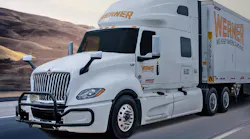
Werner CEO: Recruiting spending to remain high into ’27
Key takeaways
- Werner plans to sustain higher driver recruitment spending into early 2027 to support continued growth.
- Major carriers are increasing recruitment and training investments as competition for drivers intensifies.
- Dedicated fleet expansion and tighter freight capacity are adding pressure to driver hiring costs.

Werner Enterprises executives plan to keep investing in driver recruitment at a higher-than-normal level for several more months as they look to capitalize on what Chairman and CEO Derek Leathers calls “the early innings of a multiyear up cycle.”
Higher-than-expected recruitment and retention costs were one factor (along with rising fuel prices and an insurance reserve increase) that prompted Leathers and his team to warn two weeks ago that Werner’s third-quarter results would come up short of expectations. Among those three, driver expenses stand out as what Leathers called “a deliberate decision” to ensure Werner—the No. 11 carrier on the 2026 FleetOwner 500—can meet customer demand for its one-way and dedicated services.
Werner grew its dedicated fleet by 130 trucks during the third quarter and finished September with nearly 7,100 trucks in that segment of its business. (After buying FirstFleet early this year, the company is now the country’s fifth-largest dedicated carrier.) CFO Chris Wikoff told analysts on Werner’s third-quarter earnings conference call October 27 that executives “fully expect to build on this foundation with further fleet growth ahead.”
That ambition, combined with a freight market that is getting tighter and thus in many ways pricier, means more investment to get drivers in the door.
 Southern Glazer's truck

 sndr_trucks_1
“This advertising, beefing up recruiting, spending money on some of these fleet transition bonuses, and other things is more short-term in nature,” Leathers said on the earnings call. “But [it] will continue into Q4 and probably into Q1, to be frank.”
Leathers noted that, beyond needing to bring in more drivers for Werner, the higher spending on recruitment is also necessary because “the bad news on that front is that it’s not just us, but nationwide.” Other carriers are also stepping on the gas as they look to build market share while regulatory actions drive out capacity.
Knight-Swift and J.B. Hunt boost driver capacity spending
Executives of Knight-Swift Transportation Holdings and J.B. Hunt Transport Services, the Nos. 3 and 4 on the FleetOwner 500, recently told investors they also have been ramping up their spending on recruiting and training.
Knight-Swift CFO Andrew Hess said the company’s teams have been paying special attention to its dedicated business and that extra spending during the third quarter “helped us to stabilize our truck count.” But, he added, that won’t be enough.
“We are preparing further targeted measures to improve our driver development and enhance utilization,” Hess said. “We continue to closely monitor driver market conditions as well as our own metrics around seated tractor utilization and pay as a percentage of revenue to gauge appropriate action and invest where it generates a return.”
Nick Hobbs, a J.B. Hunt executive and president of the company’s highway and final mile divisions, delivered a similar message in mid-October. An additional $25 million in spending during the third quarter, he said, has yielded good results but more is needed to support growth.
“We have opened the same proven playbook we have used in past cycles and implemented various strategies to attract and retain drivers,” Hobbs said after J.B. Hunt’s Q3 report. “We continue to believe the industry will need to further invest in professional drivers who operate safely and comply with industry regulations.”
About the Author
 Geert De Lombaerde
Senior Editor
A native of Belgium, Geert De Lombaerde has more than two decades of experience in business journalism. Since 2021, he has written about markets and economic trends for Endeavor Business Media publications FleetOwner, Healthcare Innovation, IndustryWeek, Oil & Gas Journal, and T&D World.
With a degree in journalism from the University of Missouri, he began his reporting career at the Business Courier in Cincinnati. He later was managing editor and editor of the Nashville Business Journal. Most recently, he oversaw the online and print products of the Nashville Post and reported primarily on Middle Tennessee’s finance sector and many of its publicly traded companies.