PC-12 hits shops in 2027. What does that mean for fleets?
Key takeaways
- PC-12 introduces CL-4 and FB-4 engine oil categories, with the first licenses scheduled for January 1, 2027.
- The standards tighten SAPS limits and raise wear, soot, and oxidation performance requirements to protect engines and after-treatment systems.
- CL-4 succeeds CK-4 and is backward-compatible with C-category oils; FB-4 supports lower-viscosity oils but is not universally backward-compatible.
- Transitioning from XW-40 CK-4 leads to fuel-efficiency gains around 0.5% to 2.8%.
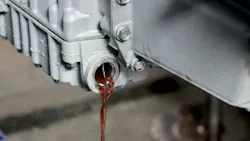
Truck engine oils are changing in 2027. In January, the American Petroleum Institute’s (API) two new oil spec categories will officially launch.
The two new categories—CL-4 and FB-4—are under the banner “PC-12.” The PC-12 shift replaces the decade-old PC-11 standard and is engineered to help reduce emissions, improve engine life, and possibly improve fuel efficiency.
During a press event promoting the coming changes to its Duron lineup, Petro-Canada Lubricants broke down the specification’s history and how the new oils will impact fleet performance:
“With durability, we see superior wear protection across the oil drain interval. With oil life, excellent oxidation control for longer oil life, potentially for extended drains,” Steve Krawiec, R&D product development manager, told media during the event. “On emissions, lower SAPS formulation helps protect exhaust after-treatment systems and helps improve emissions to meet the new greenhouse gas requirements. Fuel economy: the lower viscosity options that we have will help to improve fuel efficiency without compromising protection.”
The transition requires oils to have improved soot and oxidation management, which could lead to longer oil drain intervals. The standards also push engine oils toward thinner viscosity grades, which could improve trucks’ fuel economy.
 cost of trucking and diesel thumbnail
 pal_truck_yellow
History of API’s proposed oil formulation categories
Heavy-duty engine oil specifications have evolved to keep pace with federal emissions mandates—changing roughly every 10 years.
"Heavy-duty engine oil categories have moved roughly once a decade, in step with emissions regulations," said Darryl Purificati, OEM technical liaison at H.F. Sinclair.
That timeline began two decades ago with the introduction of exhaust after-treatment devices.
"PC-10 arrived in 2007, formulated for the 2007 and 2010 U.S. EPA emission standards, and to protect exhaust after-treatment systems such as diesel particulate filters," Purificati said.
Ten years later, the specs pivoted toward efficiency.
"PC-11 in 2017 was the most significant change the North American diesel oil industry has seen," Purificati said, noting that, "The aim was better fuel economy through the drain interval."
PC-11 introduced the industry's first split category: pairing backward-compatible CK-4 oils and lower-viscosity FA-4 oils. CK-4 saw wider adoption, while FA-4 saw slower uptake because fleets struggled to manage multiple oil grades in the shop.
In 2021, PC-12 began to take shape. Engine manufacturers requested a new specification to help meet model-year 2027 emissions.
"PC-12 in 2027 continues in the same direction, reducing emissions, improving fuel economy, and protecting after-treatment devices such as DPFs," Purificati said.
API’s test requirements were finalized in late 2024, and the technology demonstration period ran throughout 2025. By the end of 2025, PC-12’s specifications were locked in.
The industry is currently in a mandatory waiting period running through 2026 ahead of the January 1, 2027, first license date, when PC-12 oils can officially launch.
What will PC-12 do to fleet engines?
Both categories under PC-12 heighten wear resistance and tighten the chemical limits on sulfated ash, phosphorus, and sulfur (SAPS). The heightened wear resistance improves engine life, and the lowered SAPS prevents clogging of aftertreatment systems.
The new category posed a puzzle for oil formulation. Among the core elements used to build engine oils, traditional cost-effective additives often contain SAPS. Cutting SAPS forced chemists to rely on alternative components while still meeting heightened durability requirements.
"More is demanded of the oil from less chemistry, and that's the formulation challenge in one picture,” Purificati said. “It's a story of taking something away and adding performance anyway.”
CL-4 is the direct successor to CK-4 and is 100% backward-compatible with former active C categories. FB-4 replaces FA-4 to support lower-viscosity xW-30 and xW-20 oils with lower high-temperature high-shear (HTHS) values. FB-4 is not universally backward-compatible with FA-4 or older engines.
Duron’s test results
In 2025, Petro-Canada Lubricants began formulating updates to its Duron line for PC-12. It finalized its next-generation Duron recipes in 2026 and launched live field trials with contracted commercial fleets. Those field trials will continue into 2027, but the company shared some completed engine bench tests to validate the oils against PC-12’s limits.
According to Steve Krawiec, R&D product development manager, the updated lineup outperformed PC-12 bench requirements across wear, cleanliness, oxidation, and cold-weather metrics.
"Overall, Duron technology did not just meet the PC-12 requirements; it beat them by a wide margin," Krawiec said.
In wear testing, the CL-4 formulations recorded roughly 50% better performance than limits in a Caterpillar C13 test, twice the required merits in a Cummins ISM test, and 38% lower cam wear in a Cummins ISB test. In a new DD13 cylinder-liner scuffing test—where PC-12 requires a minimum of 31 hours before scuffing—the new formulation ran past 200 hours, roughly 500% beyond the limit.
Deposit and oxidation tests showed similar margins. In the Mercedes OM471 piston cleanliness test, Duron scored more than 50% better than the oxidation limit, while turbocharger and piston cleanliness ratings came in roughly 40% higher than minimum thresholds.
"Both turbocharger merits and piston cleanliness are about 40% better than their respective minimum limits," Krawiec said.
The strong soot and oxidation management “supports the case for extended drain intervals, which of course should always be done alongside a used oil analysis program,” Krawiec said.
So will the oils boost fuel efficiency?
The new engine oil categories might improve fuel efficiency from 0.5% to 2.8%: running the thinner, more exclusive oils like FB-4 would lead to the highest fuel efficiency gains.
Compared to a traditional XW-40 CK-4 oil, Petro-Canada’s experts broadly estimated that moving to XW-30 CK-4 or CL-4 would lead to a 0.5% to 1.5% gain. Moving to an XW-30 FA-4 would lead to a 0.9% to 2.2% gain. Moving to an XW-20 FB-4 could yield 1.2% to 2.8% fuel efficiency gains.
"These are extrapolations from previous HTHS data using the NACFE [North American Council for Freight Efficiency] report, and actual results will depend on duty cycle, terrain, weather, driver habits, and more,” Krawiec noted.
To meet those gains, though, fleets will need to coordinate their lubricant choices with engine manufacturers’ designs. For maintenance managers running mixed fleets, Purificati warns them to watch for misapplication on the shop floor, particularly for FB-4.
"It's crucial to make sure that those owner-operators, fleets, maintenance supervisors are consulting as frequently as need be with their lubricants technical advisor to ensure that the right products are not only being supplied but being applied to the units required," Purificati said.
About the Author
 Jeremy Wolfe
Editor
Editor Jeremy Wolfe joined the FleetOwner team in February 2024. He graduated from the University of Wisconsin-Stevens Point with majors in English and Philosophy. He previously served as Editor for Endeavor Business Media's Water Group publications.