Trucking By the Numbers: Combustion fuel's explosive prices
Key takeaways
- Average operational cost of for-hire trucking reached $2.336 per mile in 2025.
- Driver wages and benefits were the largest combined expense at $1.28 per mile.
- Heavy-duty trucks consume 17 billion gallons of fuel annually.
- Only about 4% of heavy trucks run alternative powertrains

One main takeaway from yesterday's Trucking By the Numbers article is this: The nation’s economics aren't promising new freight demand.
Today: The economics of trucking are promising cost increases.
The average cost of trucking: $2.34 per mile

Following the American Transportation Research Institute’s (ATRI's) latest survey, the national average cost of for-hire trucking rose to $2.336 per mile in 2025.
Trucking costs in 2025 grew 3.4%, outpacing the general Consumer Price Index inflation rate of 2.7%. Trucking costs in 2026 are likely to outpace inflation again.
The annual Analysis of the Operational Costs of Trucking reports use ATRI survey data and a variety of third-party sources to establish the average costs in operating a for-hire combination truck.
The latest ATRI survey data included 2025 costs from fleets operating roughly 182,248 combination trucks. That’s about 5% of all registered combination trucks in the U.S., according to yesterday’s segment of Trucking By the Numbers.
Though the report can be a general pulse check for private fleet costs, the report only represents for-hire operations. Private fleets tend to spend differently on key categories—driver compensation, for example. This year’s survey slightly overrepresents less-than-truckload operations. The report also doesn’t try to represent broader overhead costs, such as back-office labor. With those disclaimers in mind, ATRI’s annual analysis is still one of the most handy resources for rich industry data (and it’s free).
The average for-hire costs in 2025 were:
- Fuel: $0.482
- Truck/Trailer Payments: $0.404
- Repair/Maintenance: $0.215
- Insurance: $0.106
- Permits: $0.008
- Tires: $0.050
- Tolls: $0.043
- Driver Wages: $0.818
- Driver Benefits: $0.210
The largest per-mile costs from the list above were driver wages and benefits ($1.28 per mile; more on driver pay in a later segment this week), fuel ($0.482 per mile), and truck/trailer payments ($0.404 per mile).
The fastest-growing costs in 2025 were tolls (up 13.2%), repair/maintenance (up 8.6%), and driver benefits (up 6.6%). You can tell the operational data was from last year, since fuel isn’t up there.
The diesel fuel problem
The Iran War wreaked havoc on global oil markets by closing the Strait of Hormuz. A miscellany of other attacks, threats, and disruptions in a vague fog of military relationships spelled general instability for Middle East petroleum transport. U.S. commercial carriers, thousands of miles away, also felt those disruptions.
An average gallon of diesel costs $6.29
The price of diesel averaged $6.292 per gallon according to the Energy Information Administration (EIA) as of November 2, or $6.172 according to the latest data from AAA. The per-gallon cost is up about 65% year over year. Ouch.
The ATRI survey of the industry’s top concerns was conducted from August to October—just in time to capture fleets’ fuel woes. Across over 3,000 respondents, fuel ranked as the industry’s top concern by a wide margin.
Diesel prices rise largely because of oil prices, which in turn are driven by international conflicts. According to EIA, the average spot price for a barrel of oil on November 6 was $97.83 (up 54% YoY) for Brent crude and $94.37 (up 56% YoY) for West Texas Intermediate crude.
The U.S. itself is actually producing more oil this year than ever before. EIA’s measure of U.S. field oil production averages 13,788,750 barrels per day so far in 2026. Unfortunately, that extra production can’t outpace the supply constraints or inventory selloff.
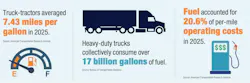
Heavy-duty trucks consume over 17 billion gallons of fuel
The total annual fuel consumption of large trucks in 2024 was about 17,022,000,000 gallons according to the Bureau of Transportation Statistics. At the current average retail price of diesel, that collective consumption would be worth over $100 billion (about $105,536,400,000) annually.
Trucks average 7.43 miles per gallon
ATRI’s operational costs report found that respondents’ average miles per gallon (mpg) in 2025 was 7.43. Higher operational weights (30,001-40,000 lb.) averaged about 6.73 mpg, a better representation of over-the-road hauls.
That’s a notable upgrade from a decade prior. Geotab’s 2016-2017 average mpg for Class 8 trucks was around 4.5-6.5 mpg.
The average price of diesel in 2025, weighed against the 7.43 mpg recorded by ATRI, rounds out to about $0.492 per mile—pretty close to ATRI’s actual recorded cost of $0.482 per mile in 2025. If trucks maintain their current fuel efficiency, and the price of diesel remains around $6.29 per gallon, fleets buying fuel at retail prices might be facing $0.847 per mile right now.
An option to work around rising fuel costs might be alternative powertrains:
4% of trucks have alternative powertrains
Natural gas is the largest driver of non-diesel propulsion. According to ATRI’s operational costs survey, 4.39% of truck-tractors have alternative powertrains. The survey data’s top propulsion types are:
- Compressed natural gas: 3.24%
- Liquid natural gas: 0.69%
- Battery electric: 0.43%
- Liquid petroleum gas: 0.03%
- Hydrogen fuel cell: 0.003%
Battery electric is still a very, very small portion of the overall truck population.
The U.S. saw 875 Class 8 electric truck sales in 2025.
Even in the face of California’s Advanced Clean Fleets and Trucks mandates, the Class 8 battery-electric vehicle saw weak demand.
 trucking numbers concept
 Semi Truck with Copy Space Above. Semi Truck Wide View with Copy Space
According to the International Council on Clean Transportation, there were only 875 electric truck sales in the U.S. For comparison, the group’s estimates for other countries’ 2025 electric truck sales were:
- India: 239
- United Kingdom: 464
- European Union: 5,021
- China: 232,001 (wow!)
The most electrified state for trucks? Massachusetts, actually
In a state-by-state breakdown of Class 8 electric truck populations, California only ranked sixth, according to the Engine Technology Forum’s analysis of Mobility Global 2025 commercial vehicle data.
The most-electrified states were:
- Massachusetts 2.0%
- Hawaii 1.5%
- Washington 1.4%
- Maryland 1.0%
- New York 0.9%
- California 0.9%
Honorable mention to the District of Columbia, which had an anomalous 27% electric truck population.
About the Author
 Jeremy Wolfe
Editor
Editor Jeremy Wolfe joined the FleetOwner team in February 2024. He graduated from the University of Wisconsin-Stevens Point with majors in English and Philosophy. He previously served as Editor for Endeavor Business Media's Water Group publications.
Related
 screenshot_20231211_082521
 Trucking by the numbers

