Report: Skilled trades are shrinking, here's how to support them
Key takeaways
- The U.S. faces a significant shortage of skilled trades workers through 2035.
- Perceptions of trades are positive among parents, teens, and counselors, but this optimism isn't fully translating into career choices.
- Strategic investments and early exposure are crucial to building a resilient skilled trades workforce capable of supporting America's infrastructure and economic growth.

The U.S. economy runs on trucks. U.S. infrastructure is powered by work trucks. These work trucks are filled with crews that construct buildings, dig electrical cable, fix plumbing, and provide countless other services that each and every American depends on for a comfortable life. These jobs are known as skilled trades. And they’re on the verge of extinction.
Year after year, fewer individuals choose a career path in trades. That creates a higher demand for these jobs. So much so that those who know skilled trades are the fastest-growing millionaires in the U.S. today, Linda McMahon, U.S. education secretary, said during a recent Ford event. So why aren’t young people choosing careers in the trades?
This is what Ford Motor Company and the other companies that make up the Alliance for America’s Skilled Trades wanted to find out. The Alliance commissioned a report on the State of America’s Skilled Trades, which surveyed students and school counselors, analyzed more than 100 trades occupations, and examined workforce conditions to set a benchmark for the work the Alliance hopes to do in the future.
The results are both positive and negative.
The State of America’s Skilled Trades at a glance
While office workers might fear the effects of artificial intelligence, skilled trades occupations are expected to be around for quite some time. Of the 124 trades occupations analyzed in the report, 80 are expected to grow or hold steady through 2035.
However, the report predicts 600,000 new positions will need to be filled in that same timeframe—all while losing more than 1,000,0000 skilled trades workers to retirement each year. In fact, nearly one-quarter of current skilled trades workers are over age 55, inching closer to retirement each day.
Another key finding: There are roughly only 55 skilled trades professionals being trained for every 100 jobs that need filled. What makes matters worse, only half of those who enter trades programs successfully complete the program.
Ford and the other Alliance companies, which include Google, BlackRock, Meta, and others, have committed to improving these metrics.
Main takeaways from the State of American Trades report
Where can the industry find folks who want to work in the trades? According to the report, it’s less about finding workers and more about letting potential workers know trades are a viable career path.
“The skilled trades challenge is not simply a shortage of workers,” the report states. “In many occupations and regions, the constraint lies in the system that develops and supports them.”
Constraints can be the occupation. Some occupations are growing rapidly, while others are in decline. Other times, the location or region can make a difference. Large investments due to fast-growing towns are an example of growth, whereas an established town that isn’t seeing an increase in new entrants could see a decline in trade opportunities.
 Ford CEO Jim Farley at Ford Accelerate 2026
 women in the trucking industry facts and numbers
Other constraints are more specific, such as loss due to retirement, the lack of training in the area, or “losses between preparation and employment,” the report states.
The report also found that there is “no single skilled trades shortage.” Some occupations are more at risk than others.
The report segmented the trades into six categories: automotive service technicians; carpenters; electricians; HVAC mechanics and installers; industrial machinery mechanics, maintenance workers, and millwrights; plumbers, pipefitters, and steamfitters.
The graph below indicates which of these occupations faces the most “shortage pressure.” The higher the percentile, the more pressure the industry faces.
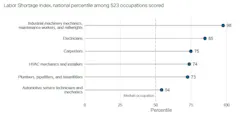
According to this graph, one might be led to believe that automotive mechanics might be in good shape, but read any article from FleetOwner’s affiliate publication and you’ll find that to be untrue. That goes to show how much more pressure industrial machine mechanics, maintenance workers, and millwrights must face. But that pressure isn’t the same everywhere.
Industrial machine mechanics face a shortage pressure in the 100th percentile in Ohio and Rhode Island, but only in the 60th percentile in Kentucky. See the nuance?
Another metric the report reviewed was the pathways chosen by those in the skilled trades workforce. The report found the typical pathway (35%) is via post-secondary credential—either through an associate’s degree or trade certification. Residential apprenticeship was the chosen pathway for 27% of the skilled trades workforce, and 26% chose the path of employer-led training. About 13% of workers entered the trades without the need for any type of training or certification. This pathway is known as open entry.
Further, the report found that employers are often instrumental in developing training and skills-building programs, noting that employers are not just consumers of these skills, but also educators. “The skilled trades workforce is developed through an ecosystem, not a single pipeline,” the report states.
Even still, potential trades employees tend to quit before they get started. As stated earlier and noted by the graph below, only about half of those who begin a skilled trades program actually complete it.
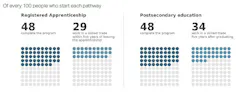
It’s worth noting that these numbers are an average of the 124 occupations analyzed and do not reflect individual career types. Some apprenticeship programs record success rates of more than 90, according to the report.
Finally, the report analyzed the perception of skilled trades jobs through a survey conducted by the Ad Council. According to results, attitudes toward trades are positive; 81% of parents indicate they would be proud if their teen chose a job in the trades. Seventy-one percent of teens say they would be proud to work in a skilled trade. Nearly all school counselors (95%) believe that trades are a valuable and credible career option.
The problem is that those positive internal feelings aren’t translating in reality. Only 54% of school counselors even recommend the trades to students as a career path, and only 28% recommend apprenticeships.
How do we make American trades great again?
This is the first report compiled by the Alliance for America’s Skilled Trades, but the Alliance wants to use these findings as a benchmark for its future endeavors that seek to bring more awareness and interest back to the occupations that built America. It lists these endeavors within its report as “priorities for strengthening the skilled trades workforce.”
These priorities aren’t meant just for the Alliance, however. They are aimed toward every industry player who could benefit by growing the trades. This includes employers, labor organizations, education and training providers, workforce organizations, state and local governments, and more.
One priority is to focus on the outcome of these training programs instead of focusing only on recruiting folks into them. Programs that show a high success rate provide high-quality instruction with current equipment, effective mentorship, and support at the first signs that a student begins to struggle, according to the report. These successful programs also identify external barriers to success, such as the lack of transportation, child care, or tools to learn the job.
The second priority is to strengthen connections between skills training systems and skilled trade careers. Successful programs have trainers who are in-the-know about the latest techniques; they teach students how to use modern equipment, and they provide workplace learning where students can practice their skills and be introduced to the workforce. “Training without access to workplace learning can leave participants without the experience employers require,” the report states.
The next priority is to improve career exposure and navigation into the trades. This starts early, often in high school or sooner. Guidance counselors need practical information about the trades programs and opportunities available to their students. Parents can aid in this as well. “The goal should be to make skilled trades pathways as understandable and actionable as more familiar education and career routes,” the report states.
The final priority is to plan workforce investment around skilled trades demand. Investments in infrastructure, manufacturing, energy, and other industries can create big demand for jobs, and skilled trades training often takes years to complete. Interested parties should begin training the workforce years in advance to complete projects on time.
“Workforce investments should align preparation with realistic project timelines, help people build skills that remain valuable across employers and projects, and strengthen pathways and training resources that can continue serving workers, employers, and communities after a particular demand surge has passed,” according to the report.
The Alliance, though 14 major companies strong, cannot complete these priorities on their own. Making America’s trade workforce great again will require the efforts of parents, teachers, trade schools, training programs, investors, and more. It’s up to all of us to build this essential workforce to help build our infrastructure, repair our homes, and keep work trucks on the road.
About the Author
 Jade Brasher
Jade Brasher
Executive Editor Jade Brasher has covered vocational trucking and fleets since 2018. A graduate of The University of Alabama with a degree in journalism, Jade enjoys telling stories about the people behind the wheel and the intricate processes of the ever-evolving trucking industry.