An alliance of major companies aims to change the future of America's trade careers
Key takeaways
- The Alliance for America’s Skilled Trades was founded by Ford, BlackRock, Carhartt, and Google to raise awareness and accelerate trade career development.
- Only half of trade education students complete their programs, highlighting the need for better support systems like apprenticeships that pay and connect directly to jobs.
- Cultural perceptions remain a barrier, with many teens and counselors favoring college over trades.
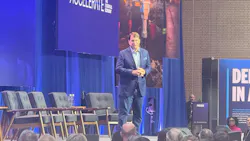
DETROIT—Those who work in skilled trades industries know that necessary jobs are getting harder to fill. It’s a problem that’s presented itself for more than a decade. Is America just now waking up to that fact?
“My grandfather was an hourly worker,” Ford CEO Jim Farley said to a packed room at Michigan Central Station. “He brought me to the Rouge (assembly plant). He said, ‘I don't want you to have to work like I did.’ His idea of the American dream was a four-year degree. That meant success for him. But today, we are paying that price.”
Farley wasn’t alone. Most of us were told that a four-year degree was the key to success. This idea that a white-collar job is the only path to the American Dream has left the trades wanting. Ford and a host of other major companies want to change this.
The Alliance for America’s Skilled Trades was founded this past July. The alliance includes founding members Ford, BlackRock, Carhartt, and Google. The Alliance aims to bring awareness and accelerate advancement in the skilled trades.
The Alliance just released its first State of America’s Skilled Trades: A National Report, which “examines 124 skilled trades occupations in all 50 states to identify where workers are needed and whether training is keeping pace,” a press release states.
Farley said the report relays facts at a time when there are “a lot of myths, a lot of fiction around this problem.” He also said the Alliance will report annually on its progress.
Those efforts include Ford’s Accelerate event here in Detroit in late September. The event featured panelists that represented companies in the Alliance. It also featured young and aspiring professionals in trades careers. U.S. Secretary of Education Linda McMahon, trades champion Mike Rowe, and other prominent decision- and change-makers were also in attendance.
Building the trades through execution and culture
Whether you’re a CEO or a mayor, it will take a unified effort to get American trades back to their glory days. Therefore, the Alliance will focus on two areas of action: execution and culture, Farley said.
The Alliance’s focus on execution is driven directly by the report, which found that for every two individuals who begin trade education programs, only one finishes. This could be due to a lack of support or services, such as transportation and childcare. “We have clear obstacles that we have to face beyond the program itself,” Farley said.
The solution, according to Farley: “high-quality apprenticeships.”
Apprenticeships help individuals learn the trade and develop skills while being paid. In addition, “they’re earning while they’re learning, and they’re getting connected directly with the job,” Farley said.
Since this summer, Ford and the rest of the Alliance have implemented programs across Detroit to make apprenticeship programs and trade education more attractive to career seekers, taking a page out of Bloomberg Philanthropies’ technical education support programs, Farley said.
These programs allow students to train for a career as an auto technician on new equipment and open the door to work at a local dealership.
 shutterstock_2639834031_cutout2
The concept is simple—help people find good-paying jobs. But that reality has its own challenges.
Apprenticeships can raise that completion rate from 55% to 90%—which the report found is the apprenticeship success rate—but what about those that don’t know that trades are an option? Or what about those that have been told a four-year degree is the only way to achieve the American dream?
This requires a shift in American culture and how trade jobs are perceived.
Ford and the Ad Council polled high school students on that. Many view trades careers with respect, with 84% saying those jobs “deserve the same respect as other directions, like college,” Farley said. But while they respect the jobs, only one-third of the students polled believe they would be respected by their parents or their peers if they chose a career in the trades.
And perception is only half the problem. Nine of every 10 school counselors recommend college as an option, but only five of 10 recommend trades careers, the report states.
“Kids are not getting the information they need,” Farley said. “Nearly six in 10 students say trade school options aren't even explained well.”
Further, only 11% of teens say they plan to pursue a career in the trades.
Changing the culture requires making teens aware of trades options, showing them it’s another path to a great life, and helping them pursue that path.
“Look, we could have all the great training programs in the world, but if we're not encouraging our children to think about trades, we are not going to solve this problem,” Farley said.
So, how will the Alliance of America’s Skilled Trades help drive these initiatives?
Accelerating interest in America’s trades
Together, the four companies that founded the Alliance have already committed to helping support skilled trades training in 30 states, Farley said, along with programs spearheaded and supported by each company.
Google, for example, has partnered with multiple organizations to train students in the trades to help support the buildout of its data infrastructure across the country.
While Google is investing in America’s data infrastructure, the federal government has funded many physical infrastructure projects that are underway—albeit slowly progressing. But the capital investment isn’t enough, Larry Fink, BlackRock CEO, said during the event. America must also invest in its people. Driven by that idea, BlackRock has committed $100 million for its Future Builders initiative. The program will help train individuals for high-demand infrastructure jobs.
“At this moment, we now have 5,600 young people who have been assisted by Future Builders,” Fink said. “It is just the beginning.”
Indeed, it’s the beginning. The Alliance announced 10 new member companies at the event, including AT&T, Blackstone, Microsoft, Verizon, Meta, Waymo, and more. With these companies’ commitment, the Alliance hopes to drastically improve next year’s State of America’s Skilled Trades report through better execution and big culture changes around valuing this essential workforce.
About the Author
 Jade Brasher
Jade Brasher
Executive Editor Jade Brasher has covered vocational trucking and fleets since 2018. A graduate of The University of Alabama with a degree in journalism, Jade enjoys telling stories about the people behind the wheel and the intricate processes of the ever-evolving trucking industry.