
2025 was an interesting year for trucking, with tariffs, regulatory changes, the freight recession, private fleet growth, and more. Needless to say, the industry had plenty of opinions that they wanted to share on these changes throughout the year.
In 2025, FleetOwner editors and contributors voiced their opinions on the good, the bad, and everything else in between going on in trucking. All opinions are valuable, but let’s take a look at the top 10 Perspective pieces of the year.

10. What’s your tariff temperature?
It’s been years since we’ve all experienced a few normal years in America. From rising political divisions to the pandemic to freight recessions, the past decade has felt anything but stable. Since President Donald Trump returned to the White House, few business leaders have felt any of the economic steadiness that defined most of his first term.
The election created immediate hope and promise of a pro-business administration coming into power as a prolonged freight recession ends. Instead, we’ve been plagued with uncertainty and this will-he-or-won’t-he-impose-tariffs drama. Read more…

9. Heller: Let's weigh out the ramifications
I could barely believe it when I realized I've been writing this column for 15 years. I was recently looking through my files and reflecting, when I also realized that while time has marched on, many of our industry's issues remain. You could pick up a 2010 trade publication and find articles relevant to 2025.
Our need to chime in when Congress considers these issues has also not changed.
At a recent U.S. House Highways and Transit subcommittee hearing on how trucking boosts American communities, the issue of increasing truck weight was discussed. It seems, once again, that the message of raising the weight limits from 80,000 lb. on five axles to 91,000 lb. on six axles is about improving productivity. Read more…
8. Rohlwing: Mount a better TPMS solution
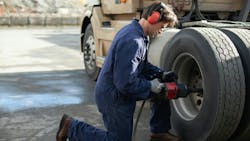
I’ve strongly supported truck and trailer TPMS (tire pressure monitoring systems) for as long as I can remember. When the first ATIS (automatic tire inflation system) was introduced, there was no doubt in my mind that it would be successful. Trailer tires are by far the most neglected in any fleet, so providing a constant source of regulated air to each wheel position seemed like a no-brainer at the time. It still does.
The interchangeability of tire and wheel assemblies makes ATIS on trailers popular. The components and mechanics of connecting the air supply to the tires may differ, but a 295/75R22.5 on a 10-hole hub-pilot wheel with a standard valve stem can be used with any ATIS currently on the market. Nothing “extra” or “special” is required.
But TPMS is a completely different story. With multiple systems from various manufacturers, the truck tire industry is where passenger and light trucks were two decades ago. Read more…
7. Freight recession survival: How fleets can cut costs and optimize operations
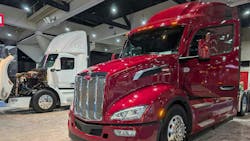
In years past, the American Trucking Associations’ fall management conference has served as a launching pad for fleets to fine-tune their growth strategies going into the following year. The 2025 ATA gathering was more like a high-level strategy meeting for motor carrier survival.
Rebecca Brewster, the American Trucking Research Institute president, captured the industry’s mood—and its crisis—starkly:
“Costs continue to go up. Rates are down. Fleets aren’t making money,” Brewster told me during a Fleet Lead podcast interview on the expo floor in San Diego.
Across every interview, press conference, and panel throughout the five-day event, powerful forces ruled: the punishing reality of the most prolonged freight recession in history amid unprecedented political and regulatory environments, and the industry’s manufacturers and suppliers pushing new technologies to increase efficiency and survive the downturn. Read more…

6. New entrants are not (completely) crazy
On the recent 2025 Transportation Outlook webcast, the market analysts at FTR Transportation Intelligence laid out what to expect from the broader economy and freight in the coming quarters. Among the slides presented by Avery Vise, FTR’s VP for trucking, was a chart featuring the change in the for-hire carrier population.
I was more than a little surprised to see the number of new entrants is still running above the pre-pandemic average—and this comes two years into the worst freight market since the Great Recession. Granted, as the FTR chart shows, the trend in new authorities has been downward since the unprecedented post-Covid peak, and the net change (meaning the difference between carriers coming in and carriers quitting) has been negative since the freight downturn kicked in. Read more…
 woman truck driver
 gettyimages1195393614
5. Are artificial safety nets setting you up for a fall?
Artificial intelligence is a powerful tool. But it’s not powerful enough yet to replace the human side of fleet safety. Don’t let this emerging technology create an artificial safety net that your fleet might regret.
Nothing in transportation is more important than safety. Every good fleet manager wants their drivers to return home safely from their routes. Every shipper wants their products delivered in full and on time. And every fleet owner doesn’t want to be on the wrong side of the next nuclear verdict because a prosecutor convinced a jury their fleet was unsafe. Read more…
4. Four lessons from private fleets on how to reduce turnover and boost operations
These are the times that try fleets’ souls.
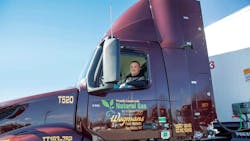
With apologies to Thomas Paine’s 249-year-old prose, the sentiment feels apt for today’s trucking industry. For-hire carriers are grappling with this prolonged freight recession, but private fleets are showing remarkable strength and resilience because of smart business decisions made years ago. Those decisions included investing in their people to reduce turnover, in equipment to improve efficiency and safety, and in operations to improve productivity.
While the longest freight recessions in generations continue to putter out and the for-hire carrier market’s capacity remains high, private fleets are still in control of their parent company’s supply chains, putting fewer miles on their equipment, getting more drivers home, and improving safety, according to the latest National Private Truck Council’s Benchmarking Survey Report. Read more…

3. Unpacking trucking's ‘FUN’ future. Is this the new normal?
The future of trucking looks like a forecasting nightmare. Just when it seems like the prolonged freight recession is hitting bottom, it stalls out. Every time the U.S. economy looks like it’s headed for a crash, it holds steady or even grows. Everyone is staring at the same data, but the conclusions are all over the map.
“That’s the world that we live in: You can take the same set of facts and have three different people analyze them and come up with four different opinions or conclusions,” Steve Tam, an ACT Research VP and analyst, said after three industry economists laid out their outlook for the sluggish freight market during ACT’s Market Vitals seminar.
Jim Meil, a longtime industry economist who announced his plans to retire later this year as ACT Research principal, summed up ACT’s 73rd seminar, which wrapped up on August 21, as the “FUN conference.” Read more…
2. Like an 18-wheeler, Alabama’s connection to trucking (and me) rolls on
It’s not every day the name of a band comes across my inbox. As a trucking writer, my emails mostly consist of new equipment, technology, electrification, and other industry news. So naturally, when I saw the Alabama band in my inbox, I was intrigued.
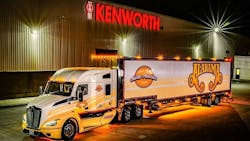
It was a Kenworth announcement that the band toured the OEM’s manufacturing facility in Renton, Washington, during a stop on Alabama’s Roll On II Tour. The OEM and the award-winning band have an extensive history, as Kenworth partnered with Alabama to provide the trucks to haul its tour equipment from the 1980s through the early 2000s and then again for its Roll On II Tour.
The announcement also sparked a thought: As a girl born and raised in Alabama, it’s interesting to think that while Alabama’s hits have played in the background of many memorable moments in my life, Kenworth trucks have played a significant role in the background of Alabama, as well. Read more…

1. Private fleets eye more growth
The NPTC 2025 Benchmarking Survey Report, authored by NPTC EVP Tom Moore, CTP, and sponsored by Penske Truck Leasing for the fifth consecutive year, was released on August 1.
The report is widely regarded as the foremost authority on private fleet operations and one of the most valuable benefits of council membership. It is recognized as the gold standard by which private fleets can scorecard their performance, justify their value, and assess how well they stack up against national standards and top-performing private fleets.
Data analysis from the report affirms private fleets as reliable, flexible, and growing strategic assets that continue to strengthen their market share and exercise greater control over their supply chains. Read more…
Along with these articles, FleetOwner publishes several popular annual features that garner attention throughout the trucking and transportation industries. These include our annual looks at the largest commercial transportation systems in the U.S., the FleetOwner 500: For-Hire and FleetOwner 500: Private Fleets.
Our annual profiles of women in the industry, Women in Transportation 2025, were published this summer. Each year, FleetOwner recognizes the transportation operations of private fleets with the FleetOwner Private Fleet of the Year award. This fall, we expanded and rebranded our annual New Models into the 2025 FleetOwner vehicle guide, our largest-ever look at the next generation of heavy-duty, medium-duty, light-duty, and alternative-powered trucks and vans.
We put a bow on the year with the 2025 Trucking By the Numbers feature, an info-graphical look at the facts and figures that make up the trucking and transportation industries.
To view what's ahead for FleetOwner in the new year, please check out our 2026 Media Kit.
About the Author
 Jenna Hume
Jenna Hume
Digital Editor
Digital Content Specialist Jenna Hume joined FleetOwner in November 2023 and previously worked as a writer in the gaming industry. She has a Bachelor of Fine Arts degree in creative writing from Truman State University and a master of Fine Arts degree in writing from Lindenwood University. She is currently based in Missouri.