Clark: How nuclear verdicts and litigation abuse are threatening trucking’s survival
Key takeaways
- Nuclear verdicts and lawsuit abuse are pushing insurance costs beyond reach.
- Poor maintenance, weak driver vetting, and compliance gaps can quickly turn accidents into multimillion-dollar courtroom losses.
- Safety technology and proactive risk management are becoming essential tools to reduce crashes, limit liability, and protect fleet viability.
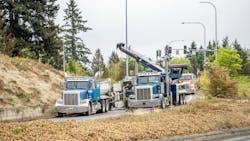
America relies on the trucking industry to keep shelves stocked and commerce moving. But behind the scenes, motor carriers and their insurers are fighting for survival against an escalating threat: lawsuit abuse and the surge of nuclear verdicts reshaping the legal landscape.
Excessive litigation and runaway jury awards have turned even minor accidents into existential financial risks. The federally mandated $750,000 insurance minimum—unchanged since the 1980s—is now a fraction of what a single serious claim can cost. No carrier is safe when settlements routinely reach into the tens of millions, particularly small and midsized fleets.
Worse still, trucking companies often shoulder the blame even when passenger vehicles cause the crash. A reckless driver cutting off a semi can still result in a jury placing the bulk of responsibility—and the financial fallout—on the carrier.
In September 2025, the Chamber of Commerce Institute for Legal Reform (ILR) published an article that detailed just how damaging this practice is and what should be done to combat it. The article noted that a 2023 study of 154 trucking litigation verdicts for accidents occurring between June 2020 and April 2023 found “an average winning plaintiffs’ award of over $27 million before repeals or reduction.”
In this same vein, data from the American Transportation Research Institute (ATRI) tracked verdicts from 2010 to 2018. They found that average verdicts of $5 million in 2010 surged to $23.5 million by 2018, and that has continued to grow. What is truly troubling is that the number of high-dollar awards often bears little correlation to actual medical costs and is treated as non-economic damages, such as pain and suffering. According to the ILR, “in six out of the 10 years in our research, economic damages accounted for more than the combined total value of economic and punitive damages in nuclear verdicts for which a breakdown of damages was available.”
For an industry already operating on razor-thin margins, the combination of nuclear verdicts, litigation abuse, higher insurance premiums, and operational challenges is creating a financial pressure cooker.
Under no circumstances do I want to imply that accidents involving commercial trucks and passenger vehicles are never the truck driver’s responsibility. However, carriers still bear the burden even when they are not at fault. Until we have the appropriate tort reform, fleets will have to do what they can to reduce accidents and mitigate damages.
1. Maintenance is your first defense against catastrophic claims
Mechanical failures are a plaintiff attorney’s best friend—and a carrier’s worst nightmare.
The 2025 Commercial Vehicle Safety Alliance (CVSA) International Roadcheck revealed troubling statistics:
- 41% of vehicle out-of-service violations were brake-related
- 21% stemmed from tire defects
Let’s face it, a single failed brake chamber or worn tire can transform a defensible case into a jackpot for plaintiffs.
To reduce exposure, fleets must commit to rigorous:
- Preventive maintenance: Catching failures before they sideline a truck
- Predictive maintenance: Using data to identify risks before they become violations
Anything less leaves carriers vulnerable not just to breakdowns but also to devastating courtroom outcomes.
 Fleets Explained: What are nuclear verdicts?
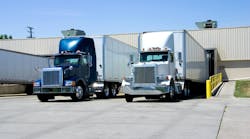 Semi-trailer trucks loading and unloading at a warehouse dock, illustrating freight shipping, logistics, and fleet operations
2. Drivers are a carrier’s greatest asset and its biggest legal risk
Human error remains a leading cause of trucking litigation. The 2025 Roadcheck highlighted persistent issues (these stats include the U.S. and Canada):
- Hours-of-service violations remain the top driver-related OOS issue.
- Nearly 25% of drivers inspected lacked a valid CDL.
- Dozens of violations involved drug and alcohol use.
In court, these gaps become narrative fuel for plaintiff attorneys eager to paint carriers as negligent.
Strong carriers must enforce:
- Thorough background screenings
- Ongoing defensive driving training
- Continuous monitoring and coaching
- Zero-tolerance drug and alcohol policies
But with a nationwide driver shortage, companies often face impossible choices: Hire underqualified drivers or miss revenue opportunities. Unfortunately, juries don’t care about staffing shortages; they care about whether you hired a driver who shouldn’t have been behind the wheel.
3. Technology is a powerful shield against nuclear verdicts
Advanced safety technology won’t eliminate all accidents, but it can dramatically reduce both incident frequency and courtroom exposure.
Studies show:
- Injury-causing truck crashes could drop 23% with modern safety systems.
- Forward collision mitigation reduces front-end crashes by 44%.
Systems like automatic emergency braking, lane departure warnings, and onboard cameras don’t just save lives; they save carriers from litigation disasters.
These technologies are expensive, and many small fleets can’t afford the upfront cost. Still, the investment often pales in comparison to the financial destruction of a nuclear verdict. Data showing proactive safety measures can significantly reduce damages or even shift liability.
Survival requires immediate action
Nuclear verdicts and predatory litigation threaten the long-term stability not only of individual carriers but also of the insurance market itself. If premiums keep climbing and verdicts keep multiplying, insurers will retreat, carriers will close, and supply chains will suffer.
Carriers that take proactive steps today stand the best chance of weathering an increasingly hostile legal environment.
About the Author
Jane Clark
Senior VP of Operations
Jane Clark is the senior vice president of operations for NationaLease. Prior to joining NationaLease, Jane served as the area vice president for Randstad, one of the nation’s largest recruitment agencies, and before that, she served in management posts with QPS Companies, Pro Staff, and Manpower, Inc.